
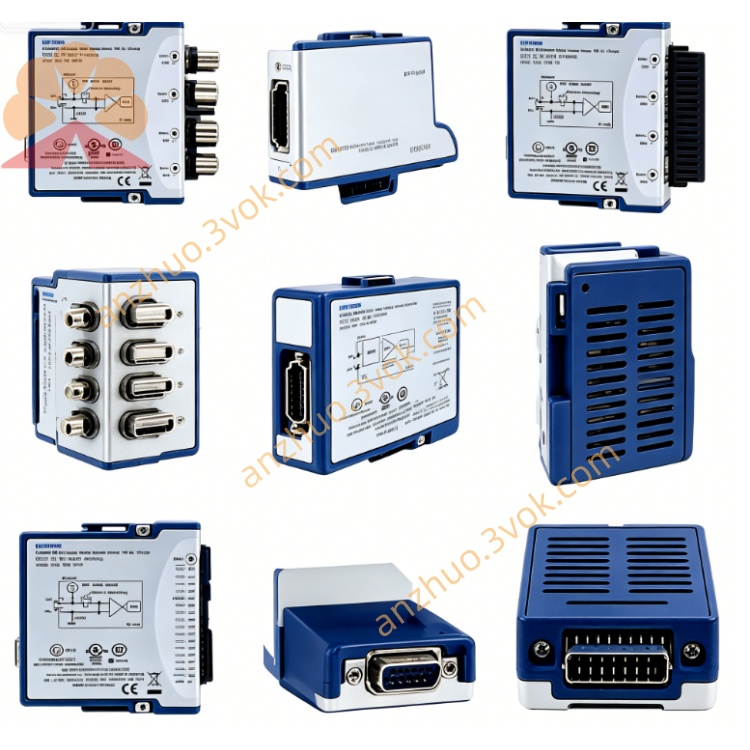
NI SCXI-1180 50-Pin Feedthrough Panel Module
Description
I. Product Introduction
NI SCXI-1180 is a 50-pin signal feed-through panel module for the SCXI platform. It is an inductive signal transfer accessory without active processing. Its main function is to transfer unprocessed signals from the rear of the SCXI chassis to the front panel, facilitating debugging, wiring, and signal monitoring. The module occupies a single slot and is compatible with all series of SCXI chassis. It has a compact structure and is industrial-grade anti-vibration. It is now discontinued and spare parts and maintenance are available.
II. Model Interpretation
SCXI: Instrument Signal Conditioning Expansion Series.
1180: Basic model, representing a 50-pin inductive feed-through panel.
Component Number: 776572-80, 181710E-01.
III. Technical Parameters
Type: Inductive feed-through module, without conditioning, amplification, or isolation.
Connector: 50-pin D-Sub on the front panel, 50-pin ribbon cable direct connection on the back panel.
Channels: 50 direct communication signals, no grouping, no switching, no buffering.
Signal Range: Compatible with TTL/CMOS, ±10V analog, digital I/O, and other common levels.
Bandwidth: DC to 1 MHz (typical, inductive feed-through).
Insulation Voltage: Low voltage isolation between the back panel and the front panel (only for short circuit prevention, not high-voltage isolation).
Power Supply: No external power supply required, passive design.
Temperature: Operating 0-55 ℃; Storage -40-85 ℃.
Humidity: 5% - 95% without condensation.
IV. Interface and Communication Configuration
Front Panel: 50-pin D-Sub female socket, recommended to be paired with SCXI-1302 terminal block for wiring and measurement.
Back Panel: 50-pin ribbon cable, directly connected to the corresponding slot on the chassis back panel to achieve direct signal transmission before and after.
Expansion Mode:
Module Signal Extension: Connect the rear 50-pin interfaces of adjacent SCXI modules to the front panel.
DAQ Card Pre-Connection: Combined with SCXI-1340/1341/1342 cables, connect the I/O of the DAQ card to the front panel.
Daisy Chain Expansion: When cascading multiple modules, access the unused signals on the cables between the modules.
Driver: Inductive module, no driver required, plug-and-play, compatible with all SCXI chassis and DAQ software.
V. Core Functions
Signal Pre-Connection: Transfer the difficult-to-access 50-pin signals from the rear of the chassis to the front panel, facilitating online measurement and debugging with multimeters and oscilloscopes.
Inductive Feed-Through: No signal attenuation, no delay, no distortion, suitable for high-frequency, precise signal monitoring.
System Expansion: One slot can achieve centralized signal transfer of 50 channels, saving space and simplifying wiring.
Flexible Adaptation: Compatible with SCXI-1340/1341/1342/1344/1351 cables, suitable for multi-module cascading and DAQ card direct connection scenarios.
Easy Debugging: Can quickly connect or introduce signals without disassembling the chassis, improving testing and maintenance efficiency.
VI. Application Scenarios
System Debugging: In the integration stage of the SCXI system, quickly measure the input and output signals of modules/DAQ cards.
Signal Monitoring: Online monitoring of unprocessed analog/digital signals, such as TTL levels, ±10V reference, clock signals.
Test Fixture: In ATE equipment, as a signal transfer panel, simplifying the wiring and maintenance of test points.
Mixed System: Connect conditioning modules and direct signals in the same chassis simultaneously, balancing signal conditioning and direct monitoring.
Education and Research: In laboratory SCXI platforms for teaching, facilitating students to observe and measure signal flow.
VII. Usage and Maintenance Instructions Instruction Manual
Power-off installation: Insert the free slot in the SCXI chassis, tighten the fixing screws, and ensure the backplane cables are securely connected.
Wiring standards: Connect the 50-pin D-Sub on the front panel to the SCXI-1302 terminal block. Avoid mixing high-voltage and low-voltage signals and prevent short circuits.
Signal adaptation: Only for signals that do not require conditioning. It cannot replace isolation, amplification, filtering and other functional modules.
Expansion configuration: When using the SCXI-1340 series cables, connect the modules and DAQ cards according to the manual to avoid pin misalignment.
Prohibition of hot swapping: Inserting or removing while powered on is likely to cause connector damage or signal short circuits.
Maintenance instructions
Environment: Maintain ventilation and dryness, temperature 0–55 ℃. Keep away from corrosive gases, dust and strong vibrations.
Regular inspection: Check the front panel connectors and backplane cables monthly for looseness, oxidation and damage. Clean or replace them in time.
Cleaning: Use a dry cloth or anti-static brush to clean the panel dust. Avoid contact with liquids on the connectors.
Troubleshooting: When the signal is not working, first check the connector contact, cable integrity, and whether the slot is damaged. The module itself has very few passive faults.
Long-term storage: After power-off, remove the module, clean it, and put it in an anti-static bag. Store it in a cool and dry place.
Get a Quote