
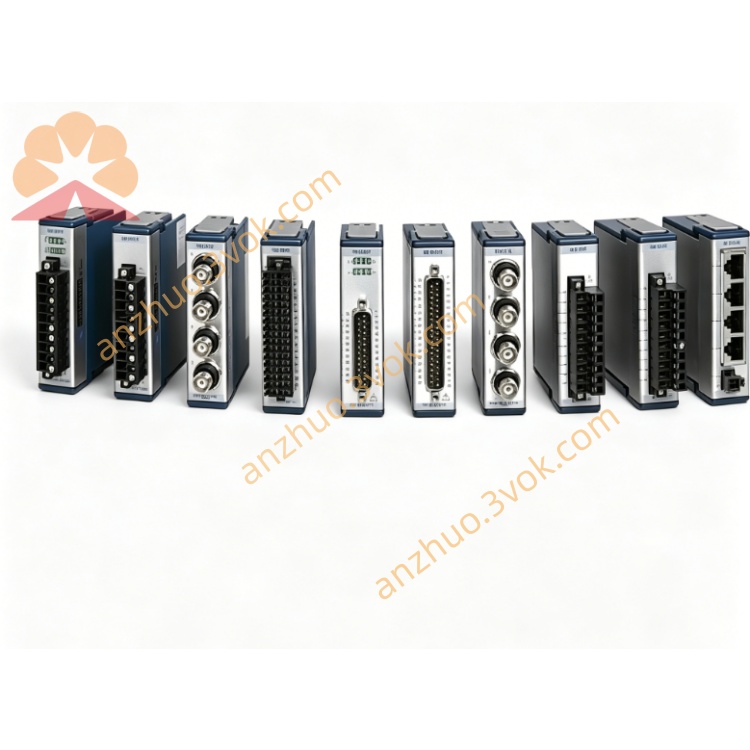
NI SCXI-1143 8-Channel Isolated Thermocouple Input Module
Description
I. Product Introduction
NI SCXI-1143 is an eight-channel signal conditioning module of the SCXI series. It is equipped with an eighth-order Butterworth low-pass filter and a programmable amplifier. The main channel has a flat gain-bandwidth and low signal distortion characteristics. The module supports flexible software configuration of gain and filter parameters, has electrical isolation and overvoltage protection, and can perform amplification, noise reduction, and anti-aliasing processing on various analog signals, suitable for scenarios requiring high signal fidelity. This product has been discontinued but still offers maintenance services. Alternatively, you can choose from inventory or second-hand equipment for continued use.
II. Model Interpretation
SCXI is the identification for the instrument signal conditioning expansion series. 1143 is an exclusive model of this series, representing an eight-channel Butterworth filter and amplification module. The series also includes 1141 for elliptical filtering and 1142 for Bessel filtering, and you can choose based on the filtering characteristics. The standard component number of the product is 776572-43.
III. Technical Parameters
The module contains eight independent differential input channels, each equipped with an amplification circuit and a filtering circuit. The software can select the input range as positive or negative fifty millivolts, positive or negative five hundred millivolts, or positive or negative five volts. It has an internal eighth-order Butterworth low-pass filter, with the cutoff frequency that can be set by software between ten hertz and twenty-five thousand hertz. Each channel supports the bypass switching of the filtering function. The gain range can be adjusted by software from one times to one thousand times, with a total of ten options available. The overall maximum sampling rate of the system is three hundred and thirty-three thousand samples per second, and the differential input impedance is not less than one megohm. The channel and the backplane can withstand a continuous isolation voltage of two hundred and fifty volts effective value, meeting CAT II safety standards. The device has positive and negative thirty volts overvoltage protection when powered on. The module is powered by the chassis backplane, and the overall power consumption is approximately two point three watts. The standard operating temperature range is zero degrees Celsius to fifty-five degrees Celsius, and the storage temperature range is minus forty degrees Celsius to eighty-five degrees Celsius. The equipment is factory-calibrated, and the calibration data is stored in the onboard non-volatile memory, supporting external re-calibration.
IV. Interface and Communication Configuration
The front of the module uses a fifty-pin DIN connector, mainly used with the SCXI-1301 terminal block, supporting screw wiring, and can be compatible with differential and single-ended connection methods. The back is connected to the SCXI standard chassis backplane bus, relying on the bus to complete power supply, command transmission, and data interaction, supporting multi-module cascading expansion. The module has an external TTL trigger interface and an external clock interface, which can be connected to external signals to achieve multi-module sampling synchronization and frequency calibration. The device has no independent communication port. It establishes communication through the SCXI bus and the backend DAQ device, and completes parameter settings, data acquisition, etc. operations with the NI-DAQmx driver software, compatible with mainstream programming development environments.
V. Core Functions
The design of Butterworth filtering ensures that the signal amplitude within the passband has no obvious ripple, with high signal restoration degree and balanced transition band characteristics, meeting the requirements of conventional anti-aliasing and noise reduction. The gain and filtering frequency of all channels can be configured by software, and each channel can be individually disabled from filtering, suitable for various signal bandwidth and amplitude requirements. The eight-channel channels are independently conditioned, combined with external triggering and bus synchronization functions, and after multi-module combination, can achieve large-scale channel synchronization acquisition. It has high-voltage isolation and overvoltage protection, effectively isolating industrial site electromagnetic interference and avoiding damage to the backend acquisition equipment from surge voltages. The module has strong compatibility and can be used in combination with other conditioning modules of the same series, flexibly building a composite signal acquisition system.
VI. Application Scenarios
It is suitable for laboratory research, teaching experiments, etc., for high-fidelity acquisition of various sensor signals, ensuring that the original signal does not distort. It can amplify and filter weak signals output by thermocouples, strain gauges, piezoelectric sensors, etc., for material testing and structural monitoring. The medium bandwidth vibration and acoustic signal acquisition scenarios can also be used, balancing signal integrity and noise suppression. It is widely applied in multi-channel process parameter monitoring in industrial sites, and can stably complete analog signal acquisition in strong electromagnetic interference environments. It can also be combined with synchronous sampling modules to build a comprehensive test system that simultaneously meets time synchronization and high-fidelity filtering requirements.
VII. Usage and Maintenance Instructions
Usage Instructions
Before installing the module, cut off the power supply of the chassis, insert the module smoothly into the slot and tighten the fixing screws. When cascading multiple modules, set independent addresses to prevent address conflicts. Complete the terminal seat wiring according to the signal type, distinguish the positive and negative poles of differential signals, and use single-ended grounding for the shielding layer of the line. In the accompanying software, set the corresponding input range, gain size and filter cutoff frequency. When multiple modules work synchronously, correctly connect the external trigger or clock signal. After confirming that the wiring and parameters are correct, turn on the power supply and run the acquisition program. It is not recommended to hot-plug the module during use.
Maintenance Instructions
Place it in a ventilated and dry environment, away from strong electromagnetic sources, vibration equipment and high-temperature areas. Avoid condensation and corrosive gases in the working environment. Regularly check the terminal seats, connectors and external cables, tighten loose lines, clean the dust on the module surface, and ensure normal heat dissipation. It is recommended to calibrate the module's accuracy once a year. For equipment used for precise measurement for a long time, the calibration frequency can be appropriately increased. If the collected data has excessive noise, check the filtering parameters, line grounding and shielding status; when there is no signal or abnormal data, sequentially troubleshoot the module installation, bus connection and driver configuration. Before the equipment is put into long-term storage, disconnect all power supplies and external lines, clean it thoroughly, and store it in a cool and dry place.
Get a Quote