
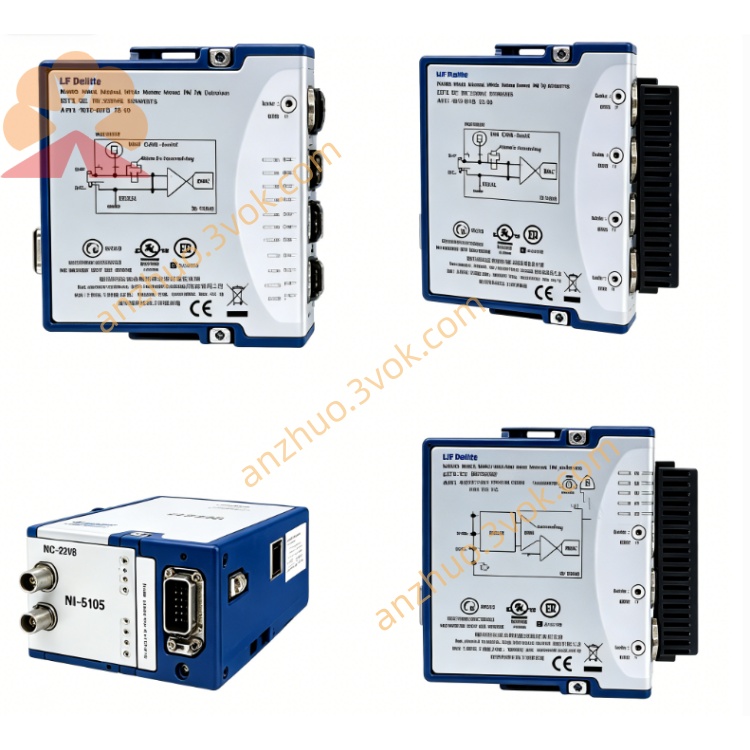
NI SCXI-1126 16-Channel High-Voltage Isolated Relay Multiplexer Module
Description
I. Product Introduction
NI SCXI-1126 is an 8-channel isolated frequency input module of the SCXI series. Its core is an independent frequency-voltage (F/V) conversion circuit for each channel, suitable for digital/analog periodic signals. It supports high-voltage isolation and programmable triggering, filtering, and is specifically designed for multi-channel frequency, speed, and vibration measurement in industrial environments with strong interference. It is no longer in production (Legacy), but can be repaired or purchased as a second-hand/inventory NI.
II. Model Interpretation
SCXI: Instrument Signal Conditioning Expansion Series
1126: Basic model, 8-channel isolated frequency input module
Part Number: 776572-26
III. Technical Parameters (Official, 25°C)
Channels and Isolation
Channels: 8 independent isolated frequency inputs, isolation between channels and between channels and ground
Isolation Voltage: 250Vrms continuous (between channels / ground), up to 1000VDC with TBX-1316, CAT II, CE certified
Input Overvoltage Protection: withstands 250Vrms during power-on / power-off
Frequency and Conversion
Frequency Range: 15Hz to 128kHz, 10 programmable steps
Trigger Configuration: Programmable threshold (-0.5 to 4.48V), hysteresis (0 to 4.98V), compatible with TTL, 24V, 120/240VAC signals
F/V Conversion Accuracy: ±0.05% FSR (typical), long-term stability guaranteed by low-temperature drift reference source
Output Filtering: 4-level 4-pole low-pass filtering for each channel, cutoff frequencies of 1Hz, 10Hz, 100Hz, 1kHz
Sampling and System
Maximum Sampling Rate: 333kS/s (single channel), multi-channel scanning shared to DAQ single channel
Input Signal Types: Digital (TTL/CMOS), Analog (sine / square wave / pulse), High-voltage AC signals
Electrical and Environmental
Power Supply: 5V ≤ 30mA; ±15V ≤ 200mA (backplane of the chassis)
Operating Temperature: 0 to 50°C
Storage Temperature: -40°C to +85°C
Humidity: 5% to 90% without condensation
Size / Weight: 1U SCXI standard (30×173×203mm) / approximately 0.7kg
Calibration: Board-mounted EEPROM stores factory/user calibration constants, supports self-calibration software
IV. Interface and Communication Configuration
Front Panel: 32-pin DIN C connector, equipped with SCXI-1327 (100:1 high-voltage attenuation terminal) or universal terminal, compatible with high-voltage/low-voltage frequency signals
Back Panel: 50-pin ribbon cable connector, connects to the SCXI chassis backplane bus, transmits control signals, timing, and power supply
Communication: No independent communication port, relies on the SCXI bus to communicate with the backend DAQ device (such as PCIe-6251), NI-DAQmx driver configures frequency range, trigger threshold, filtering parameters
Output Mode: Supports multi-channel multiplexing (single channel reads 8 frequency channels) or parallel output (8 independent outputs)
V. Core Functions
8-channel Independent Isolated F/V Conversion: 250Vrms isolation for each channel, blocking ground loop, compatible with high-voltage, floating-ground frequency signals, protecting DAQ and field equipment.
Wide Frequency Range and Programmable Trigger: 15Hz to 128kHz covering industrial common frequencies, threshold / hysteresis programmable, compatible with TTL, 24V, high-voltage AC, etc. types of signals.
Independent Low-pass Filtering for Each Channel: 4-level 4-pole filtering, suppressing high-frequency noise, suitable for different scenarios such as speed (low frequency), vibration (medium frequency), acoustic (high frequency). High-speed scanning and multi-channel multiplexing: 333kS/s sampling rate, 8 channels multiplexed to a single DAQ channel, improving multi-channel acquisition efficiency and reducing system cost.
High accuracy and stability: On-board precise low-drift reference source, F/V conversion accuracy ±0.05% FSR, EEPROM calibration, ensuring long-term measurement stability.
Six. Application scenarios
Industrial speed/frequency measurement: Motor speed, gear pulse, flowmeter, encoder signal acquisition, compatible with 4–20mA frequency transducer.
High-voltage power frequency monitoring: 120/240VAC power frequency, high-voltage equipment vibration frequency measurement, isolation to ensure safety.
Vibration and acoustic testing: Mechanical equipment vibration, bearing fault detection, acoustic sensor frequency signal acquisition, stable measurement in strong interference environment.
Multi-channel periodic signal acquisition: Frequency/pulse signals at multiple stations on the production line, non-destructive testing ultrasonic frequency, environmental monitoring wind speed (pulse) signal.
Seven. Usage and maintenance instructions
Usage instructions
Installation: Power off and insert the SCXI chassis, tighten the fixing screws; supports hot swapping, modules can be replaced during operation.
Connection: Low-voltage signals directly connect to the 32-pin terminal, high-voltage signals use SCXI-1327 attenuation terminal;严禁 mixing high and low voltage connections, ensure firm and no loose connections.
Configuration: NI-DAQmx sets the frequency range, threshold/lag, filter cut-off frequency for each channel; sampling rate does not exceed 333kS/s (single channel).
System: 68-pin SCSI cable connects the SCXI chassis and DAQ; multi-chassis cascading requires a unique address to avoid conflicts; parallel mode requires a SCXI-1180 interface panel.
Maintenance instructions
Environment: Maintain dry and ventilated, prevent condensation; away from strong electromagnetic sources, vibration sources, avoid high-temperature exposure.
Regular inspection: Inspect terminals, connectors, cables every quarter for looseness, oxidation, and damage; clean surface dust to maintain good heat dissipation.
Calibration: Once a year, calibrate F/V conversion accuracy, linearity, isolation performance; precise measurement scenarios calibrate once every six months, update EEPROM calibration constants.
Fault handling: Frequency drift → perform self-calibration; signal jump → check grounding, shielding, and terminal tightening; isolation failure → stop the machine to test isolation circuit and terminal insulation.
Get a Quote