
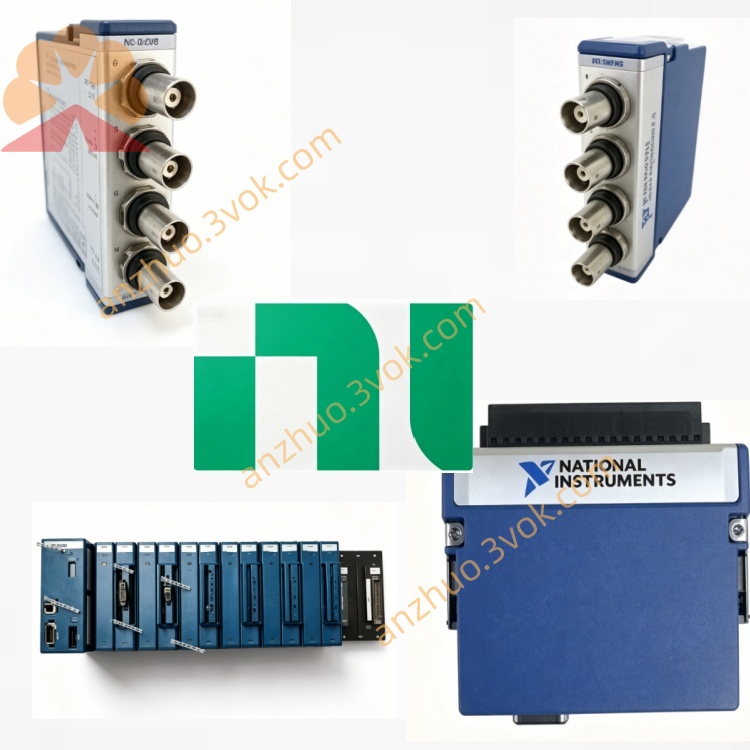
NI SCXI-1125 8-Channel Isolated High-Voltage Analog Input Module
Description
I. Product Introduction
NI SCXI-1125 is an 8-channel independent isolation programmable gain analog input module of the SCXI series. Each channel has an independent instrumentation amplifier and low-pass filter, specially designed for high-precision, high-speed multi-channel signal conditioning in industrial strong interference environments. It is suitable for millivolt-level weak signals to high-voltage signals, and supports thermocouples, strain bridges, 4-20mA sensors, etc. It is discontinued (Legacy), but can be repaired or purchased as a second-hand / inventory item.
II. Model Interpretation
SCXI: Instrument Signal Conditioning Expansion Series
1125: Basic model, 8-channel independent isolation programmable gain input module
Part Number: 776872-25
III. Technical Parameters (Official, 25℃)
Channels and Isolation
Channels: 8 differential isolated inputs, each channel isolated independently
Working Isolation Voltage: 300Vrms continuous (channel to channel / ground), CE certified double insulation, CAT II
Input Impedance: Differential > 1GΩ, Common Mode > 10GΩ
Common Mode Suppression Ratio CMRR: ≥100dB (DC~60Hz)
Input Range and Gain
Basic Input Range: ±2.5mV~±5V (software programmable gain 1/10/100/1000)
Extended Range: With SCXI-1313 high-voltage attenuation terminal, it can reach ±300V; with TBX-1316, it can reach ±1000VDC (680Vrms)
Resolution: 16 bits
Non-linearity: ≤±0.01% FSR
Gain Error (Calibrated): ≤0.05% reading
Temperature Drift: ≤10ppm/℃
Filtering and Sampling
Low-pass Filter: Each channel can be software-selected as 4Hz (anti-power frequency) or 10kHz (high-speed)
Maximum Sampling Rate: 333kS/s (single channel), multi-channel random scanning
Scanning Mode: Supports random scanning of any channel order without polling all channels
Electrical and Environmental
Power Supply: 5V ≤ 30mA; ±15V ≤ 200mA (backplane of the chassis)
Operating Temperature: 0~50℃
Storage Temperature: -40℃~+85℃
Humidity: 5%~90% without condensation
Size / Weight: 1U SCXI standard (30×173×203mm) / approximately 0.64kg
Calibration: Built-in EEPROM stores factory/user calibration constants, supports self-calibration software
IV. Interface and Communication Configuration
Front Panel: 96-pin DIN C connector, equipped with SCXI-1313 (high-voltage attenuation), SCXI-1322 (thermocouple / isolation), or universal terminal
Back Panel: 50-pin ribbon cable connector, connected to the SCXI chassis backplane bus, for data, timing, and power transmission
Communication: No independent communication port, relies on the SCXI bus to communicate with the backend DAQ device (such as PCIe-6251), NI-DAQmx driver configuration parameters, and data reading
Cabling: Supports floating ground / grounded signals, compatible with thermocouples, RTD, strain gauges, 4-20mA transmitters, high-voltage DC
V. Core Functions
8-channel independent isolation and amplification: Each channel 300Vrms isolation + independent programmable gain, no interference between channels, suitable for micro signals from various types of sensors.
Ultra-wide range coverage: Basic ±2.5mV~±5V, extended up to ±1000VDC, covering both weak signals and industrial high voltages, no additional conditioning module required.
Independent Filtering per Channel: 4Hz/10kHz software selectable, static measurement anti-power frequency interference, dynamic measurement retains high-frequency signals, suitable for different scenarios. High-speed random scanning: 333kS/s sampling rate, supports arbitrary channel sequence scanning, enhancing multi-channel acquisition efficiency.
High precision and stability: 16-bit resolution, low drift, onboard calibration, ensuring long-term measurement accuracy, suitable for precise testing scenarios.
Six. Application scenarios
Multi-channel precise testing: strain testing, pressure/weight measurement, vibration monitoring, compatible with strain bridges, LVDTs, piezoelectric sensors.
Industrial high-voltage / floating ground signal acquisition: high-voltage equipment monitoring, signal acquisition from different ground potential systems, isolation to ensure safety and accuracy.
High-speed temperature / process monitoring: 8 channels of thermocouples (with external CJC), RTD, 4-20mA transmitters signals, balancing rate and anti-interference.
Data acquisition in strong interference environments: factory workshops, power equipment, rail transit, etc., with strong electromagnetic interference.
Seven. Usage and Maintenance Instructions
Usage instructions
Installation: Power off and insert the SCXI chassis, tighten the fixing screws; supports hot swapping, modules can be replaced during operation.
Connection: Firmly connect the isolation terminals, high-voltage signals use SCXI-1313, thermocouples require external CJC;严禁 mixing high and low voltage.
Configuration: NI-DAQmx sets the gain, filter bandwidth, input range for each channel; sampling rate should not exceed 333kS/s (single channel).
System: 68-pin SCSI cable connects the SCXI chassis and DAQ; multi-chassis cascading sets a unique address to avoid conflicts.
Maintenance instructions
Environment: Keep dry and ventilated, prevent condensation; away from strong electromagnetic sources, vibration sources, avoid high-temperature exposure.
Regular inspection: Check terminals, connectors, cables every quarter for looseness, oxidation, damage; clean surface dust to maintain good heat dissipation.
Calibration: Once a year, calibrate gain, linearity, isolation performance; in precise measurement scenarios, calibrate once every half year, update EEPROM calibration constants.
Fault handling: Data drift → perform self-calibration; signal jump → check grounding, shielding, terminal tightening; isolation failure → stop and test isolation circuit and terminal insulation.
Get a Quote