
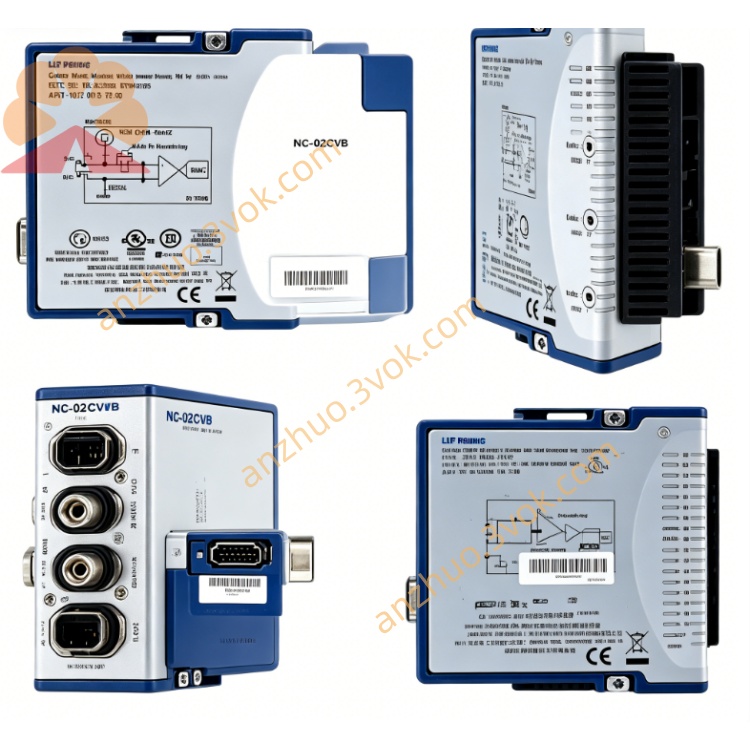
NI SCXI-1104C 32-Channel Medium Voltage Analog Input Module
Description
I. Product Introduction
The NI SCXI-1104C is a 32-channel differential input signal conditioning module of the SCXI series. It can directly collect industrial standard high voltage signals and features an extremely wide operating temperature range, high-speed response, and excellent anti-interference capability. This module is equipped with a fixed attenuation circuit and a programmable amplifier, along with a high-frequency low-pass filter. It is suitable for the collection of dynamic voltage signals and can adapt to various harsh field environments such as high and low temperatures. This model has been discontinued but still offers maintenance services. Alternatively, you can choose from inventory or second-hand equipment.
II. Model Interpretation
SCXI represents the Instrument Signal Conditioning Expansion Series. 1104 is the base model, corresponding to a 32-channel high voltage input module. The suffix C indicates a wide temperature enhanced version, which also upgrades the filter circuit and response speed. The official standard part number for this product is 776574-01.
III. Technical Specifications
The module is equipped with 32 pure differential input channels, does not support single-ended mode, and can withstand a continuous isolation voltage of 500 volts DC between channels. The signal input range is ±60 volts DC, 30 volts RMS AC, and the maximum combined signal and common-mode voltage does not exceed ±60 volts DC. The differential input impedance is greater than 10 gigohms, and the common-mode rejection ratio from DC to 60 Hz frequency band is no less than 120 dB. Each channel integrates a ten-to-one fixed attenuator and a programmable amplifier. The software offers four gain settings, including one times, two times, five times, and ten times. The onboard ten-kilohertz three-pole fixed low-pass filter has a 40 dB noise suppression capability at 60 Hz, and the response time for a signal step to 0.01% accuracy is approximately 1 millisecond. The module's overall maximum scanning rate is 333 kilosamples per second, with a 12-bit analog-to-digital conversion specification. The full-scale non-linearity does not exceed ±0.01%, and the gain error after calibration does not exceed 0.2% of the reading. The temperature drift is less than 5 ppm per degree Celsius. The module is powered by the SCXI chassis backplane, with each of the five power supplies not exceeding 15 mA, and the positive and negative 15-volt power supply not exceeding 150 mA. The operating temperature range is from -40 degrees Celsius to 70 degrees Celsius, and the storage temperature range is from -40 degrees Celsius to 85 degrees Celsius. The operating environment humidity is maintained at 5% to 90% without condensation. The module is in standard 1U SCXI specification, with an external size of 30 mm x 173 mm x 203 mm, and the overall weight is approximately 0.7 kilograms.
IV. Interface and Communication Configuration
The front panel of the module uses a 96-pin DIN C-type male connector for external connection of terminal devices and field signal lines. The back panel features a 50-pin ribbon cable male connector for connection to the SCXI chassis backplane bus. The compatible terminals are mainly SCXI-1301 high differential terminals, and can also be used with the universal SCXI-1300 terminals. The module supports two signal access methods: floating ground and grounding. It is specifically adapted for industrial high-voltage sensor circuits. The equipment completes data transmission and synchronous control through the SCXI backplane bus, without the need for additional communication lines. When paired with the corresponding DAQ equipment and driver software, it can operate normally.
V. Core Functions
It supports direct collection of ±60 volts DC high voltage signals without the need for additional external voltage divider circuits, simplifying the wiring of industrial high-voltage circuits. It is equipped with a ten-kilohertz high-frequency filter and fast-response circuits, capable of accurately capturing dynamic and transient voltage signals. The ultra-wide temperature design ensures stable measurement accuracy within the temperature range of -40 degrees Celsius to 70 degrees Celsius, suitable for outdoor and high-temperature workshop environments. High input impedance and high common-mode rejection ratio, combined with channel isolation design, can resist electromagnetic interference generated by equipment such as frequency converters and motors. Each module has 32 acquisition channels, and multiple modules can be installed in the same chassis. It also supports cascading of multiple chassis, allowing for flexible expansion of the total number of system channels.
Six. Application Scenarios
It is widely used in industrial electrical monitoring fields, collecting voltage signals from motors, frequency converters, energy storage battery packs, and industrial power supply circuits. It is suitable for various dynamic parameter tests, capturing voltage signals corresponding to vibration, transient voltages generated by equipment start-up and shutdown, and fast-changing operating parameters of transmission systems. It can be deployed in high-temperature workshops such as metallurgy and cement, as well as low-temperature outdoor scenarios such as wind power and photovoltaic stations in northern regions, for long-term online monitoring. It is also used for process status monitoring in chemical industries and large mechanical equipment, and to build an unmanned long-term data collection system.
Seven. Usage and Maintenance Instructions
Usage Instructions
Before installing the module, it is necessary to cut off the power supply of the SCXI chassis and insert the module smoothly into the chassis slot and tighten the fixing screws. The equipment supports hot plugging, and modules can be replaced during system operation. When connecting an external high-voltage line, ensure that the connection terminals are firmly connected, take insulation protection measures, and avoid exposing the lines to prevent safety issues. Use the NI-DAQmx software to set the gain level, combine with the signal bandwidth to configure the acquisition scanning rate, and match the module filtering parameters. When connecting the entire system, use standard 68-pin cables to connect the SCXI chassis and DAQ equipment. When cascading multiple chassis, set a separate address for each device to prevent address conflicts.
Maintenance Instructions
During daily use, keep the equipment environment dry, strictly avoid condensation, and regularly check for any looseness, oxidation, or damage to the high-voltage connection terminals and connectors. It is recommended to perform a complete machine calibration once a year, focusing on calibrating gain and linearity indicators. After long-term use in extreme temperature environments, additional calibration frequencies may be required. When there is significant drift in the measurement data, re-perform the calibration operation; when the signal frequently jumps, check the grounding, shielding status, and terminal tightening conditions. When the equipment is not in use for a long time, disconnect all power sources and external lines, and store it properly in a cool and dry environment.
Get a Quote