
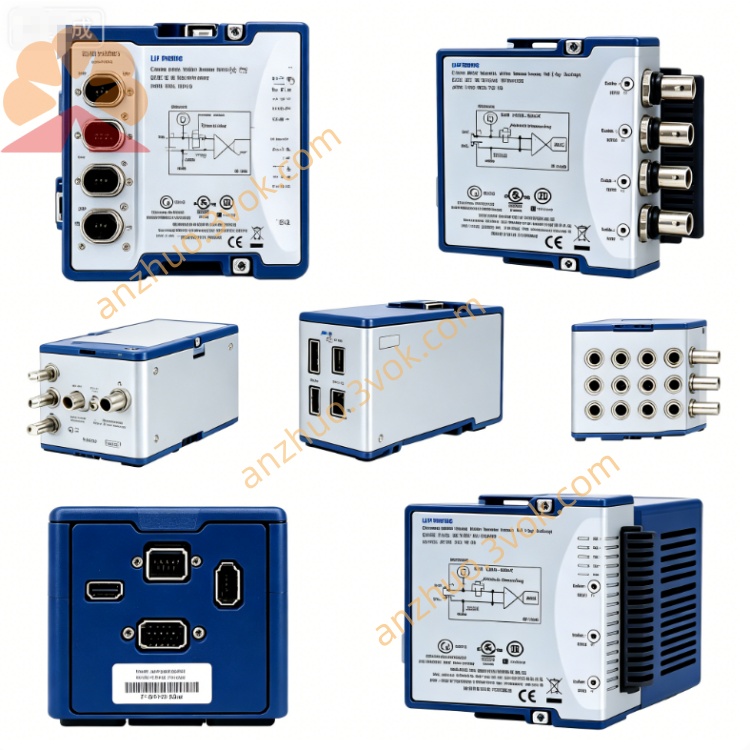
NI SCXI-1102 32-Channel High Voltage Analog Multiplexer Module
Description
I. Product Introduction
The NI SCXI-1102 is a 32-channel high-precision thermocouple / low-level signal conditioning module launched by National Instruments (NI). It belongs to the SCXI series of high-end analog input modules and is specifically designed for high-precision acquisition of weak signals such as thermocouples, millivolt-level voltages, and 4-20mA currents. Compared to SCXI-1100, it features independent instrumentation amplifiers for each channel + 2Hz low-pass filtering, higher cold junction compensation (CJC) accuracy, and is suitable for scenarios with strict requirements for temperature measurement stability and accuracy.
II. Model Interpretation
SCXI: Signal Conditioning eXtensions for Instrumentation, a series of instrument signal conditioning extensions.
1102: The basic model, representing 32 channels, each with independent PGA, 2Hz low-pass filtering, and dedicated for high-precision thermocouples.
Common variants: SCXI-1102B (enhanced accuracy), SCXI-1102C (wide temperature version); part number: 776572-02, etc.; discontinued (Obsolete), repairable or available as second-hand / in stock.
III. Technical Parameters
Channel Configuration: 32 differential inputs (non-single-ended), channel-to-channel isolation of 500VDC continuous.
Input Signals: Thermocouples (J/K/T/E/R/S/B/N, high-precision), millivolts (±100mV), voltage (±10V), current (0-20mA/4-20mA); compatible with SCXI-1581 to support RTD.
Input Impedance: 100MΩ (differential), common-mode rejection ratio (CMRR) 120dB.
Gain Range: Programmable per channel, fixed two settings: ±100mV (gain 100), ±10V (gain 1).
Filter: Fixed 2Hz low-pass filter per channel (suppressing 50/60Hz power frequency noise), bandwidth 2Hz; stability required approximately 3 seconds after gain switching.
Sampling Rate: Module maximum scanning rate 333kS/s (multi-channel multiplexing); per channel maximum approximately 333SPS.
ADC Resolution: 12 bits (effective approximately 11.5 bits, high-precision gain setting).
Cold Junction Compensation (CJC): Built-in high-precision CJC sensor, hardware scanning per channel, accuracy ±0.5℃.
Overvoltage Protection: ±42V, preventing module damage from on-site surges.
Environmental Parameters: Operating temperature 0–50℃ (1102C: - 20–70℃), storage temperature - 20–70℃, humidity 5%–90% without condensation.
Physical Specifications: Standard SCXI module (1U height), size approximately 30×173×203mm, weight approximately 0.7kg.
IV. Interface and Terminal Compatibility
Front panel connector: 96-pin DIN C-type male connector for connecting external terminals.
Backplane connector: 50-pin ribbon cable male connector for connecting the backplane of the SCXI chassis.
Compatible terminals: SCXI-1303 (thermocouple dedicated, with CJC, open-circuit detection), SCXI-1300 (general-purpose), TBX-96 (extension).
Connection Characteristics: Supports floating or grounded thermocouples, with built-in isothermal structure in terminals, reducing CJC errors.
V. Core Functions
Independent high-precision conditioning per channel: Each of the 32 channels is equipped with an independent instrumentation amplifier + 2Hz low-pass filter, avoiding cross-talk between channels, and the thermocouple measurement accuracy is much higher than that of SCXI-1100. Outstanding noise suppression: 120dB CMRR + 2Hz low-pass filter. Even in industrial strong interference environments, it can still stably collect micro-volt level signals.
Hardware cold-end compensation: Independent CJC scanning for each channel, with accurate compensation, suitable for multi-node temperature synchronous acquisition.
Multi-sensor compatibility: Software configures channel types, supporting thermocouples, voltages, currents, and can measure RTDs with SCXI-1581.
High-density system expansion: Single module has 32 channels. The SCXI-1001 chassis can accommodate 12 boards, with a maximum of 384 channels. Cascading 8 chassis can reach 3072 channels.
Six. Application Scenarios
Industrial high-precision temperature monitoring: Multi-node thermocouple temperature acquisition in the chemical, metallurgical, and power industries, requiring long-term stability and low drift.
Automotive / Aviation environmental testing: High and low-temperature cycling tests for components, stress temperature synchronous acquisition, high precision to meet strict testing standards.
Research laboratories: Material thermal properties and thermodynamics experiments, requiring precise measurement of micro-volt level signals, with data traceability.
Energy equipment monitoring: Temperature monitoring of key parts of boilers, steam turbines, and wind power equipment to ensure equipment safe operation.
Process control: Temperature closed-loop control in the pharmaceutical and food industries, 2Hz filtering to ensure stable and no jitter control signals. Instruction Manual
Module Installation: Power off, insert the SCXI chassis, and lock the screws; supports hot swapping, and can be replaced during operation.
Terminal Wiring: Preferentially use SCXI-1303 terminals. Connect the positive and negative poles of the thermocouple in the corresponding positions to ensure good contact of the CJC sensor.
Software Configuration: Set the channel type (thermocouple / voltage / current), gain, and filtering in NI-DAQmx; enable CJC compensation and configure the scanning sequence.
System Connection: Connect the chassis to the DAQ device (such as PCIe-6251) via a 68-pin SCSI cable. Configure a unique address for multi-chassis cascading.
Maintenance Instructions
Daily Inspection: Monthly check if the terminal wiring is loose or oxidized, and if the connectors are intact; clean the dust on the module surface.
Regular Calibration: Calibrate once a year, focusing on calibrating the gain and CJC accuracy. This can be done using the NI calibration tool or a third-party NIST-certified service.
Environmental Control: Avoid high temperatures, humidity, and strong electromagnetic interference; operating temperature is 0–50℃ (1102C can be -20℃ up to).
Fault Troubleshooting: Check the CJC wiring or calibrate when the temperature drift is significant; check the terminal grounding and shielded cable connection when there is a signal jump.
Get a Quote