
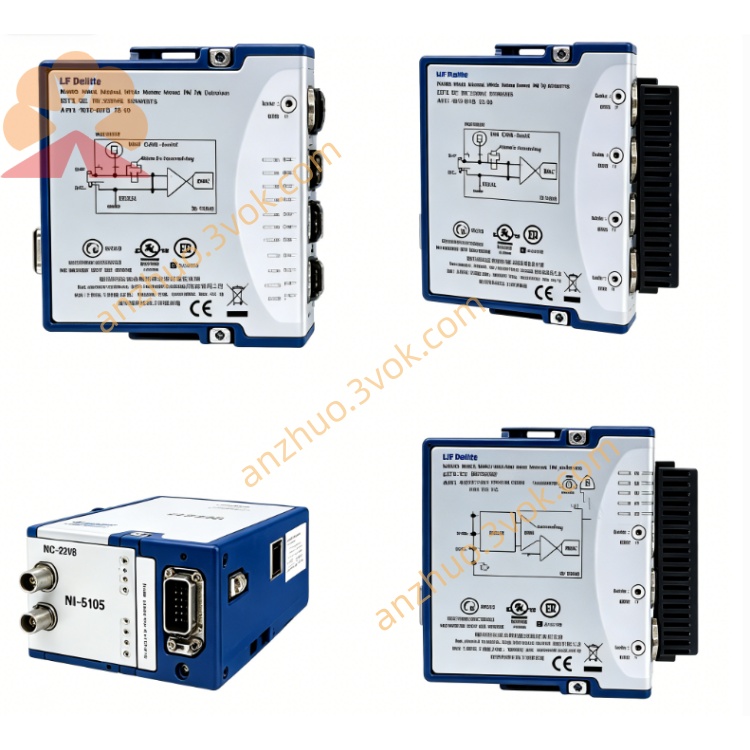
NI SCXI-1100 32-Channel Low-Cost Analog Multiplexer Module
Description
I. Product Introduction
The NI SCXI-1100 is a 32-channel differential multiplexed analog input module launched by National Instruments (NI). It belongs to the core signal conditioning module of the SCXI series, used for low-cost conditioning and acquisition of millivolt/voltage/current signals, suitable for scenarios with weak signals such as thermocouples, RTD, and low-level sensors. The module integrates a multiplexer, programmable gain amplifier (PGIA), and low-pass filter. The 32-channel multiplexing is single-channel output, significantly expanding the channel capacity of the DAQ system and is a commonly used high-density input module for SCXI chassis.
II. Model Interpretation
SCXI: Signal Conditioning eXtensions for Instrumentation, the identification of the instrument signal conditioning extension series.
1100: The basic model, representing 32-channel differential input, programmable gain, 4Hz low-pass filter standard version.
Part number: 776572-00 (standard type), 181690-01 (matching terminal version); discontinued (Obsolete), still repairable and purchasable as second-hand / inventory.
III. Technical Parameters
Channel Configuration: 32 differential inputs (software can be set as 64 single-ended), channel isolation of 500VDC continuous.
Input Signals: Voltage (±10mV~±10V), Current (4~20mA/0~20mA), Thermocouple (J/K/T/E/R/S/B/N), RTD (Pt100/Pt1000).
Input Resistance: 100MΩ (differential), Common Mode Rejection Ratio (CMRR) 120dB.
Gain Range: Programmable 1/2/5/10/20/50/100/200/500/1000 times.
Filter: Jumper selectable 4Hz low-pass filter (anti-aliasing, bandwidth 10kHz when off).
Sampling Rate: Full bandwidth (without filter) up to 166kS/s; 10kHz filtering 6.6kS/s; 4Hz filtering 3S/s.
ADC Resolution: 12 bits (effective approximately 10.5 bits, depending on gain and filter).
Excitation Source: No built-in constant current source (RTD measurement requires external excitation or combination with SCXI-1303 terminal).
Environmental Parameters: Working temperature 0~50℃, storage temperature -20~70℃, humidity 5%~90% no condensation.
Physical Specifications: Size approximately 30×173×203mm (1U height), weight approximately 0.7kg; standard SCXI module size.
IV. Interface and Terminal Compatibility
Front panel connector: 96-pin DIN C-type male connector, used for connecting external terminal blocks.
Backplane connector: 50-pin ribbon cable male connector, connects to the backplane bus of the SCXI chassis.
Compatible terminals: SCXI-1300 (general), SCXI-1303 (thermocouple/RTD), SCXI-1308 (high voltage), TBX-96 (extension terminals), etc.
Cold Junction Compensation (CJC): Terminal built-in temperature sensor, 32-channel multiplexed CJC reference, suitable for thermocouple measurement.
V. Core Functions
High-density Signal Acquisition: Single module 32 differential inputs, 12 blocks can be inserted in one SCXI-1001 chassis, maximum 384 channels, suitable for large-scale multi-node monitoring.
Low-noise Weak Signal Conditioning: High input resistance + 120dB CMRR, suppresses industrial EMI interference; programmable gain amplification of millivolt-level signals, suitable for thermocouples, strain gauges, etc. low-level sensors. Flexible filtering and anti-aliasing: 4Hz low-pass filter jumper is selectable, which can filter out power frequency / high-frequency noise and improve measurement stability; the non-filtering mode supports high-speed acquisition.
Multi-sensor compatibility: The software configures the channel type, supporting voltage, current, thermocouple, RTD, and no need to replace the module to adapt to different sensors.
System expansion and synchronization: 32 channels can be multiplexed into a single DAQ channel. Combined with SCXI chassis cascading, it realizes multi-module and multi-chassis synchronous acquisition, simplifying system wiring.
Six. Application Scenarios
Industrial monitoring: Multi-node monitoring of temperature, pressure, flow, and vibration in large production lines, suitable for thermocouples, RTD, and pressure sensors.
Automotive / Aviation testing: Component environmental tests, temperature stress tests, multi-channel data acquisition, high-density channels meet testing requirements.
Laboratory research: Scientific research experiments, university teaching, building multi-channel testing systems, suitable for sensor signal acquisition, supporting custom conditioning parameters.
Process control: 4-20mA current signal acquisition in chemical and metallurgical industries, combined with terminals to achieve industrial site signal isolation and conversion.
ATE automatic testing: Batch testing of electronic components, multi-channel synchronous acquisition improves testing efficiency and reduces system costs.
Seven. Usage and Maintenance Instructions Instruction Manual
Module Installation: Insert the SCXI chassis slot while the power is off, then tighten the panel screws; it supports hot swapping, allowing module replacement during operation.
Terminal Wiring: Connect the terminals of SCXI-1300/1303, connect according to the sensor type; thermocouples need to be connected to the CJC compensation terminal to ensure accurate cold end reference.
Software Configuration: Set the channel type, gain, and filtering through NI-DAQmx; configure the multiplex scanning sequence and synchronize the acquisition timing of multiple modules.
System Connection: Connect the SCXI chassis to the DAQ device (such as PCIe-6251) via a 68-pin SCSI cable; set a unique address for cascaded chassis to avoid conflicts.
Maintenance Instructions
Daily Inspection: Check monthly if the terminal wiring is loose or oxidized, and if the connectors are intact; clean the dust on the module surface to avoid heat dissipation issues.
Regular Calibration: Calibrate once a year to ensure that the gain and accuracy meet the requirements; this can be done using the NI calibration tool or a third-party NIST-certified calibration service.
Environmental Control: Avoid high temperatures, humidity, and strong electromagnetic interference; the working temperature should be controlled at 0 to 50℃, with humidity ≤ 90% and no condensation.
Fault Troubleshooting: When there is an abnormal signal, check the wiring, CJC compensation, and gain configuration; when there is no signal, check if the module is securely inserted and if the backplane connection is normal.
Get a Quote