
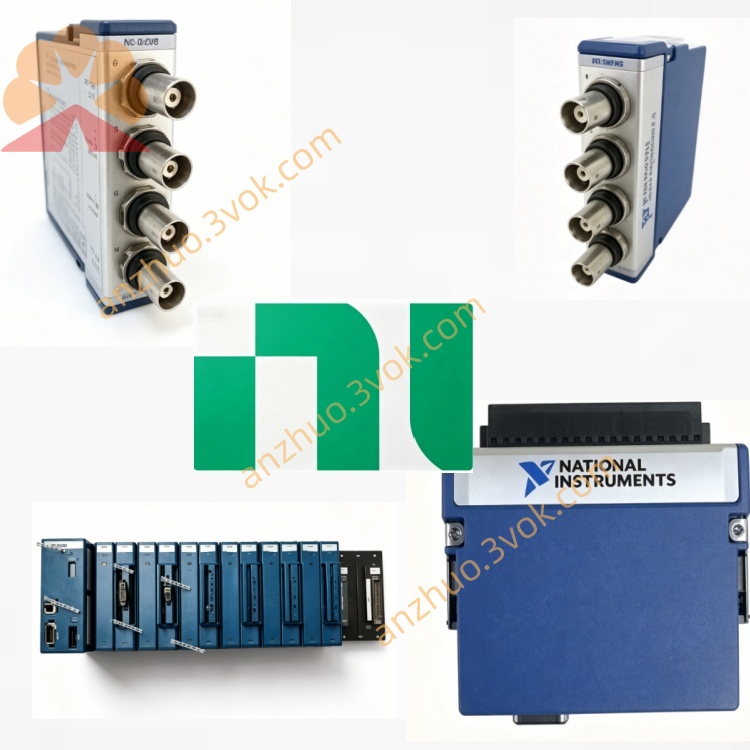
NI PXIe-4353 8-Channel Temperature & Voltage Input Module
Description
I. Product Introduction
The NI PXIe-4353 (Part Number 781348-01) is a 32-channel 24-bit high-precision thermocouple temperature acquisition module, belonging to the NI SC Express series. It integrates signal conditioning, cold junction compensation (CJC), and isolation protection, specifically designed for high-density and high-precision temperature measurement. It is compatible with the PXI Express bus architecture and can be directly inserted into a PXIe chassis for use.
II. Model Interpretation
NI: Brand logo of National Instruments.
PXIe: PXI Express, a high-speed PXI standard based on the PCIe bus.
4353: Product series number, representing 32-channel thermocouple input, with integrated signal conditioning for temperature acquisition module.
781348-01: Complete part number, used to uniquely identify this model of hardware.
III. Technical Specifications
Channel Configuration: 32 differential thermocouple input channels, 2 automatic zeroing channels, 8 cold junction compensation (CJC) channels.
ADC Specifications: 24-bit Δ-Σ type analog-to-digital converter, maximum sampling rate of 90 S/s per channel, supports 7 timing modes (balanced speed and accuracy).
Measurement Range: Voltage input range ±80 mV, compatible with J/K/T/E/N/R/S/B type thermocouples.
Accuracy Indicators: In high-resolution mode, for K-type thermocouples, the typical accuracy is ±0.36°C for 0–300°C, ±0.30°C for T-type; typical DC linearity is 20 ppm.
Isolation and Protection: 300 Vrms CAT II isolation, channel-to-channel ±60 V overvoltage protection.
Input Impedance: 20 MΩ (differential).
Physical Specifications: Standard 3U PXIe module, size 16×10 cm, weight 139 g.
Environmental Parameters: Operating temperature 0–55°C, storage temperature - 40–70°C, humidity 10%–90% (no condensation), maximum altitude 2000 m.
IV. Interface and Communication Configuration
Front Panel I/O: 96-pin DIN 41612/IEC 60603-2 connector, used for signal connection of thermocouples, CJC, and automatic zeroing channels; requires TB-4353 temperature connection box (including 8 CJC thermistors) for use.
Bus Interface: x1 PXIe bus, dedicated bandwidth 250 MB/s, supports plug-and-play and system synchronization.
Clock and Trigger: Supports PXIe backplane clock and trigger bus, can synchronize acquisition with other PXIe modules; built-in automatic zeroing channel for offset compensation and open-circuit thermocouple detection.
V. Core Functions
High-density and High-precision Temperature Acquisition: 32-channel synchronous measurement, 24-bit ADC + multiple CJC channels, combined with temperature compensation with equal temperature reference boxes to achieve precise cold junction compensation, significantly reducing measurement errors.
Compatibility with Multiple Types of Thermocouples: Supports J/K/T/E/N/R/S/B type thermocouples, covering a wide temperature range from -200°C to 1800°C.
Flexible Timing and Noise Suppression: 7 ADC timing modes selectable, strong 50/60 Hz noise suppression in high-resolution mode, suitable for precise measurement scenarios.
Safety Isolation and Fault Detection: 300 Vrms isolation protection, supports ground-referenced thermocouple measurement; each channel has an open-circuit detection function, automatically identifying open-circuit faults. System-level synchronization and expansion: The PXIe bus synchronization mechanism can work in conjunction with the PXIe chassis and other modules (such as data acquisition and switch modules) to build a large-scale distributed temperature monitoring system.
VI. Application Scenarios
Semiconductor testing: Wafer and chip thermal distribution testing, reaction chamber temperature monitoring, requiring multi-channel high-precision synchronous acquisition.
Aerospace and defense: Engine, turbine blades, aircraft structure temperature testing, reliability verification in extreme environments.
Automotive electronics: Battery pack, motor, ECU temperature monitoring, thermal management system testing for new energy vehicles.
Industrial automation: Production line equipment, heat treatment furnaces, high-voltage equipment temperature monitoring, batch data acquisition and abnormal alarm.
Research and laboratories: Material thermal property analysis, precise instrument temperature control, environmental simulation experiments, requiring high resolution and stability.
VII. Usage and Maintenance Instructions Instruction Manual
Installation steps: Insert the module into any mixed slot of the PXIe chassis while the power is off, then tighten the fixing screws; Connect the TB-4353 wiring box to the 96-pin connector on the front panel, ensuring good contact.
Wiring configuration: Connect to the corresponding terminals of the TB-4353 according to the thermocouple type (positive and negative poles), keep the CJC channel open or connect a compensation resistor; Avoid cross-interference from multiple-channel measurement by avoiding cable crossover.
Software configuration: Install the NI-DAQmx driver and PXI platform service, and identify the module through NI MAX; Configure the thermocouple type, sampling rate, timing mode, and CJC compensation parameters; Enable open-circuit detection and automatic zeroing functions.
Preheating and calibration: After powering on, preheat for 15 minutes to reach the rated accuracy; Regularly (suggested annually) perform NIST traceability calibration to ensure measurement accuracy.
Maintenance instructions
Daily maintenance: Keep the module and wiring box clean and dry, and wipe the surface dust with a dry soft cloth regularly; Check for any looseness, oxidation or corrosion of the wiring terminals, and tighten or replace them in time.
Environmental control: Working environment temperature 0–55°C, humidity 10%–90% (no condensation), away from strong electromagnetic interference, vibration and corrosive gases.
Fault troubleshooting: When there is an abnormal measurement, first check the thermocouple wiring, terminal connection and CJC configuration; If there is no signal in the channel, check if the open-circuit detection function has been triggered or if the module has not been recognized by the system.
Long-term storage: When not in use for a long time, power off the module, remove it and store it in a dry, cool environment, avoiding compression and static damage; Storage temperature - 40–70°C.
Get a Quote