
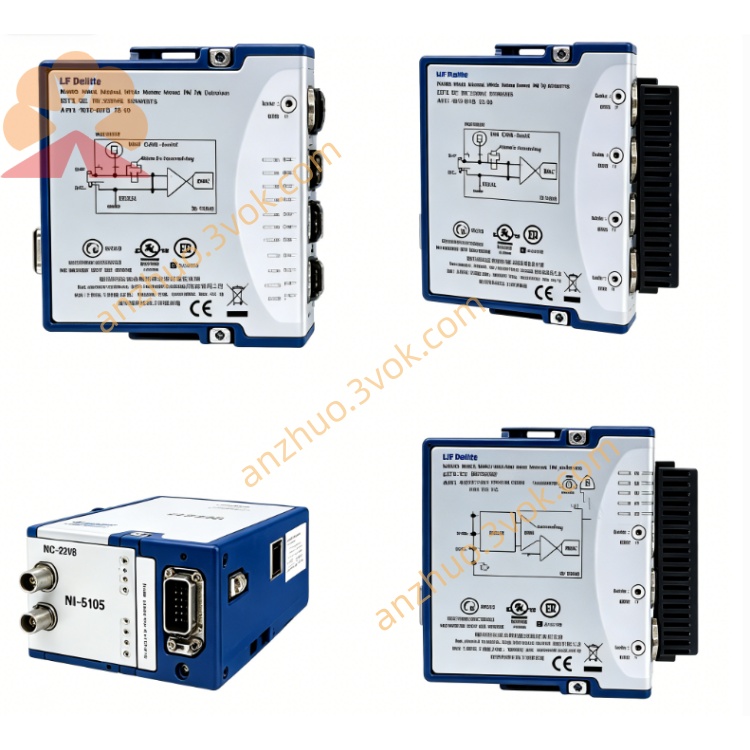
NI PXIe-6536 25MHz 32CH Digital I/O Module
Description
Model Explanation
PXIe: PXI Express bus, 3U size, supports high-speed transmission and multi-box synchronization.
6536: High-speed bidirectional I/O series, 32 channels, 25 MHz, targeted at high-density and high-bandwidth digital testing.
Core Identifier: Bidirectional I/O, 25 MHz, 100 MB/s, programmable level, per-channel direction control, streaming data. Technical Specifications
Channels and Levels
Channels: 32 bidirectional digital I/O, each channel has independent input/output configuration.
Logic Levels: Software selectable: 2.5 V, 3.3 V, 5 V TTL.
Input Voltage: -1 V to +6 V; Output Voltage: 0 V to 5 V.
Single-channel Drive: 32 mA, can directly drive TTL loads, relays.
Timing and Performance
Maximum Clock: 25 MHz, sampling accuracy 10 ns.
Data Throughput: 100 MB/s, supports PXIe continuous streaming transmission.
Channel-to-Channel Jitter: ≤1.2 ns; Output Setup Time Deviation ≤1.5 ns.
Synchronous Clock: 100 MHz reference, multi-module / multi-rack synchronization.
General Specifications
Bus: PXIe Gen1, single slot, DMA and RTSI triggering.
Connector: Front panel 68-pin VHDCI, with SHC68-C68-D4 shielded cable.
Power Consumption: +5 V approximately 1.8 A, total power consumption ≈ 9 W.
Operating Temperature: 0 °C to +55 °C, industrial-grade wide temperature range.
Interface and Communication Configuration
Host Interface: PXIe bus, plug-and-play, DMA high-speed transmission, RTSI synchronization, PXI trigger bus.
Front Panel Interface: 68-pin VHDCI shielded connector, integrates all I/O, power, ground, strong anti-interference.
Trigger and Synchronization: Software / edge / handshake trigger; synchronized with 6535/6537 multi-modules, clock alignment in multi-rack.
Driver Software: NI-DAQmx, compatible with Windows / real-time systems, LabVIEW, C/C++, Python, TestStand development. Core function
32-channel bidirectional programmable I/O: Each channel has independent input/output, enabling flexible data acquisition and control.
Multi-level compatibility: 2.5/3.3/5 V TTL software switching, suitable for mainstream digital devices.
High-speed streaming transmission: 25 MHz, 100 MB/s, suitable for high-speed data capture and generation in image/display.
Precise timing synchronization: 100 MHz reference, channel-to-channel jitter ≤ 1.2 ns, multi-module synchronous testing.
Input filtering and change detection: Programmable debouncing, edge triggering, reducing CPU usage.
High driving capability: 32 mA per channel, capable of driving TTL loads, relays, and small actuators. Applicable scenarios
Semiconductor testing: Memory/Logic Device Testing, Parallel I/O Pattern Generation and Capture, Chip Protocol Simulation.
Image/Display Testing: High-speed Acquisition of CMOS Sensors, LCD/OLED Timing Control and Signal Verification.
High-speed Digital Communication: UART/SPI/I²C Protocol Simulation, Bus Monitoring, Handshake Interaction Testing.
Industrial Automation: High-density Switching Quantity Acquisition, High-speed Relay Array Control, Parallel Signal Synchronization Testing of Production Line.
Aerospace/Defense: Digital Signal Synchronization Acquisition under Strong Interference, Multi-device Timing Linkage, Weapon System I/O Control.
User and Maintenance Instructions
Key Usage Points
Installation: Insert into a single slot of the 3U PXIe chassis and lock the screws; recommended PXIe-1071/1085 chassis.
Cabling: Use SHC68-C68-D4 shielded cables, separate strong and weak electricity, avoid common ground interference; secure the 68-pin connection firmly.
Configuration: Set channel direction, level, clock, filtering and triggering in NI-MAX/DAQmx.
Timing Considerations: Cable length ≤ 1 m for ≥ 10 MHz, reduce attenuation and jitter.
Maintenance and Calibration
Cleaning: Use a dry soft cloth to wipe the panel and connectors, prevent dust and oxidation; avoid contact with liquids.
Calibration: Digital I/O does not require regular calibration, check level, drive current and timing every 2 years.
Storage: Place for long-term non-use in an environment of -20 °C to + 60 °C, humidity ≤ 60%, anti-static.
Troubleshooting: First check wiring, power supply, and configuration for abnormalities; check cable and grounding for timing abnormalities; check load overload/surge for output abnormalities.
Get a Quote