
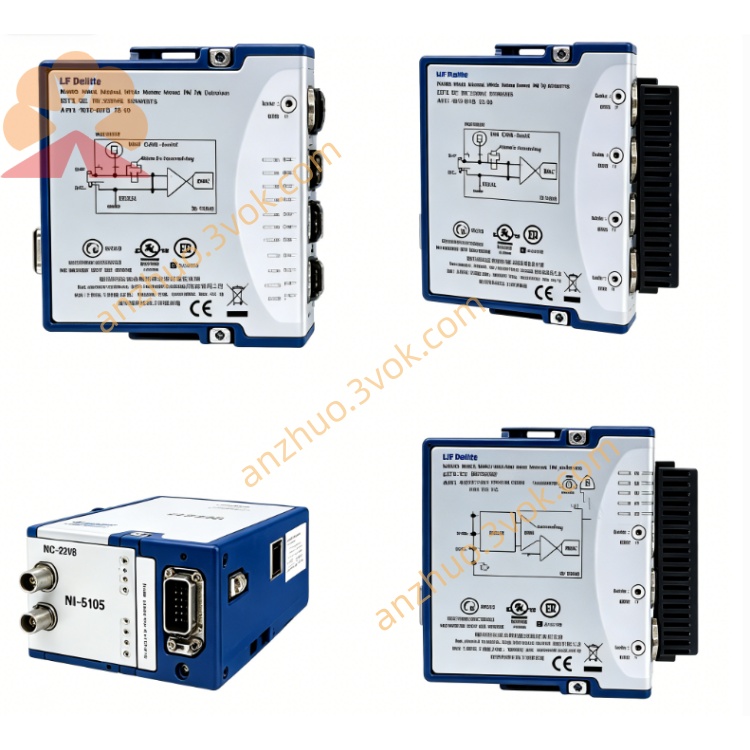
NI PXIe-6368 X Series Simultaneous Multifunction DAQ Module
Description
Model Explanation
PXIe: PXI Express Gen2 x4 bus, with a bandwidth of 1.6 GB/s.
6368: X series DAQ, 16 synchronous AI + 4 AO + 48 DIO configuration from NI.
Core Identifier: 2 MS/s synchronous sampling per channel, 16 bits, NI-STC3 timing engine from NI. Technical Specifications
Analog Input (AI)
Channels: 16 differential, synchronous sampling NI.
Resolution: 16 bits, no bit loss NI.
Sampling rate: 2 MS/s per channel, total throughput 32 MS/s NI.
Range: ±1 V, ±2 V, ±5 V, ±10 V NI.
Input protection: maximum ±11 V, DC coupling NI.
Common mode suppression: 75 dB (60 Hz), bandwidth 1 MHz NI.
Analog Output (AO)
Channels: 4 NI.
Resolution: 16 bits.
Update rate: 3.33 MS/s per channel.
Output range: ±10 V, drives ±5 mA.
Digital I/O (DIO)
Channels: 48, 3.3 V TTL/CMOS level.
Hardware timing: 16 channels up to 10 MHz, supports PWM, mode I/O, trigger.
Counter / Timer
4 32-bit counters NI.
Function: PWM generation, encoder measurement, frequency / event counting NI.
General electrical and environmental
Power consumption: approximately 25 W.
Operating temperature: 0 °C to 55 °C NI.
Calibration: factory calibration, recommended calibration once every 2 years; supports internal self-calibration NI.
Size: 1 slot 3U PXIe, weight approximately 0.48 kg.
Interface and communication configuration
Host interface: PXIe Gen2 x4, 1.6 GB/s, supports DMA stream reading and writing NI.
Front panel connectors: 2 × 68-pin VHDCI female connectors, divided CON0 (AI/AO), CON1 (DIO / counter) NI.
Timing and synchronization: onboard NI-STC3 timing engine, 10 ns resolution, 50 ppm accuracy; supports PXI trigger bus, star trigger, external 10 MHz reference clock, multi-module precise synchronization NI.
Trigger function: analog/digital edge, window trigger, supports re-triggerable tasks NI.
Driver software: standard NI-DAQmx, compatible with Windows and real-time systems, provides API for easy development in LabVIEW, C/C++, Python. Core function
16-channel synchronous high-speed acquisition: Each channel samples at 2 MS/s synchronously, and the phases of multiple channels are strictly consistent, suitable for synchronous measurement of vibration, acoustic, and mid-frequency signals by NI.
High-precision mixed signal control: 16-bit AI/AO ensures the accuracy of measurement and waveform generation; an independent timing engine supports asynchronous complex tasks for AI/AO/DIO by NI.
Flexible triggering and synchronization: Rich triggering sources and multi-module synchronization capabilities meet the needs of transient capture and multi-device collaborative testing by NI.
High-throughput streaming transmission: The PXIe bus and DMA ensure the high-speed upload of continuous data, suitable for long-term high-speed recording by NI.
High-density multi-function integration: 16 AI + 4 AO + 48 DIO + 4 counters integrated together, reducing slot occupation and hardware costs by NI. Applicable scenarios
Intermediate Frequency (IF) digitization and transient recording: High-speed synchronous acquisition of radar and communication IF signals by NI.
Telecommunication equipment manufacturing testing: ISDN, ADSL, POTS interface function and performance testing by NI.
Ultrasound/Sonar and high-energy physics experiments: Multi-channel synchronous signal acquisition and analysis by NI.
Vibration and noise monitoring: Multi-point synchronous vibration testing of motors, engines, and structural components by NI.
Hardware-in-the-Loop (HIL) real-time simulation: Real-time I/O and closed-loop testing of automotive and aerospace control systems by NI.
Industrial automation and process control: High-speed closed-loop control, multi-parameter synchronous monitoring.
User and Maintenance Instructions
Key Usage Points
Installation: Insert into an empty slot of the 3U PXIe chassis, lock the fixing screws, and no external power supply is required.
Preheating: Power on and preheat for 15 minutes to ensure measurement accuracy by NI.
Cabling: Use shielded twisted-pair cables for analog signals, separate digital and analog ground wires to avoid interference by NI.
Range selection: Select an appropriate range based on the signal amplitude to avoid module damage due to over-range NI.
Driver installation: Install NI-DAQmx and use MAX to complete hardware identification and configuration.
Maintenance and Calibration
Cleaning: Regularly wipe the front panel and connectors with a dry soft cloth to avoid dust accumulation affecting contact by NI.
Calibration cycle: Send for external calibration every 2 years; perform internal self-calibration periodically to correct temperature drift and time drift by NI.
Storage: When not in use for a long time, store in a dry and cool environment to avoid high temperature, humidity, and static damage.
Troubleshooting: Check wiring, power supply, and driver configuration when there is an anomaly; contact NI technical support when necessary.
Get a Quote