
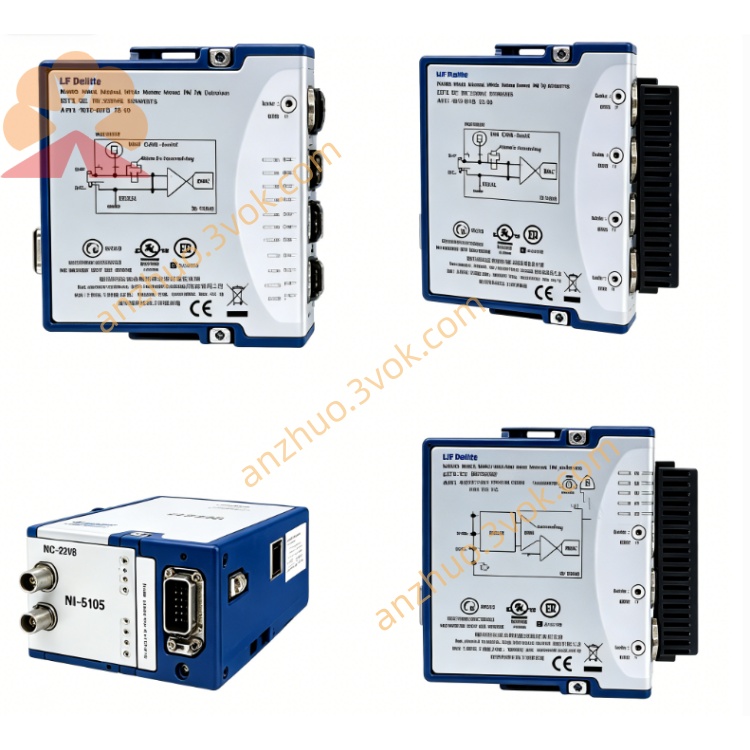
NI PXIe-5160 500MHz 2.5GS/s 10-bit PXIe Modular Oscilloscope Digitizer
Description
Model Nomenclature
PXIe: PXI Express high‑speed modular bus
51: PXI oscilloscope/digitizer series
60: 500 MHz bandwidth, 2.5 GS/s, 10‑bit, 2/4‑channel, deep memory
Technical Specifications
Form factor: 3U single‑slot PXIe module
Channels: 2 or 4 simultaneous sampled analog inputs
Resolution: 10 bits
Bandwidth: 500 MHz (50 Ω), 300 MHz (1 MΩ)
Sample rate: 2.5 GS/s (1 ch), 1.25 GS/s (2 ch), 625 MS/s (4 ch)
Input impedance: Software‑selectable 50 Ω or 1 MΩ || 15 pF
Voltage ranges (full‑scale):
50 Ω: ±0.5 V → ±5 V
1 MΩ: ±0.5 V → ±25 V
Memory depth: 2 GB per channel (fixed; 64 MB variant discontinued 2026)NI
SFDR: >50 dBc (typical)
Rise time: ~700 ps (50 Ω)
Filters: 20 MHz, 175 MHz (software‑selectable)
Triggering: Edge, pulse, window, video, pattern; PXI trigger bus
Time stamping: 100 ps resolution
Operating temperature: 0 °C to 55 °C
Connectors: Front‑panel BNC (2/4× analog in, 1× trigger in/out)
Weight: ~400 g
Interface & Communication
Bus: PXIe Gen1, plug‑and‑play with PXI/PXIe chassis
Driver: NI‑DAQmx, NI‑Scope
Software: NI‑MAX, LabVIEW, C/C++, Python, .NET
Synchronization: PXI trigger lines, PXIe star trigger, NI‑TClk, external clock in/out
Data transfer: DMA streaming; multi‑record acquisition (up to 100,000 records)
Core Features
500 MHz bandwidth + 2.5 GS/s: Captures fast digital/RF signals up to 500 MHz
10‑bit resolution: Better noise performance than 8‑bit scopes for mid‑dynamic‑range signals
2 GB deep memory: Long-duration captures without host streaming
Flexible front‑end: 50 Ω/1 MΩ, AC/DC coupling, selectable filters
PXI synchronization: Picosecond‑level alignment with other PXIe instruments
CableSense™ (opt): Detect/locate signal path faults
Application Scenarios
Semiconductor: High‑speed digital I/O, clock, and power rail characterization
Power electronics: SMPS, inverter, and power supply waveform analysis
Automotive: ECU, CAN/LIN, and sensor signal validation
Aerospace: Avionics, radar, and high‑speed analog/digital testing
Communications: Baseband/RF signal capture and analysis
Get a Quote