
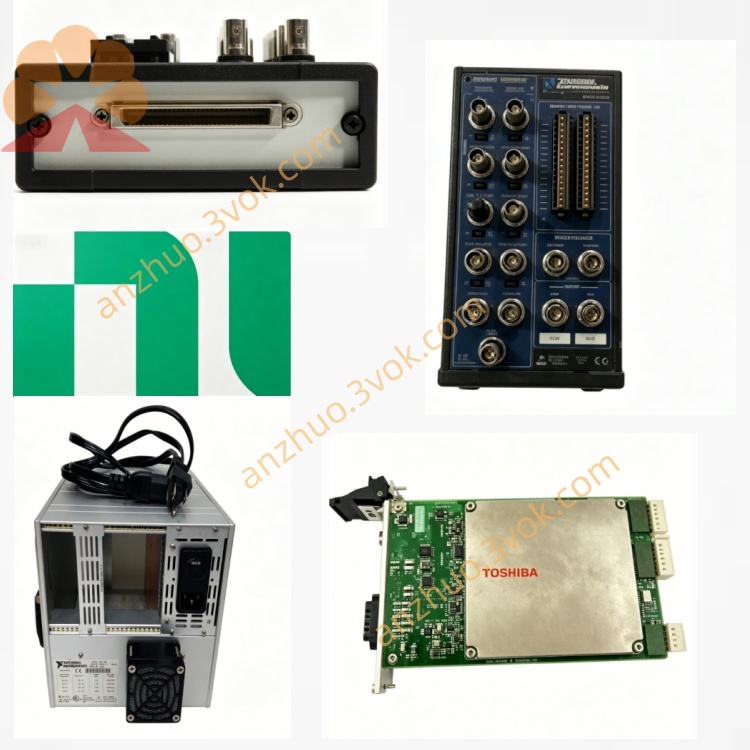
NI PXI-7352 2-Axis Servo/Stepper Motion Controller
Description
Operating temperature: 0 ℃ ~ 55 ℃
Storage temperature: −20 ℃ ~ 70 ℃
IV. Interface and Communication Configuration
1) Hardware Interface
Motion I/O (68-pin): 2 encoders, 2 AO, 8 AI, limit/origin, breakpoint input.
Digital I/O (68-pin): 64 TTL for triggering, interlocking, status monitoring.
Backplane Bus:
PXI Trigger Bus (8 channels): Multi-module synchronization;
RTSI Bus: Multi-card synchronization accuracy <100 ns.
2) Software and Drivers
Driver: NI-Motion, supports complex interpolation, electronic gearing, fly-saw, contour control.
Development Environment: LabVIEW, C/C++, Python, TestStand, supports real-time control.
Firmware Functions: On-board multitasking, hardware breakpoints (200 ns), watchdog (63 ms), fault-safe shutdown.
V. Core Functions
2-axis high-performance closed-loop control + brushless sinusoidal commutation
Each axis 62.5 μs PID update, supports servo/stepper hybrid control; brushless motor sinusoidal commutation, smooth torque, low noise, suitable for high-speed precision scenarios.
Board-level real-time multitasking and complex trajectory interpolation
Dual processors + real-time OS, can run multiple motion programs simultaneously; native support for 2D/3D straight/arc interpolation, electronic gearing, vector space control, does not occupy the host CPU.
Rich I/O integration, integrated control
2 channels 16-bit AO, 8 channels 16-bit AI, 64 TTL I/O, 2 channels encoders, directly connect to motors, sensors, limit switches, simplifies system architecture.
Advanced control algorithms and safety protection
PID + feedforward control, S curve acceleration/deceleration smooth; hardware limit, software limit, watchdog, short circuit protection, automatic safe shutdown in case of faults.
System-level synchronization and integration
Share clock and trigger with PXI data acquisition, vision, FPGA modules, build a unified time reference, suitable for complex automation system integration.
VI. Application Scenarios
2-axis precision platform
Optical platform, microscope stage, laser processing XY axis, semiconductor wafer positioning platform, requirements for micron-level positioning and smooth motion.
Brushless motor high-speed control
High-speed spindle, textile/packaging high-speed axis, robot joints, power tool testing, low noise, high torque smoothness scenarios.
Automation testing and verification
2-axis motion + data acquisition synchronous testing, sensor calibration, product lifespan testing, precision detection equipment (such as coordinate measuring machine).
Laser processing and precision processing
Laser cutting / marking, PCB drilling, precision grinding, semiconductor slicing, complex trajectories and high-speed synchronization requirements.
Equipment upgrade and replacement
Original 7352 system spare parts, maintenance replacement; upgrade of 2-axis motion control from PCI to PXI platform.
VII. Usage and Maintenance Instructions
1) Installation and Power On
Disconnect power, insert into any slot of the PXI chassis, tighten screws and reliably ground;
Before powering on, check that the 68-pin cable has no short circuit / false connection to avoid damaging I/O channels;
Keep the chassis ventilated during operation, environmental temperature ≤ 55 ℃, avoid accumulated temperature affecting control accuracy.
2) Wiring and Operation
Cables: Use shielded 68-pin VHDCI cables, separate analog signals, encoder signals and digital signals for wiring to reduce crosstalk; encoder cable length ≤ 10 m to avoid signal attenuation.
Configuration: Set axis type (servo/stepper), control mode, limit parameters, trajectory data through NI MAX software; For the first run, perform unloaded debugging first to confirm normal movement, and then connect the load.
Synchronization: When synchronizing multiple cards, use the PXI_TRIG or RTSI signal to ensure consistent timing; hardware breakpoints are used for precise triggering of external events.
3) Daily Maintenance
Regularly clean the 68-pin connector, check the integrity of the cable shielding layer, add a dust cap when the equipment is idle for a long time to prevent oxidation and dust from affecting the contact reliability.
Calibration: It is recommended to calibrate once a year. Use the NI-Motion calibration tool to calibrate the accuracy of analog I/O, encoder zero points and limit trigger values.
Driver Update: Regularly update the NI-Motion driver and firmware to fix compatibility issues and optimize the stability of motion control.
Get a Quote