
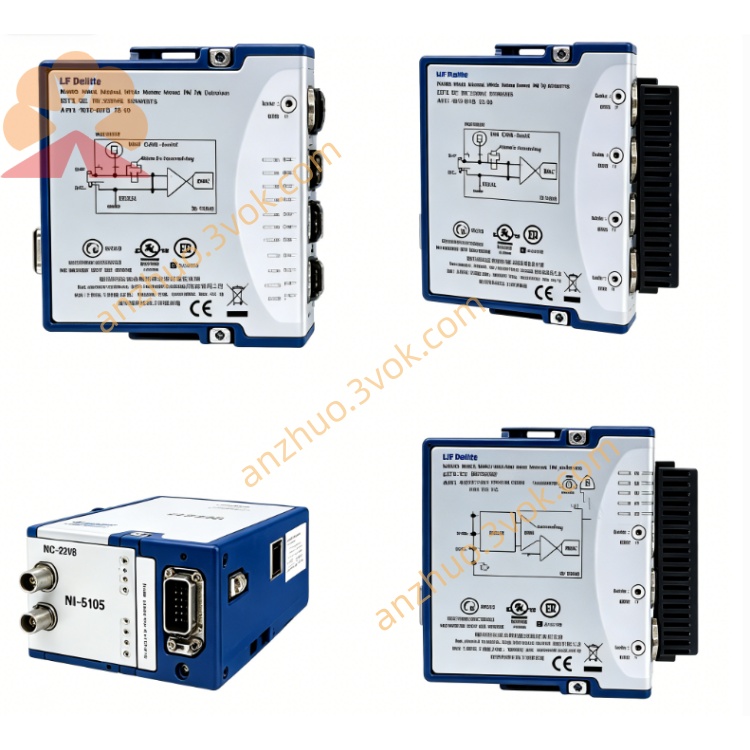
NI PXI‑6122 S‑Series Simultaneous‑Sampling Multifunction DAQ Module
Description
II. Model Interpretation
PXI: 3U single slot, PXI bus, compatible with PXI/PXIe chassis.
6122: S series synchronous sampling model, 16-bit, 500 kS/s/ch, 4 channels synchronous AI.
Part number: 779179-01 (standard); recommended alternative model: 781053-01NI.
S series: Simultaneous (synchronous sampling), different from E series multiplexing architecture.
III. Technical Parameters (25℃)
1. Analog Input (AI)
Channels: 4 differential (synchronous sampling, no single-ended mode) NI
Resolution: 16 bits (65536 levels)
Sampling rate: 500 kS/s per channel, total 2 MS/s
Range: ±1.25 V, ±2.5 V, ±5 V, ±10 V (software selectable)
Input impedance: 1 MΩ || 20 pF
Coupling: DC coupling; overvoltage protection ±25 V (on power-on) / ±15 V (off power)
FIFO: 16 MB onboard memory, supports DMA continuous acquisition
Anti-aliasing: Built-in low-pass filter, matching sampling rate
2. Digital I/O (DIO)
Channels: 8 bidirectional TTL/CMOS
Level: High ≥ 2.4 V, Low ≤ 0.4 V
Rate: Up to 1 MHz (hardware timing)
3. Counter / Timer
Quantity: 2 24-bit (STC3 chip)
Time base: 100 MHz internal clock
Function: event counting, frequency / period measurement, pulse generation, edge triggering
4. Physical and Environmental
Size: 3U single slot (approx. 22×124×126 mm)
Operating temperature: 0~50℃
Power consumption: approximately 8 W (PXI backplane power supply)
Calibration: recommended once every 2 years for traceable calibration
IV. Interface and Communication Configuration
Front panel interface: 68-pin SCSI-II female connector (with SH68-68-EP cable, CB-68LP wiring box)
Bus: standard PXI (PCI, trigger, 10 MHz reference clock)
Driver: NI-DAQmx, supports LabVIEW, TestStand, Python, C#
Synchronization: PXI trigger bus / RTSI, multi-module nanosecond-level synchronization
PFI lines: 8 programmable function inputs for board-to-board / board-to-board triggering and timing routing
V. Core Functions
4 channels full synchronous sampling: independent ADC, no phase difference between channels, suitable for vibration, acoustic, transient signal synchronous acquisition.
16-bit high resolution: high dynamic range, accurately captures small signals and large signals coexisting scenarios.
Medium-high-speed continuous acquisition: 500 kS/s/ch + 16 MB FIFO, supports long-term high-speed disk transfer.
Multifunctional integration: AI + DIO + counter + trigger, one module completes measurement, control, and timing (NI).
Wide range and signal conditioning compatibility: 4 range levels; can be equipped with SCXI/SCC conditioning, suitable for sensor signals.
VI. Application Scenarios
Vibration / modal testing: 4 channels synchronous acquisition, suitable for motor, bearing, small structure vibration analysis.
Acoustic / ultrasonic testing: microphone array, ultrasonic transducer synchronous sampling, used for non-destructive testing, acoustic measurement (NI).
Communication intermediate frequency (IF) digitization: ISDN, ADSL, POTS manufacturing test, high-speed acquisition of intermediate frequency signals (NI).
Transient signal recording: shock, pulse, discharge, etc., short-time high dynamic signal capture (NI). Research and High Energy Physics: Detector Signals, Pulse Synchronous Measurement, Multi-module Expansion Synchronous System NI.
VII. Installation and Maintenance Instructions
Installation and Power On
Disconnect and insert the single slot, ensure the chassis is reliably grounded; after powering on, NI-DAQmx self-checks and preheats for 15 minutes.
Operating Temperature: 0 - 50℃. Keep the air ducts unobstructed and avoid blocking the fans.
Wiring and Operation
Use shielded twisted-pair differential wiring for analog inputs; differential wiring must be selected in strong interference environments.
Input voltage should not exceed ±10 V; avoid frequent plugging and unplugging of the 68-pin interface; it is recommended to use a wiring box.
When synchronizing multiple modules, share the PXI 10 MHz reference clock and trigger bus.
Daily Maintenance and Calibration
It is recommended to conduct a traceable calibration once every 2 years; built-in self-calibration compensates for temperature drift.
Keep the interfaces clean, prevent dust accumulation during long-term inactivity; keep away from strong vibrations, condensation, and strong electromagnetic interference.
Get a Quote