
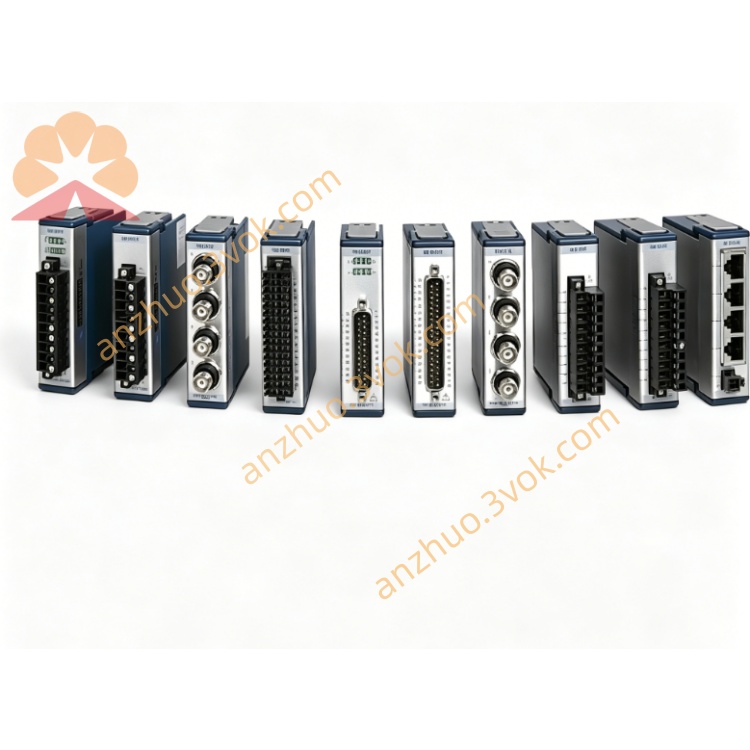
NI PXI‑5922 24‑Bit Flexible‑Resolution PXI Oscilloscope Module
Description
II. Model Interpretation
PXI: Compliant with the PXI bus standard, 3U size, single slot, compatible with PXI/PXIe chassis.
5922: NI's high-precision digital instrument series code, representing Flex II ADC, 24-bit, 6 MHz bandwidth, dual-channel acquisition card.
Component Number: 779153-02 (256 MB / channel), 779153-03 (512 MB / channel) from NI.
III. Technical Parameters (25℃, preheating 10 minutes)
1. Channels and Bandwidth
Number of channels: 2 synchronous sampling
Analog bandwidth: 6 MHz (±0.5 dB)
Input impedance: Software selectable 50 Ω / 1 MΩ from NI
2. Resolution and Sampling Rate (Flex II ADC)
High-precision mode: 24 bits @ ≤ 500 kS/s
High-speed mode: 16 bits @ 15 MS/s
Sampling rate range: 10 S/s to 15 MS/s, software continuously adjustable
3. Input Characteristics
Voltage range: ±5 V (standard), expandable
Coupling mode: AC/DC software selectable
Noise density: -120 dBFS @ 50 kS/s
SFDR: 114 dBc (typical, 100 kHz) from NI
4. Storage and Trigger
On-board memory: 256 MB / channel (standard), 512 MB / channel (optional)
Trigger: Edge, window, pulse, sequence, external trigger; supports PXI trigger bus synchronization
Time base: Internal VCXO, external 10 MHz reference, PXI PLL synchronization
5. Physical and Environmental
Size: 3U, single slot (21.6 cm × 2.0 cm × 13.0 cm)
Operating temperature: 0~55℃; humidity: 10%~90% (no condensation)
Power consumption: Powered by PXI backplane from NI
IV. Interface and Communication Configuration
Front panel (BNC female connector)
CH0/CH1 IN: Analog input, 50 Ω/1 MΩ selectable, AC/DC coupling
TRIG IN/OUT: External trigger input / synchronization output
Indicators: Power, operation, lock, fault from NI
Bus and software
Backplane: PXI mixed bus (PCI, trigger, 10 MHz reference, star trigger)
Driver: NI-5922, supports LabVIEW, TestStand, Python, C#
Synchronization: Multi-module clock / trigger synchronization, supports PXIe system expansion from NI
V. Core Functions
Flex II variable resolution: Seamless switching between 24-bit high-precision (low rate) and 16-bit high-speed (15 MS/s), balancing resolution and bandwidth.
Ultra-high dynamic range: SFDR up to 114 dBc, noise as low as -120 dBFS, suitable for weak signals and large dynamic scenarios from NI.
Dual-channel synchronous sampling: 2 channels sampling simultaneously, high phase synchronization accuracy, meeting differential, comparative measurement requirements.
Flexible input configuration: 50 Ω/1 MΩ impedance, AC/DC coupling, multiple ranges selectable, suitable for sensors, audio, vibration, etc. signals.
Deep storage + stream disk: Maximum 512 MB / channel, supports high-speed data stream disk, suitable for long-term transient recording from NI.
VI. Application Scenarios
Audio and acoustic testing: Microphones, speakers, audio equipment distortion / noise / frequency response measurement from NI.
Vibration and structural analysis: Industrial vibration, modal analysis, impact testing (high-resolution capture of tiny deformations). Precision Voltage and Sensors: Thermocouples, strain bridges, photodiodes, etc. for low-level signal acquisition by NI.
Low-frequency RF and Intermediate Frequency: Signals within 6 MHz IF, IQ acquisition, spectrum analysis (high SFDR to reduce noise) .
Research and Medical: Sonar, ultrasound, bioelectric signals (EEG/ECG), etc. for high-precision measurement by NI.
VII. Installation and Maintenance Instructions
Installation and Power On
Install to a single slot position, with the chassis reliably grounded; preheat for 10 minutes and then perform software self-check.
Keep the air duct unobstructed during operation. The environmental temperature should be ≤ 55℃. Avoid blocking the fan.
For wiring and operation, use 50 Ω BNC cables (50 Ω mode) or high-shielded cables (1 MΩ mode). Avoid wiring in environments with strong interference over long distances.
Input voltage should not exceed ±5 V to prevent front-end overload and damage.
When synchronizing multiple modules, share a 10 MHz reference clock and PXI trigger bus.
Daily Maintenance and Calibration
Perform a traceable calibration once a year to compensate for long-term drift; include built-in self-calibration to correct temperature drift.
Regularly clean the BNC interface. Install a dust cap for long-term inactivity; maintain the environment free of condensation and strong vibrations.
Do not plug or unplug cables while powered on. Interfaces are sensitive to ESD, and perform static protection before operation.
Get a Quote