
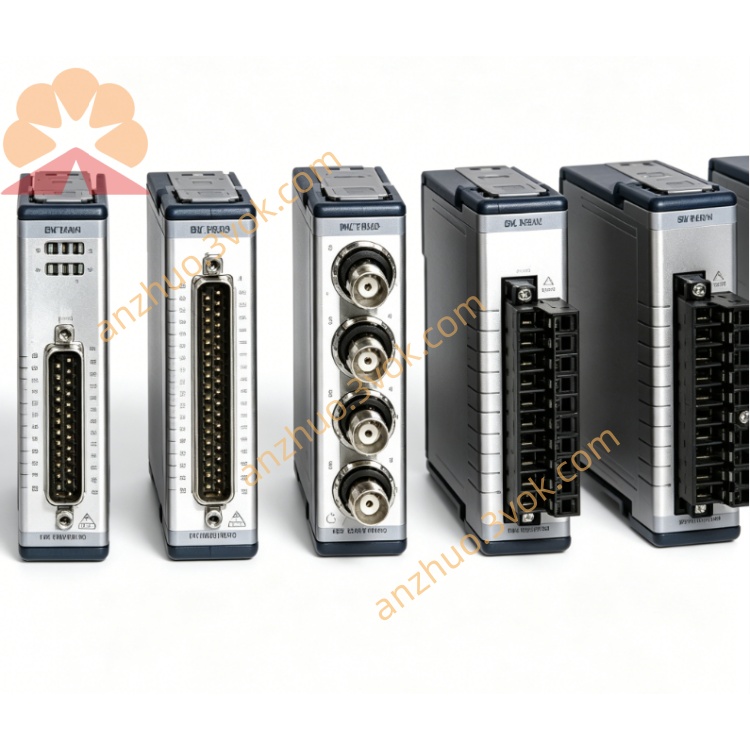
NI PXI‑4132 ±100 V 2‑W Isolated PXI SMU Module
Description
Model Explanation
PXI: 3U PXI standard bus, single slot, compatible with PXI/PXIe mixed chassis.
4132: NI PXI SMU series code, representing four-quadrant, ±100 V, 2 W, pA level accuracy, isolation.
Component Number: 779647-01 (standard version, without auxiliary power supply).
Location: High-voltage high-precision SMU, providing four-quadrant source / suction capability, suitable for high-voltage leakage, weak current, high-resistance testing.
III. Technical Parameters (23 ℃ ± 5 ℃, preheating 30 min)
(1) Channel Configuration
ChannelTypeVoltage RangeCurrent RangePowerIsolation
CH0 (SMU)Quadrant Source / Suction±100 V (2 positions: ±20 V / ±100 V)±100 mA (3 positions: 100 μA / 1 mA / 100 mA)Source 2 W / Suction 2 W±150 VDC (Channel - Ground)
(2) Programmable Control and Measurement Accuracy (18 bits)
Voltage (CH0)
Resolution: ±100 V position 1.2 mV; ±20 V position 0.24 mV.
Accuracy: 0.02% reading + 5 mV (100 V).
Current (CH0, 3 positions)
Resolution: 10 pA (100 μA position) ~ 1 μA (100 mA position).
Accuracy: 75 ppm reading + 10 pA (100 μA position).
Readback Rate: Maximum 1 kS/s (Voltage / Current Synchronization).
4-Wire Remote Sensing: Supports Kelvin measurement, eliminating lead resistance error.
Protection: Integrated external protection, suppressing leakage current to pA level.
(3) Dynamic and Protection
Ripple Noise: ≤ 2 mVpp (20 MHz bandwidth).
Rise Time: ≤ 1 ms (10% to 90%).
Load Regulation Rate: ≤ 0.005% (full load change).
Protection Mechanism: Overvoltage, Overcurrent, Overheat, Reverse Polarity, hardware + software dual protection; High-voltage interlock (optional).
(4) Electrical / Mechanical / Environmental
Power Supply: PXI backplane (+5 V/+12 V), no need for auxiliary power supply.
Power Consumption: Internal approximately 8 W; External full load approximately 12 W.
Connector: Triaxial (three coaxial) terminals (CH0/Guard/Sense/Isolated GND).
Size / Weight: 3U single slot (216×20×130 mm); approximately 350 g.
Safety: IEC 61010-1, CAT I 150 V.
Temperature: Operating 0 ℃~55 ℃; accuracy guaranteed 15 ℃~35 ℃.
Calibration Cycle: 1 year (NIST traceable).
IV. Interface and Communication Configuration
(1) Front-End I/O (Triaxial Three-Coaxial)
CH0 (SMU): ±100 V isolated output.
Sense+ / Sense‑: 4-wire remote sensing end (Kelvin measurement).
Guard: Protection end (suppress surface leakage current).
Isolated GND: Isolated ground (separated from system ground).
Shield: Optional connection to chassis ground.
(2) Status Indicator Lights (Panel)
CH0 Status: Off = Disabled; Green = Constant Voltage (CV); Amber = Constant Current (CC); Red = Fault (Over Temperature / Over Current / High Voltage Interlock).
Remote Sense: Off = Local; Green = Remote Sensing Enabled. Guard: Green = Protection Enabled.
(III) Bus and Software
Bus: Standard PXI, compatible with PXIe, supports PXI Trigger synchronization.
Driver: NI-DCPower (IVI), supports LabVIEW/TestStand/Python/C#.
Configuration: NI MAX (Identification, Self-Check, Parameter Configuration, Calibration, Trigger Settings).
Synchronization: PXI Trigger/PFI, multi-module synchronization delay ≤ 1 μs; up to 17 modules in parallel per chassis.
V. Core Functions
Four-Quadrant Bidirectional Power (CH0): Supply power in I/III quadrants, absorb power in II/IV quadrants, replacing high-voltage power supply + precision load.
pA-level Ultra-High Precision Measurement: Minimum 10 pA resolution, suitable for leakage current, weak current, high-resistance testing.
±150 V Isolated Output: Channels are isolated from the system ground, avoiding ground loops, suitable for floating ground/high-voltage testing.
Integrated Protection (Guarding): Three-coaxial protection design, suppressing external leakage current, improving the stability of weak current measurement.
4-Wire Kelvin Measurement: Eliminates lead resistance errors, essential for precise resistance / high-resistance device testing.
High Voltage High Precision: ±100 V high-voltage output, 0.02% voltage accuracy, suitable for high-voltage device parameter testing.
Board-level Hardware Sequencing: High-speed I-V measurement, supports diodes, OLEDs, transistors for rapid characteristic analysis.
Multi-module Synchronization Parallel: Up to 17 modules can be synchronized in the same chassis, expanding the multi-channel high-voltage SMU testing system.
VI. Application Scenarios
High Voltage Testing for Semiconductor Devices: Breakdown voltage, leakage current, high-resistance testing of MOSFET/IGBT; Reverse leakage current, zener voltage testing of diodes.
Insulation Materials / Dielectric Testing: Ultra-high resistance / leakage testing of PCB, cables, insulating films (pA level).
Optoelectronic Device Testing: Weak current / high-voltage reverse bias testing of photodiodes, photovoltaic cells.
High Resistance Testing of Passive Components: Insulation resistance / leakage current measurement of high-voltage resistors, capacitors, inductors.
High Voltage Testing for Automotive Electronics: Reliability testing of high-voltage sensors, wiring harnesses, insulation components.
ATE Mass Production Testing: High-precision parameter mass testing of high-voltage devices, high-resistance components.
VII. Usage and Maintenance Instructions
(I) Installation and Power On
Installation: Disconnect power, insert PXI single slot, tighten panel screws; ensure good grounding of the chassis.
Preheating: Power on for 30 minutes to ensure pA-level accuracy; NI MAX confirms the equipment is normal and there are no error reports during self-check.
Heat Dissipation: Ensure the chassis fan is normal, environmental temperature ≤ 55 ℃, avoid blocking the ventilation ports.
(II) Wiring and Operation
Three-coaxial Wiring: CH0 must use three-coaxial cable, Guard terminal connects to the device protection ring to suppress leakage current.
Isolated Channel Wiring: CH0 connects to Isolated GND,严禁 mixing with the system ground, to avoid ground loop interference.
4-Wire Remote Sensing: When conducting long-distance or high-resistance testing, be sure to connect Sense+ / Sense‑ to eliminate lead errors.
High Voltage Safety: When outputting ±100 V, strictly isolate to avoid short circuits; high-voltage operation requires wearing insulating gloves.
Guard Protection Enabled: For weak current testing, the Guard protection must be enabled to reduce the influence of surface leakage current.
(III) Maintenance and Calibration
Regular Calibration: Once a year, external NIST traceable calibration; daily internal self-calibration to compensate for temperature drift.
Cleaning and Maintenance: Regularly clean the dust on the three-coaxial terminals, keep dry; when idle for a long time, disconnect power and cover the terminals for protection. Environmental Control: Working environment: 0 ℃ to 55 ℃, no condensation, low humidity (<60% RH), away from strong vibration / strong electromagnetic interference.
Prohibition for Use: Prohibit use with overpressure (>±110 V) / overcurrent (>110 mA); Avoid frequent short-circuit impacts; The isolation channel must not be operated with grounding.
Get a Quote