
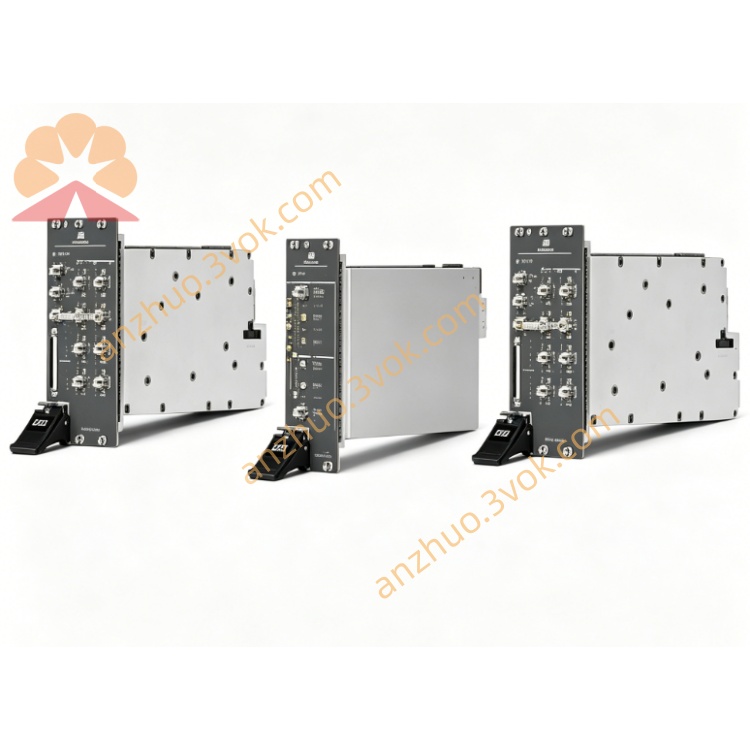
NI PXI‑2549 2.7‑GHz 50‑Ohm Terminated SPDT RF Module
Description
T supports single-channel switching and sequential scanning
Adaptation and expansion
Adaptation cables: SMA-SMA direct connection; optional SMA to BNC/SMB/MCX conversion
Expansion capability: multi-module cascading, forming an N×N matrix or large-scale multiplexer, no external terminal required throughout the process
VII. Core functions
Dual-channel SPDT + built-in terminal: each channel integrates a 50Ω load, open-circuit channels automatically match, completely eliminating reflection risks, protecting the source end and DUTNI.
DC~2.7 GHz wideband coverage: covers Bluetooth, WiFi, ISM, 2G/3G, etc., meeting the needs of consumer electronics, industrial radio frequency and general testing by NI.
Low loss high isolation + excellent VSWR: low insertion loss, high isolation, small standing wave ratio, maximizing signal integrity, reducing test errors by NI.
Relay life management: on-board counter counts the number of channel switches for each path in real time, predicts lifespan, reducing unplanned downtime by NI.
PXI standard integration: single slot 3U size, seamless integration into PXI chassis, supports hardware trigger synchronization, compatible with automated ATE systems.
Latch relay + low power consumption: latch design, no continuous power supply required after switching, low power consumption, low heat generation, high stability.
VI. Application scenarios
High reflection risk RF testing: frequent switching between signal source/spectrum analyzer/network analyzer and DUT to prevent open-circuit reflection from damaging instruments, especially suitable for high-power scenarios by NI.
Consumer electronics RF mass production testing: verification and mass testing of Bluetooth, WiFi, NFC module functions, no need for manual load connection, improving testing efficiency and consistency.
High-channel-count multiplexer construction: multi-module cascading, forming a large-scale SPDT matrix, consistent throughout the path, no external terminal required, suitable for parallel testing of multiple DUTs by NI.
Research and development laboratories and precision measurement: RF link debugging, matching test, multi-scheme comparison, low reflection ensures test accuracy, reducing system errors by NI.
Semiconductor RF chip testing: functional verification, parameter testing, aging screening of medium-low frequency RF ICs, high reliability, long lifespan, suitable for high-frequency switching in mass production.
VII. Usage and maintenance instructions
Usage points
Installation: standard 3U PXI single slot, lock the panel, ensure reliable contact of the backplane; avoid strong vibration and electromagnetic interference.
Connection: SMA connector is lightly inserted and removed, avoid violence; RF power ≤ 10 W (continuous), terminal withstand power ≤ 1.5 W @ 25°C,严禁 operating beyond power limit.
Power-on state: default each COM and NC are connected (normally closed), NO is disconnected; NO/NC has a 50Ω terminal built-in, no external load required by NI.
Software control: use NI-SWITCH or LabVIEW VI to control each SPDT; regularly read relay counters to monitor remaining lifespan by NI.
Environment: 0~55 °C operation, dust-proof, moisture-proof, dew-proof; away from strong electromagnetic interference, ensure good grounding.
Maintenance instructions
Regular inspection: inspect SMA connector for looseness, oxidation or damage every quarter; clean the panel and ventilation ports, maintain good heat dissipation.
Life management: electromechanical relays approximately 1 million times; regularly read onboard counters, plan replacement in advance to avoid downtime by NI.
Fault troubleshooting: first check SMA connection, grounding; use MAX to diagnose switch status; take precautions against static electricity to avoid module damage by NI.
Storage: disconnect power when not in use, cover SMA with a dust cap, dry and dust-proof storage, avoid high temperature, high humidity and strong magnetic fields. Calibration: It is recommended to calibrate once a year to ensure that the insertion loss, isolation, VSWR, etc. meet the specifications; you can contact NI or a third-party calibration institution.
Get a Quote