
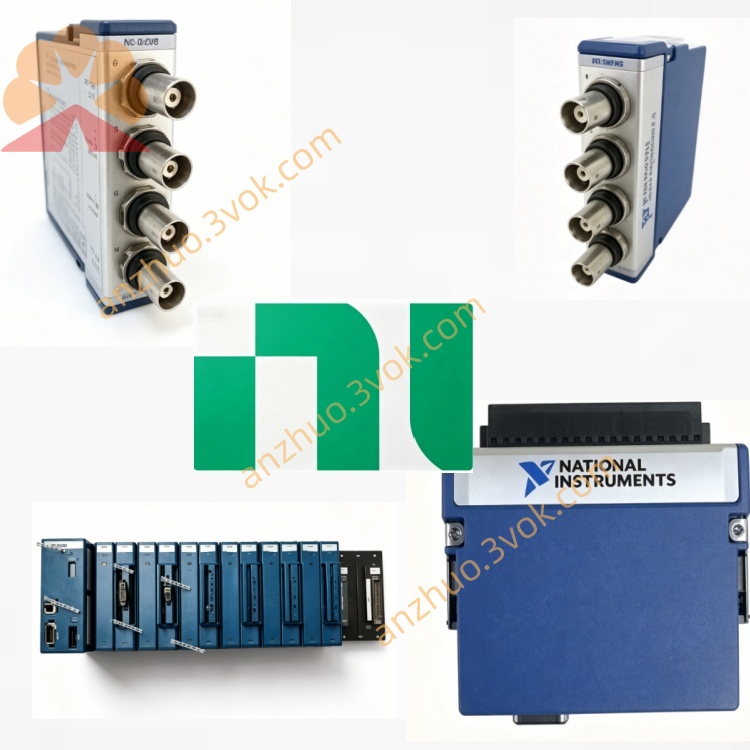
NI PXI‑1042Q 8‑Slot Quiet AC‑Powered PXI Chassis
Description
II. Model Interpretation
PXI: PCI eXtensions for Instrumentation, a PCI expansion bus standard for instruments.
1042: 1000 Series (General PXI chassis), 42 represents 8 slots, high-performance backplane, 300 W power supply.
Q: Quiet, low-noise version (Standard PXI-1042 is the high-heat dissipation version).
Part Number: 778636-02 (Standard AC model).
III. Technical Parameters
Slot Configuration: 8 3U PXI slots (1 controller slot + 7 peripheral slots), including 1 star trigger slot (Slot 2); compatible with CompactPCI PICMG 2.0 R3.0.
Power Supply:
Input: 90–264 VAC, 47–63 Hz (global standard).
Output: 300 W, maximum 25 W cooling capacity per slot.
Voltage: +3.3 V, +5 V, +12 V, −12 V, with overcurrent / overvoltage protection.
Backplane and Synchronization:
32-bit PCI backplane, 132 MB/s system bandwidth, supports DMA and plug-and-play.
10 MHz low-jitter global reference clock (PXI_CLK10), slot-to-slot jitter ≤ 250 ps.
8-channel PXI trigger lines per slot, star trigger, local bus.
Physical Specifications:
Size: 4U (177 mm) × 19-inch rack width.
Weight: Approximately 7.7 kg (without modules).
Environment and Noise:
Operating Temperature: 0–50 °C; Storage: −40–70 °C.
Noise: 43 dBA (AUTO mode, silent); HIGH mode approximately 48 dBA.
Heat Dissipation: 3 fans (2 frame fans + 1 power fan), AUTO/HIGH two-speed, temperature-controlled speed regulation.
IV. Interface and Communication Configuration
PXI Backplane Bus: 32-bit PCI, supports multi-module DMA, plug-and-play, hot-swappable (some modules).
Synchronization and Trigger:
10 MHz global clock, supports external clock input/output (rear board connector).
Star Trigger: Slot 2 as the center, independent trigger lines for each slot, low skew synchronization.
Local Bus: High-speed point-to-point communication between adjacent modules, supports analog/digital signal direct connection.
External Interfaces:
Front Panel: Power switch, status LED (power/fault).
Back Panel: IEC AC power input, grounding terminal, remote power disable/monitor interface, 10 MHz clock I/O.
V. Core Functions
Low-noise Design: 43 dBA silent operation, suitable for environments sensitive to noise such as offices, laboratories, and desktop testing.
8-slot High Expansion: 8 slots, supports multiple modules (such as data acquisition, signal processing, bus interface), balancing compactness and channel count.
Intelligent Heat Dissipation Management: AUTO/HIGH fan mode, temperature-controlled speed regulation, balancing low noise and heat dissipation (25 W per slot).
High Precision Synchronization: 10 MHz low-jitter clock + star trigger, ensuring timing consistency of multiple modules (such as synchronous acquisition, timing control).
Easy Maintenance Architecture: Plug-and-play modular power supply, washable fan filter, remote monitoring, reducing MTTR.
VI. Application Scenarios
Laboratory Precision Measurement: Sensor array acquisition, vibration/noise analysis, multi-channel synchronous testing.
Desktop Automated Testing: Electronic product functional testing, verification experiments, small-scale production line inspection. Research and Teaching: University laboratory platforms, data collection for research projects, course experiment systems.
Light Industrial Monitoring: Equipment status monitoring, small automation systems, low-noise industrial control nodes.
VII. Usage and Maintenance Instructions
Installation:
Rack: 4U standard cabinet, fixed front and rear rails, reserved 100 mm front and rear ventilation space.
Desktop: Install foot pads, place stably; avoid blocking the bottom intake / rear exhaust masks.
Module: Unplug and plug in power, tighten the fixing screws; in high-vibration environments, it is recommended to add locking clips.
Power On and Operation:
Connect 90–264 VAC, turn on the front panel power switch, the LED lights up normally.
Controller (such as PXI-8106) automatically recognizes the module, install NI-MAX and drivers after installation, and it can be used.
Fan Mode: Default AUTO (silent); switch to HIGH to enhance cooling when under heavy load.
Daily Maintenance:
Cleaning: After power off, use a soft-bristled brush / compressed air to clean the fan filter and ventilation port dust, once every quarter.
Environment: Avoid humidity (<60% RH), dust, strong electromagnetic interference; working temperature 0–50 °C.
Static Protection: When plugging in and unplugging the module, wear an anti-static wristband, ensure good grounding, and avoid static damage to the board.
Get a Quote