
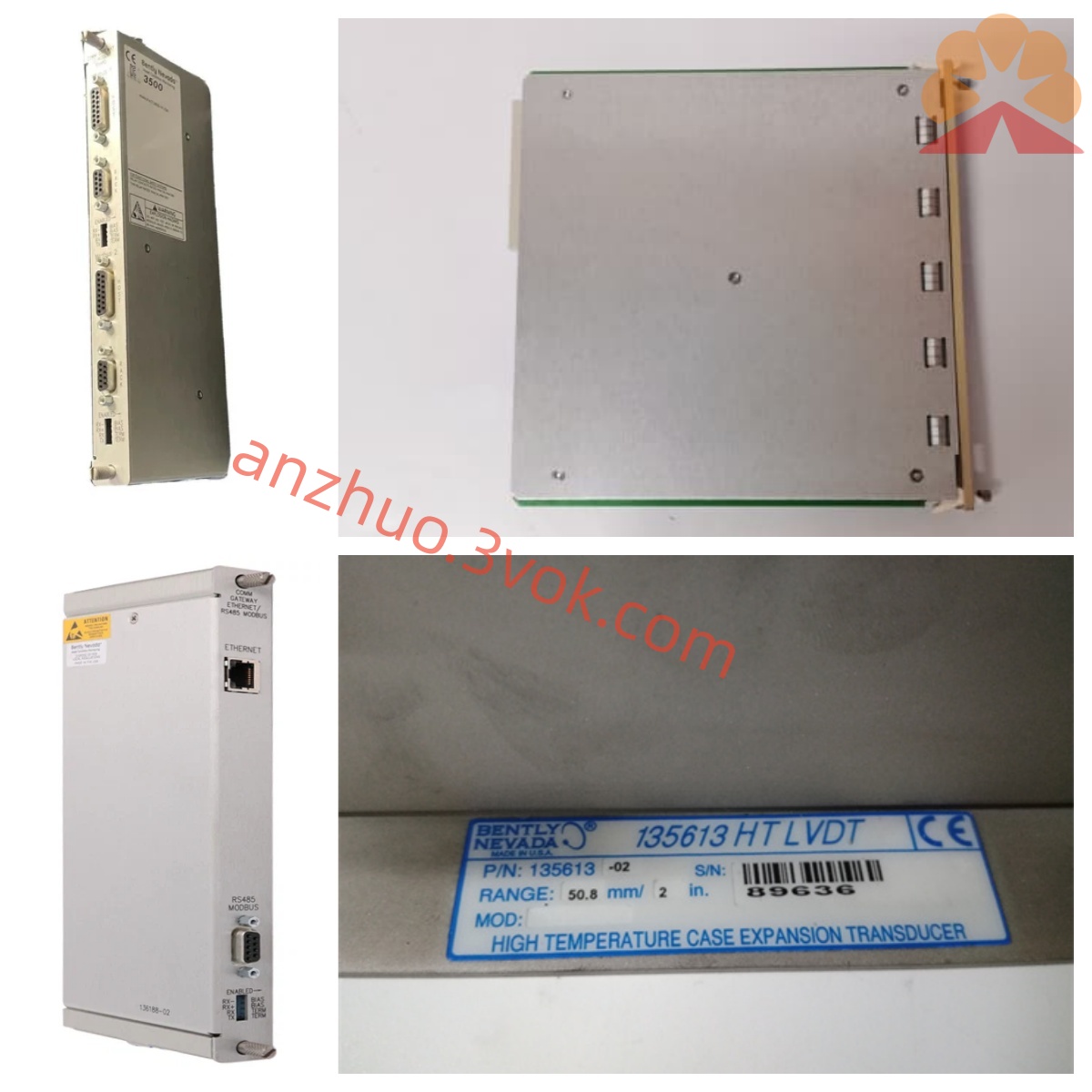
Bently Nevada 330500-03-01 3300 XL Industrial Accelerometer Vibration Sensor
Description
I. Model Explanation (330500-03-01)
330500: Velomitor standard piezoelectric velocity sensor (4.5Hz - 5kHz)
03: Installation thread 1/4 - 28 UNF
01: 1m integrated cable, standard connector, no explosion-proof certification (industrial general type)
II. Core Parameters (Electrical / Mechanical)
Measurement type: Absolute vibration velocity (bearing box / casing)
Sensitivity: 3.94mV/mm/s (100mV/in/s) ±5%
Frequency response range: 4.5Hz - 5kHz (±3dB); or 6Hz - 2.5kHz (±0.9dB)
Range: 0 - 1270mm/s (0 - 50in/s) peak
Power supply: 24V DC (22 - 30V), ≤ 10mA
Output: Voltage signal (directly connected to 3500/42 etc. monitoring module)
Shell: 316L stainless steel, IP67, rainproof and corrosion-resistant
Temperature: -55℃ - +121℃ (operation); -65℃ - +135℃ (storage)
Cable: 1m original cannot be shortened, the longest extension can reach 305m
Installation: 1/4 - 28 UNF thread installation, any angle (horizontal / vertical)
III. Standard Accessories
Sensor: 330500-03-01 (1m cable)
Monitoring module: 3500/42 earthquake monitoring card, 3300/55 dual-speed monitoring card
Extension cable: Optional as needed (up to 305m)
IV. Typical Applications
Rotating machinery: pumps, motors, fans, compressors, gearboxes (rolling bearing equipment)
Conditions: humid, dusty, corrosive environment (no additional protective shell required)
General vibration monitoring in non-explosion-proof areas, replacing eddy current probes (unable to measure shaft vibration when applicable)
V. Installation Tips
Installation surface: flat, clean, without rust, ensure rigid connection (avoid soft base).
Direction: install at any angle, sensitive axis in the same direction as vibration.
Cable: cannot be shortened, avoid bending, crushing; away from power lines, single-ended grounding.
Grounding: sensor shell floating, shielding layer single-ended grounded on the monitoring module side.
Tightening: thread installation torque 8 - 10Nm, reliable anti-loosening.
VI. Maintenance and Fault Diagnosis Maintenance
Regularly inspect the cable outer skin and connectors for any damage or loosening.
Clean the sensor surface, ensuring no oil stains or corrosion.
Annual calibration of sensitivity and frequency response is required to ensure accuracy.
Common faults
No signal: abnormal power supply, broken cable, loose connector, module channel failure.
Weak signal / drift: loose installation, insufficient base rigidity, high temperature, long cable.
Noise interference: poor grounding, electromagnetic interference, mixed movement of cable and power line.
VII. Precautions
Do not plug or unplug the sensor or cable while powered on.
Avoid severe impacts and drops, as the internal piezoelectric elements are easily damaged.
Not suitable for explosion-proof areas (select models with ATEX/CSA certification).
Get a Quote