
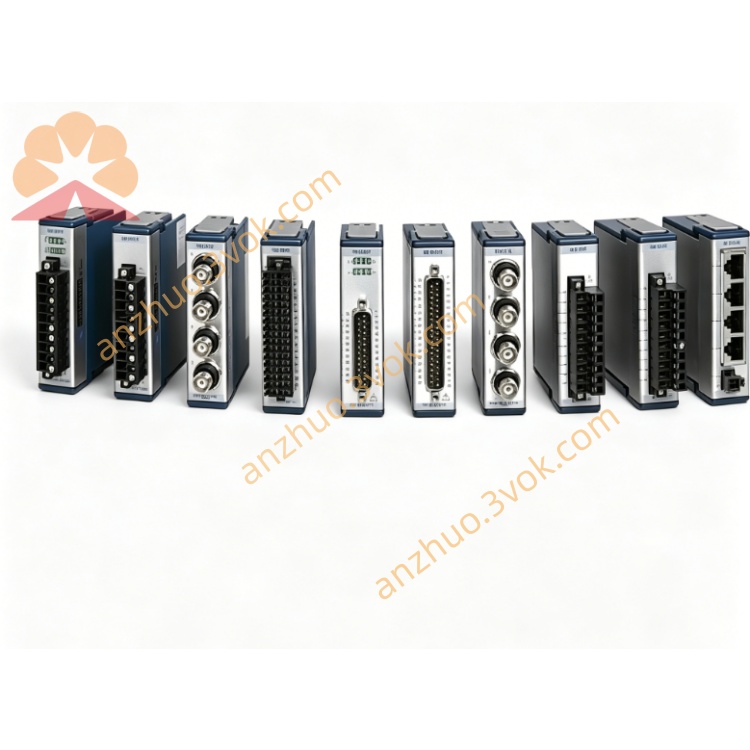
NI PCI‑8517 Dual‑Port FlexRay PCI‑Bus Interface Card
Description
I. Basic Information
Model: PCI‑8517/2 (fixed 2 ports, no 1-port version)
Part Number: 780685‑02
Bus: 32-bit PCI / PCI‑X (33 MHz, 5 V), does not support native PCIe
Ports: 2 × Full-function FlexRay, DB‑9 female connector
Protocol: FlexRay 2.1 (A/B frames, static/dynamic segments, fault-tolerant)
Status: In stock (not discontinued); PCIe version: PCIe‑8517
II. Core Specifications (Easy to Understand)
1) FlexRay Communication
Channels: 2 independent FlexRay channels, dual bus redundancy / parallel
Rate: 1–10 Mbps programmable (typical 10 Mbps)
Transceivers: NXP TJA1080 (FlexRay physical layer), NI
Topology: Bus type, star type, multi-node (up to 64 nodes)
Fault Tolerance: Dual-channel redundancy, node fault isolation, timing tolerance
Terminals: Software-configurable 120 Ω terminal resistor per channel
2) Hardware and Performance
Transmission: DMA engine, zero-copy, low latency (<1 μs)
On-board Memory: 256 MB, cache for massive FlexRay frames / signals
Synchronization: RTSI bus + front panel trigger, nanosecond-level synchronization across multiple cards / chassis
Connectors: DB-9 (FlexRay standard pins: CH1/CH2, GND, VCC)
Board Type: Full-height half-length PCI card
Power Supply: PCI +5 V / +3.3 V power supply, NI
+5 V: 210 mANI
+3.3 V: 940 mANI
Temperature: 0 °C ~ 55 °C (operating)
Size: 10.67 × 16.76 cm, NI
Weight: 102 g, NI
III. Key Features of PCI-8517 (Compared to CAN)
✅ Higher Bandwidth: FlexRay 10 Mbps vs CAN 1 Mbps
✅ Hard Real-time: Deterministic timing, microsecond-level synchronization, fault tolerance
✅ Dual-channel Redundancy: Dual bus parallel, automatic fault switching
✅ More Nodes: Single bus up to 64 nodes vs CAN 32 nodes
✅ Preferred for High-End Automotive: Chassis, steering, braking, power system bus
IV. System Compatibility (Drivers + OS)
Driver: NI-XNET (required), supports FIBEX, ARXML, FlexRay database
System:
✅ Windows 7/10/11 (32/64) ✅ LabVIEW Real‑Time
✅ Linux (NI-XNET support)
Software: LabVIEW, NI-XNET API, Python/C#/C++, Vehicle Network Toolbox
V. Typical Applications (Core Scenarios in Automotive FlexRay)
ECU Testing in Vehicles: Communication between chassis / powertrain / steering ECU, UDS diagnosis, flashing
HIL Hardware-in-the-Loop: Real-time simulation of FlexRay bus nodes, high throughput and low latency
Bus Monitoring / Recorder: Long-term packet capture, fault playback, timing analysis
Dual-Bus Redundancy: Safety-critical systems (such as autonomous driving, line control steering)
Multi-Node Network: 1 host with 64 slaves, complex automotive network VI. Common Questions
❌ The PCIe slot is not usable: It must be the old-fashioned PCI/PCI-X; PCIe should be selected as PCIe-8517
⚠️ DB-9 pins: CH1 = 1/2, CH2 = 4/5, GND = 3/6, VCC = 9 (connect according to the standard wiring)
⚠️ Terminal resistors: The start and end of the bus are connected with 120 Ω to reduce signal reflection
⚠️ FlexRay rate: 10 Mbps is the standard, and it is affected by the total bus length / number of nodes
VII. Alternative / Upgrade Models
PCIe-8517: PCIe ×1, 2-port FlexRay, 10 Mbps, native support for Windows 10/11
PXI-8517: PXI bus version, suitable for PXI chassis integration
Get a Quote