
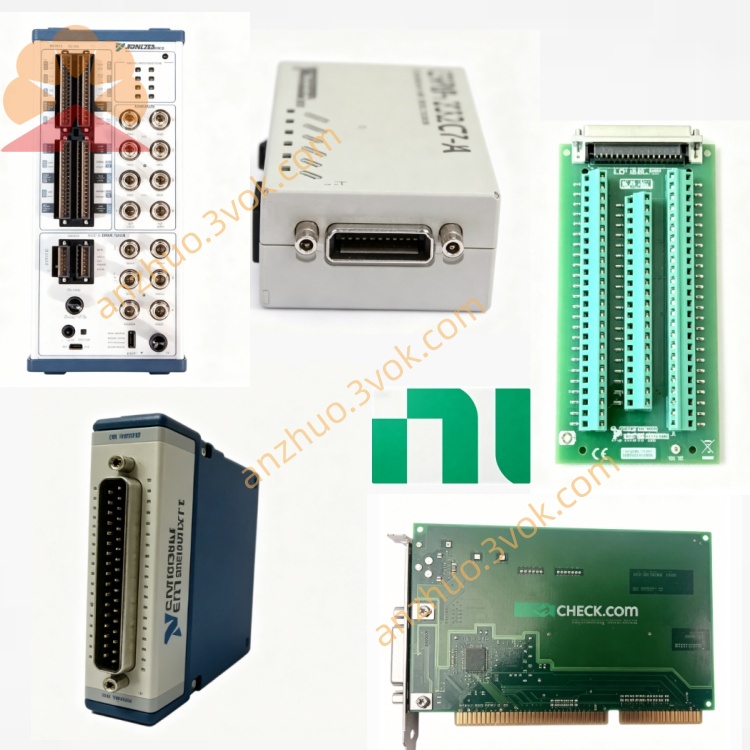
NI PCI‑6703 16‑Bit 16‑Channel Static PCI Voltage‑Output Board
Description
Model: PCI‑6703
Part Number: 778316‑01 / 183689G‑02
Brand: National Instruments (NI)
Type: 16-bit, 16-channel static analog voltage output card + 8-channel DIO
Bus: Standard PCI (5 V, half-length card)
Connector: 1 × 68-pin SCSI (female)
Driver: NI‑DAQmx
Status: Out of Production (EOL), recommended replacement: PCIe‑6738
Core Overview
PCI‑6703 is a software-timed (static) analog voltage output card that provides 16 channels of 16-bit voltage output (±10 V) + 8 channels of 5 V TTL/CMOS digital I/O. All channels are multiplexed by a single DAC, each channel has sampling hold (S/H), suitable for slow, high-precision, stable voltage control scenarios such as calibration sources, setpoint control, DAC simulation, relay / valve control.
Main Specifications
Analog Output (AO)
Channels: 16 single-ended voltage outputs
Resolution: 16 bits
Output Range: ±10 V (default)
Accuracy: ±0.001% of full scale
Stability Time: Typical 14.4 ms, Maximum 48.8 ms
Temperature Coefficient: 5 μV/°C (Offset), 1 ppm/°C (Gain)
Update Mode: Software Timing (Static)
Scan Period: 50 μs per channel × 18 channels = 0.9 ms
Digital I/O (DIO)
Channels: 8 bidirectional, 5 V TTL/CMOS
Input: Low ≤ 0.8 V; High ≥ 2.0 V
Output: Low ≤ 0.55 V @ 16 mA; High ≥ 2.4 V @ 16 mA
Power-On State: Input High-Z Power supply
+5 V @ 1.5 A
±12 V @ 70 mA (for analog circuits)
Operating temperature: 0 ~ 55 °C
Features: User-defined power-on state, short-circuit protection, S/H holding accuracy Typical application
Instrument calibration source (voltage reference, sensor calibration)
Industrial process setpoint control (valves, heating, pressure)
Slow and precise voltage output (no high-speed waveform requirements)
Relay / contactor drive, analog load
ATE static testing, DAC simulation, closed-loop control
PCI‑6703 User Manual (Chinese version - simplified operation)
1. Hardware Installation
Power off: Turn off the PC and unplug the power cord.
Insert card: Insert PCI‑6703 into the 5 V PCI slot and tighten the retaining screw.
Wiring:
Use SH68‑68‑D1/E1 shielded cable to connect to the 68-pin SCSI port
AO: AO0–AO15 (±10 V, single-ended)
DIO: D0–D7 (bidirectional 5 V TTL)
Power / Ground: +5 V, ±12 V, GND (connector auxiliary power supply)
2. Driver and Software Installation
Install NI‑DAQmx (required, supports Win7/10/11)
Open NI MAX:
Devices and Interfaces → Find PCI‑6703
Right-click self-check, display "Passed" for normal operation
Development Environment: LabVIEW, C/C++, Python, VB (DAQmx API)
3. Analog Output Configuration (DAQmx)
Mode: Static voltage output (software timing)
Range: Fixed ±10 V
Update: Software write value, hardware S/H maintained
Power-on state: Can be set to 0 V, ±10 V or open circuit
Load: Each channel ≥ 1 kΩ (avoid voltage drop)
Protection: Output short circuit automatically limits current
4. Digital I/O Operations
Direction: Set input/output by byte
Read/write: Static read/write (no handshake)
Power-on: Default input is open circuit, prevent false triggering
5. Key Considerations
Non-high-speed card: No hardware clock, no waveform generation; suitable for slow, stable voltage
Load resistance: ≥ 1 kΩ; otherwise, accuracy decreases
Common ground: Load and card are connected to common ground, reduces noise
Channel crosstalk: Low in slow mode; shielded lines required for high-speed switching
Out of production: New design recommends using PCIe‑6738 (32 channels, 1 MS/s)
6. Common Problems
Output not accurate: Check load ≥ 1 kΩ, common ground, calibration
Channel drift: Preheat for 30 minutes, stable environmental temperature
Cannot find device: Switch to 5 V PCI slot, reinstall DAQmx, refresh MAX
Get a Quote