
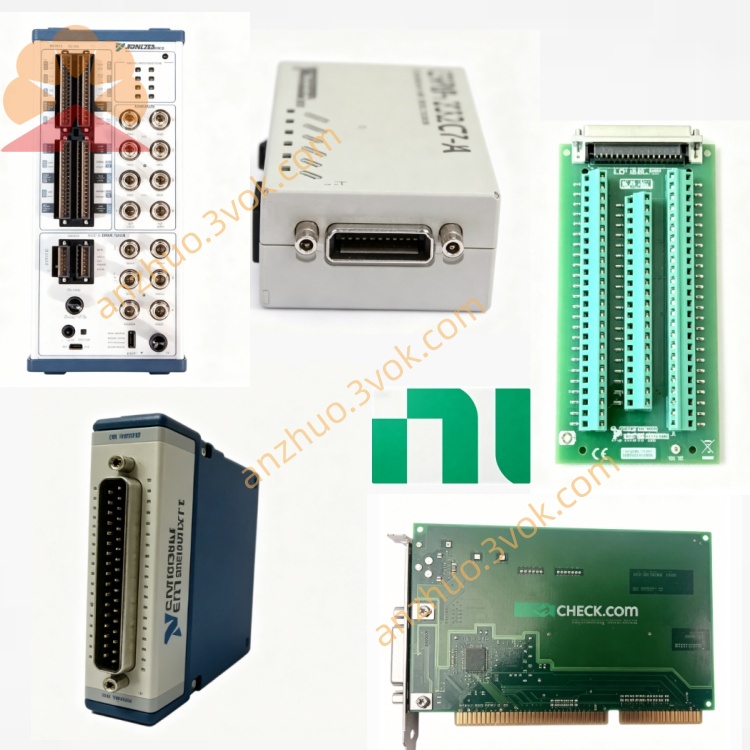
NI PCI‑6601 4‑Channel Counter‑Timer PCI‑Bus Board
Description
PCI-6601 (4-channel 32-bit counter/timer, 5 V TTL/CM
Core Summary
The PCI-6601 is a low-cost, industrial-grade 5 V PCI counter/timer card that integrates 4 32-bit add/subtract counters + 32 bidirectional static digital I/O, with anti-jitter filtering, pre-doubling, DMA, designed specifically for event counting, encoder position, frequency/period/pulse width measurement, and pulse/pulse train generation. It is suitable for industrial automation, motion control, sensor monitoring, and ATE.
Main Specifications
Counter Channels: 4 (32-bit, add/subtract) NI
DIO Channels: 32 bidirectional, 5 V TTL/CMOS NI
Counter Clock: Internal 100 kHz, 20 MHz; External up to 20 MHz
Pre-Division: Each channel selectable ×2 / ×8 (up to 60 MHz expansion)
Maximum Count Value: 2³² - 1 = 4,294,967,295 NI
DIO Levels (TTL/CMOS)
Input Low: ≤ 0.8 V; Input High: ≥ 2.0 V
Output Low: ≤ 0.4 V (sourcing 24 mA); Output High: ≥ 2.4 V (pulling 24 mA)
Connector: 68-pin SCSI (compatible with SCB-68, TB-2715)
Power Supply: +5 V @ 0.4–0.75 ANI
Operating Temperature: 0 ~ 55 °C
Features: Anti-jitter, Schmitt trigger, 1 DMA channel, power-on high-impedance weak pull-down NI Typical application
Encoder position/velocity measurement (motor, conveyor belt)
Event counting, flow / output / pulse accumulation
Frequency, period, pulse width, duty cycle measurement
Pulse / square wave / sequence generation (trigger, synchronization, control)
Industrial I/O monitoring, relay driving, sensor interface
II. User Instructions (Chinese Version - Simplified)
1. Hardware Installation
Power off: Shut down the PC and unplug the power cord.
Insert card: Insert the PCI-6601 into the 5 V PCI slot and tighten the retaining screw.
Wiring:
Use SH68-68-D1/E1 cable to connect the 68-pin SCSI port
Counter signals: CI0–CI3 (input), CO0–CO3 (output)
DIO: D0–D31 (bidirectional)
Power / ground: +5 V, GND (connector power supply ≤ 1 A)
2. Driver and Software Installation
Install NI-DAQmx (required).
Open NI MAX: Devices and Interfaces → Find PCI-6601 → Right-click self-check, display "OK" indicates normal.
Development environment: LabVIEW, C/C++, Python, VB (DAQmx API).
3. Common Configuration of Counter (DAQmx)
Mode selection: Event counting, frequency, period, pulse width, encoder (A/B/Z), pulse generation.
Clock source: Internal 20 MHz (default), 100 kHz, or external CIx.
Pre-scaling: ×2 / ×8 (reduce frequency input to prevent overflow)
Demodulation: Software setting (filter out spikes).
Count direction: Add / Subtract (encoder A/B automatically determine direction).
4. Digital I/O Operations
Direction: Set input/output for each port (8 bits).
Read/write: Static read/write (no handshake), suitable for low-speed control.
Power-on state: Input high impedance, weak pull-down (to avoid false triggering) NI
5. Key Considerations
Level matching: Only supports 5 V TTL/CMOS, cannot connect ±12 V/24 V.
Common ground: Equipment and the measured object share the ground, reduces noise.
Overload protection: Output ≤ 24 mA / channel, avoid short circuit.
High-frequency signal: > 1 MHz use shielded line, length ≤ 2 m.
Pre-scaling: Input > 20 MHz must use ×8 pre-scaling.
6. Common Problems
Cannot find device: Change 5 V PCI slot, reinstall DAQmx, refresh MAX.
Counting inaccurate: Check common ground, demodulation, pre-scaling, signal level.
Output abnormal: Confirm direction configuration, load current, short circuit. Table
Project PCI‑6601 PCI‑6602
Counter 4 channels 8 channels
Highest clock 20 MHz (60 MHz pre-divided) 80 MHz (125 MHz pre-divided)
DIO 32 channels 32 channels
Power consumption 0.4–0.75 A 0.5–1.5 A
Price Lower Higher
ApplicableBasic counting, low-speed pulseMulti-channel, high-frequency, precise timing
OS DI
Get a Quote