
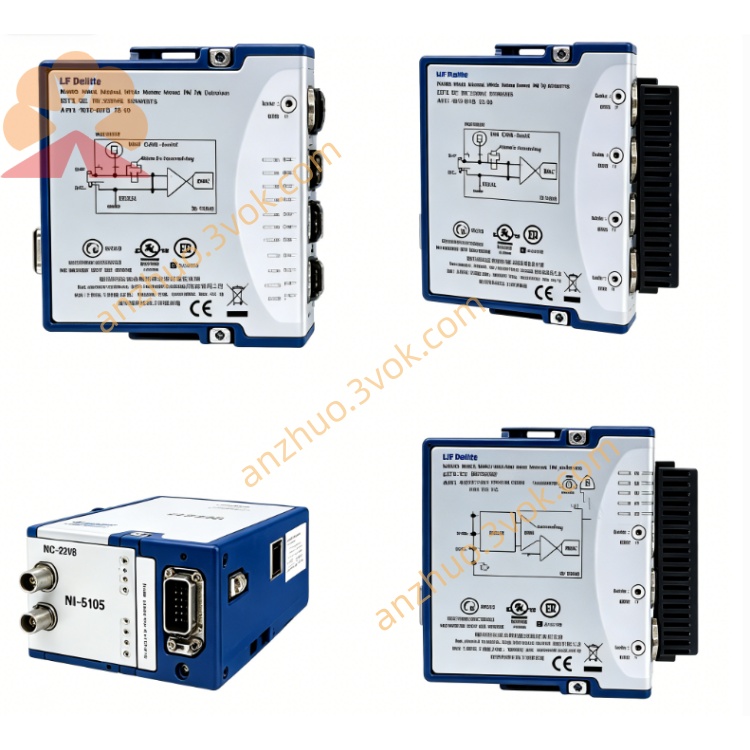
NI PCI‑6221 Multifunction M‑Series DAQ Board
Description
PCI‑6221 | Product Introduction
The NI PCI‑6221 is a low-cost multi-functional DAQ card in the M series of National Instruments (NI), featuring analog output. It is a PCI bus-based full-length card, with a focus on 16 channels of AI (16 bit/250 kS/s) + 2 channels of AO + 24 channels of DIO + 2 channels of counters. It is an enhanced version of PCI‑6220 for AO, suitable for laboratory automation, R&D verification, and closed-loop control in production testing, etc., in medium-low speed and cost-sensitive scenarios.
Part Number: 779066‑01; Out of Production (EOL), replacement model PCIe‑6321NI.
I. Basic Information
Model: PCI‑6221
Brand: National Instruments (NI)
Series: M-Series (low-cost, multi-functional, with AO)
Bus: PCI (3.3 V / 5 V compatible, full-length card)
Connector: 68-pin VHDCI
Driver: NI-DAQmx
Operating Temperature: 0 ~ 55 °C
Size: 9.7 × 15.5 cm
II. Analog Input AI (16 channels)
Channels: 16 single-ended / 8 differential (software configurable)
Resolution: 16 bits, no bit loss guarantee
Maximum Sampling Rate: 250 kS/s (single / total of multiple channels)
Input Range (software selectable): ±0.2 V, ±1 V, ±5 V, ±10 V
Coupling: DC
Input Impedance: >10 GΩ || 100 pF
Maximum Working Voltage: ±11 V (signal + common mode)
CMRR: 92 dB @ DC~60 Hz
Input FIFO: 4,095 samples
III. Analog Output AO (2 channels)
Channels: 2 voltage outputs
Resolution: 16 bits
Maximum Update Rate: 250 kS/s (per channel)
Output Range (software selectable): ±5 V, ±10 V
Drive Capacity: ±5 mA (per channel)
Setup Time: 10 µs (to ±0.5 LSB)
Load: Minimum 1 kΩ
IV. Digital I/O (DIO)
Channels: 24 bidirectional TTL (PFI 0~23)
Level: 5 V TTL/CMOS
Maximum Rate: 10 MHz
Functions: bidirectional input/output, event triggering, handshake signal
V. Counter / Timer
Channels: 2 32-bit general-purpose counters
Clock: 20 MHz internal base
Functions: event counting, frequency / period measurement, pulse output, encoder, PWMNI
VI. Trigger and Synchronization
Trigger: AI analog trigger, PFI external digital trigger
Synchronization: RTSI multi-card synchronization
Data Transfer: DMA, interrupt, programmable I/O
VII. Installation and Usage Tips (Core of the Manual) Installation
Power off and disconnect the power supply. Insert into the standard PCI slot and secure the retaining screws.
After powering on, the device will be identified and self-tested in MAX (Measurement & Automation Explorer).
Wiring (68-pin VHDCI)
AI: Single-ended connect to AIn + GND; differential connect to AI+ / AI−, common-mode voltage ≤ ±11 V.
AO: AO output + AGND, load ≥ 1 kΩ, avoid short circuit.
DIO: TTL level, common ground, avoid long-distance parallel lines.
Software configuration (NI-DAQmx)
Sampling mode: Asynchronous scan (non-synchronous).
Range: AI selects ±0.2 / ±1 / ±5 / ±10 V; AO selects ±5 / ±10 V.
Trigger: Commonly used edge trigger (rising / falling). Notes for Attention
The analog input must not exceed ±11 V, and the analog output must not be short-circuited; otherwise, the front-end will be damaged.
There is no isolation, and it is not suitable for strong interference/high-voltage environments. It requires a SCC/SCXI signal conditioner.
VIII. Core Features
16 channels of 16-bit AI + 2 channels of 16-bit AO + 24 DIO + 2 counters, integrated acquisition + control
Low cost, PCI bus, plug-and-play, stable NI-DAQmx driver
Channels can be configured as single-ended/differential, AO can be selected as ±5/±10 V, suitable for most sensors and actuators
Applications: Laboratory acquisition and control, research and development verification, production test loop, small-scale automation
Get a Quote