
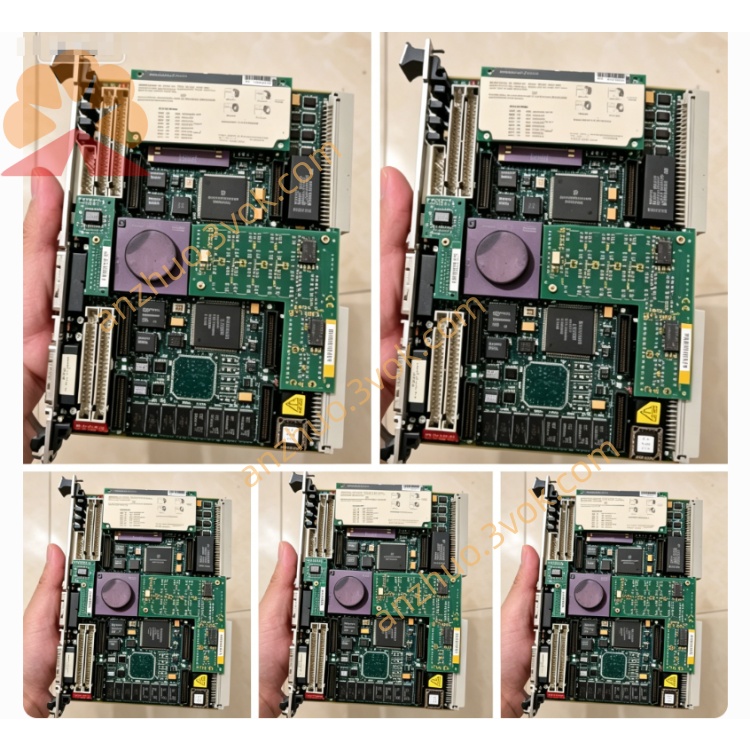
MVME162-220 Motorola 6U Single Height VMEbus Embedded Single Board Computer CPU Module
Description
I. Basic Information
Model: MVME162-220
Brand: Motorola / Emerson (now Schneider)
Form: 6U dual high VME64 SBC
CPU: MC68040 @ 25 MHz (✅ with FPU floating-point coprocessor, MMU, 8KB Cache)
Key Features: 4MB DRAM, 128KB SRAM, 1MB Flash, 2×IP, 4×Serial Port, ✅SCSI, ✅10Mbps Ethernet, ✅Hardware FPU
II. Hardware Specifications (Key Point: 68040 with FPU)
1) Processor (220's main difference: hardware floating point)
MC68040, 25 MHz
✅ Built-in FPU floating point coprocessor (supports high-precision floating point operations)
✅ MMU + 8KB instruction/data cache
210/212/213/216 are LC040 without FPU; 211 is 040 with FPU (but 211 has no network port)
2) Memory (Same as 213/210/211)
DRAM: 4 MB (parity check)
SRAM: 128 KB (battery backup)
Flash: 1 MB
NVRAM/RTC: 8 KB + real-time clock (battery backup)
3) I/O Interfaces (Same as 213: network port + SCSI dual controller)
VMEbus: VME64 A32/D32, master / slave, DMA
Ethernet: ✅ 10 Mbps (AUI/BNC) + DMA
Serial Port: 4×RS-232 (Console + 3 configurable)
SCSI: ✅ Narrow SCSI 50-pin + DMA
IP Slot: 2×IndustryPack
Parallel Port: None
4) Electrical / Environmental
Power Supply: +5 V @ 3.5 A
Operating Temperature: 0 ℃ ~ +70 ℃
Size: 233 × 160 mm
III. Ultimate Comparison of 210/211/212/213/216/220 (At a Glance) Table
Model CPU FPU DRAM SRAM SCSI Ethernet IP Slot Position 210 LC040 ❌ 4MB 128KB ✅ ❌ 2 4MB+SCSI
211 040 ✅ 4MB 128KB ✅ ❌ 2 4MB + Floating Point + SCSI (without network port)
212 LC040 ❌ 4MB 128KB ❌ ✅ 2 4MB + Network port
213 LC040 ❌ 4MB 128KB ✅ ✅ 2 4MB + Network + SCSI (mainstream)
216 LC040 ❌ 8MB 512KB ✅ ✅ 2 8MB + Network + SCSI (high-end memory configuration)
220 040 ✅ 4MB 128KB ✅ ✅ 2 4MB + Network + SCSI + Floating Point (top-end computing)
Four, Core Features of 220
Unique "Network + SCSI + FPU" integration: Models in the 200 series that simultaneously feature Ethernet, SCSI hard drives, and hardware floating-point capabilities, without the need for trade-offs
Strong computing power of hardware floating-point: 68040 + FPU, supporting 32/64-bit floating-point operations, suitable for PID control, signal processing, motion control, and simulation algorithms
Comprehensive interface compatibility: The same as 213 interface definition, can be directly replaced with 213, and software only needs to enable floating-point support, the old system upgrade is the first choice
Five, Typical Applications
Floating-point-intensive control: Motion control, robots, industrial automation (requires high-precision PID / trajectory calculation)
Signal processing / data acquisition: Vibration analysis, spectrum analysis, sensor data floating-point operations
213/211 Upgrade: The original 213 requires floating-point, or the original 211 requires network port, directly replace with 220
High-end configuration of VxWorks real-time system: Multi-tasking + floating-point algorithms + networking + local storage, one-stop complex control
Get a Quote