
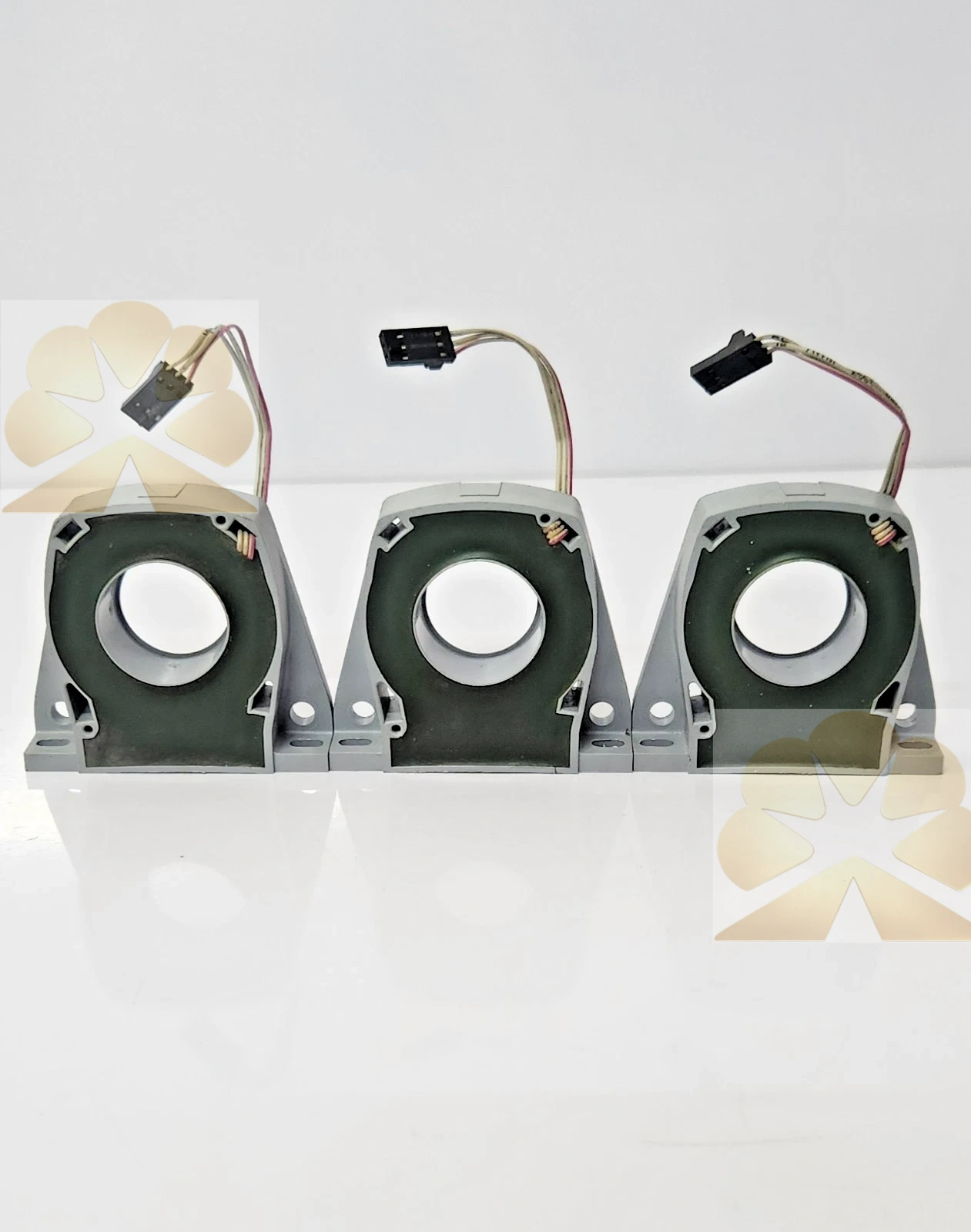
HONEYWELL CSNS300F-002: CSNS Series Closed-Loop Hall Effect Current Sensor Product Description
Description
HONEYWELL CSNS300F-002: CSNS Series Closed-Loop Hall Effect Current Sensor Product Description
Brand and Product Identification
The HONEYWELL CSNS300F-002 is a closed-loop bidirectional current sensor from Honeywell’s CSNS series of industrial current sensing products, manufactured under the Honeywell Microswitch division. The CSNS prefix identifies the closed-loop zero-flux current sensor family, 300 denotes the 300 A nominal rated current, F specifies the flying lead with Molex connector wiring variant, and -002 indicates the specific configuration revision. Designed for high-accuracy AC and DC current measurement in power electronics and industrial control systems, the sensor delivers galvanic isolation between the primary power circuit and secondary sensing electronics.
Product Function and System Role
The CSNS300F-002 measures current flowing through a primary conductor passing through its aperture, and outputs a proportional secondary current signal that mirrors the primary waveform scaled by the turns ratio. Based on the closed-loop zero-flux Hall effect principle, it maintains zero magnetic flux in the core at all times, delivering highly accurate, linear measurement with fast response. The sensor converts high-level primary currents into a low-level secondary current signal suitable for input to control circuits, protection relays, power monitors and PLC analog inputs. It is a dedicated current sensing device, not a standard metering current transformer, power supply, contactor or circuit breaker.
Electrical and Performance Specifications
Nominal rated primary current is 300 A RMS, with a bidirectional measuring range of 0 to ±600 A covering both DC and AC waveforms up to 150 kHz. Turns ratio is 1:2000, producing a nominal output current of 150 mA at 300 A primary current. Accuracy is ±0.5 % of rated current at 25 °C, with linearity better than ±0.1 % full scale. Supply voltage ranges from ±12 V DC to ±18 V DC (±5 % tolerance), with typical quiescent current consumption of 10 mA plus the output current. Galvanic isolation between primary and secondary circuits is rated at 6 kV RMS / 50 Hz for 1 minute. Response time is less than 500 ns, enabling capture of fast transient current events and high-frequency switching waveforms. Zero offset current is less than ±0.2 mA at 25 °C, with thermal offset drift below ±0.4 mA across 0 °C to 70 °C. The output can be converted to a voltage signal by connecting an external measuring resistor across the secondary terminals.
Operating Principle and Core Features
The sensor operates on the closed-loop zero-flux (null balance) principle. A Hall effect element detects residual magnetic flux in the core, and a feedback amplifier drives a secondary winding current to cancel the flux generated by the primary conductor. This method eliminates core saturation effects, provides excellent linearity and low offset drift, and supports accurate measurement of DC, AC and impulse currents. Key performance benefits include bidirectional sensing capability, wide bandwidth, high immunity to external magnetic interference and stable performance across the full operating temperature range.
Mechanical Construction and Mounting
The sensor features a compact chassis-mount housing made of insulated thermoplastic, with a circular central aperture for primary conductor pass-through. The CSNS300F variant is supplied with flying lead wiring terminated in a Molex connector for flexible field wiring and quick connection to control circuits. Mounting is achieved via two flanged mounting holes with hardware, suitable for panel or chassis installation inside power electronics enclosures. Operating ambient temperature ranges from -40 °C to +85 °C, and storage temperature ranges from -40 °C to +90 °C. Net weight is approximately 70 grams. The device is intended for installation inside enclosed control cabinets and power assemblies.
Standards and Compliance
The CSNS300F-002 is RoHS compliant for environmental compatibility. It is designed and tested to meet industrial EMC and electrical safety requirements for power electronics and industrial automation applications, with the 6 kV isolation rating supporting use in typical low-voltage industrial power distribution systems.
Typical Application Scenarios
Typical applications include variable frequency drives, servo drives, UPS systems, welding equipment, battery management systems, DC power supplies, inverter and converter current monitoring, motor control overcurrent protection, power quality monitoring and renewable energy power conditioning. The sensor is widely used in industrial automation, renewable energy, material handling, machine tools and power electronics where accurate, fast, isolated current measurement is required for control and protection functions.
Installation and Commissioning Notes
Installation shall follow the Honeywell CSNS series datasheet, local electrical codes and power electronics wiring best practices. Mount the sensor securely on the chassis or panel, route the primary conductor through the central aperture with correct polarity for bidirectional measurement, and connect the ±DC supply, output signal and ground terminals via the flying lead connector. Select and size the external measuring resistor according to the desired voltage output and burden requirements. Verify supply voltage polarity, output signal scaling, offset null and isolation clearances before energizing the primary circuit. Avoid placing the sensor near strong external magnetic fields that could degrade measurement accuracy.
Advantages and Selection Notes
The CSNS300F-002 offers closed-loop zero-flux Hall effect sensing, ±600 A bidirectional measurement range, ±0.5 % accuracy, sub-500 ns fast response, 6 kV galvanic isolation, bandwidth up to 150 kHz, flying lead with Molex connector, compact chassis-mount form factor and stable performance across -40 °C to +85 °C. When selecting a replacement, confirm nominal current rating, measuring range, output type, supply voltage, connection style, aperture size and isolation rating. The CSNS series includes 100 A, 200 A and 300 A variants with different mechanical configurations; verify the exact part number to match the existing installation. The CSNS300F-002 is a closed-loop current sensor, not an open-loop sensor, current transformer, voltage transducer or protection relay; its role is to provide isolated, proportional current measurement for industrial power electronics and control systems.
Get a Quote