
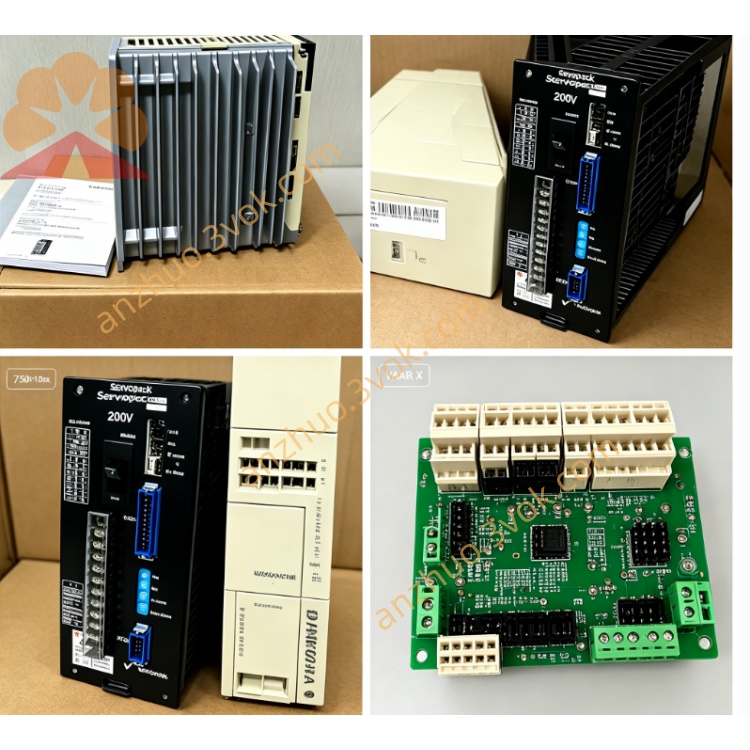
JANCD-GIO02B
Description
The board card has a semi-long industrial standard card shape, with gold finger interface. It is powered by the backplane DC5V, and the external I/O circuit is powered by an independent DC24V. The input and output points are 64 inputs / 64 outputs. The input is compatible with NPN/PNP sensor signals, with a rated DC24V, and the input current is approximately 10mA per point; the output is a transistor collector open circuit, with a maximum of 0.5A/DC24V per point. It is suitable for driving relays, solenoid valves, indicator lights, etc. Inductive loads must be externally connected with a shunt diode.
The interface configuration includes input connectors CN1 to CN4, output connectors CN5 to CN8, 24V common terminal and ground terminal. The front of the board card has PWR, RUN, and ALM indicator lights, which respectively display normal power supply, operation, and abnormal alarm status. The design is optically isolated, with an isolation voltage of AC1500V/1 minute, and the anti-interference meets the requirements of industrial machine EMC.
Environmental specifications: working temperature 0 to 55℃, storage temperature -25 to +85℃, humidity 30% to 95% RH without condensation, pollution grade 1, no corrosive or explosive gases, installation altitude does not exceed 2000m.
Installation method: vertical insertion into the control cabinet slot, tightening the fixing screws to ensure reliable contact of the gold fingers, good connection between the enclosure and the cabinet ground, separate wiring of strong and weak electricity, and away from interference sources such as frequency converters and contactors. The backplane bus automatically completes communication and logic power supply, no additional address setting is required. After system identification, the default input address is X0 to X77 (octal), and the output address is Y0 to Y77 (octal). It can be directly replaced with GIO02/GIO01, without modifying system parameters.
Maintenance and fault troubleshooting: keep the board card clean daily, regularly blow dust with low-pressure dry air, check the connection of connectors and terminals, and the reliability of the ground wire. Common abnormalities include no signal input, mostly due to 24V power failure, loose terminals or phototransistor damage; constant output mostly due to breakdown of the driving transistor or short circuit of the load; the system does not recognize the board card mostly due to oxidation of the gold fingers, poor contact of the slot, or abnormality of the backplane bus.
Get a Quote