
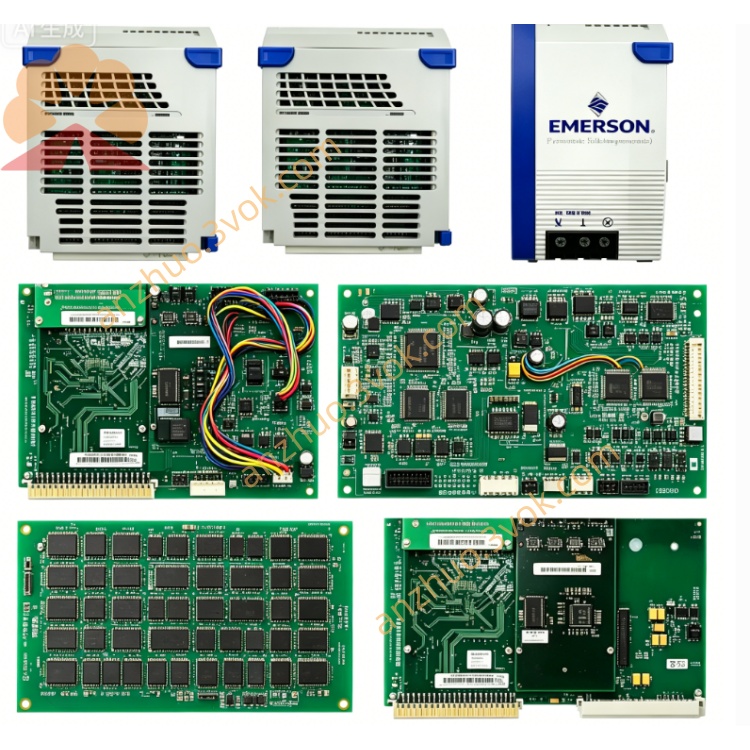
EMERSON 1X00046H02 Ovation Analog Input Module
Description
EMERSON 1X00046H02 Product Detailed Description
I. Product Overview
EMERSON 1X00046H02 is a high-performance copper-to-fiber communication module (fiber optic transceiver / media converter) of Emerson's Ovation™ Distributed Control System (DCS), originally produced in the United States. It is also commonly known as the Westinghouse OVATION system fiber optic communication module. As an upgraded version / module of 1X00046H01 within the same series, it is specifically designed for high-reliability communication in industrial environments, used for optical-electrical signal conversion between nodes such as controllers, I/O racks, operator stations, etc. in the Ovation system, effectively extending communication distance, resisting strong electromagnetic interference, and being the core component ensuring stable real-time data transmission of the DCS.
II. Core Functions
Bidirectional Optical-Electrical Conversion: Achieves transparent mutual conversion between 10/100Mbps Ethernet electrical signals (RJ45) and optical signals (fiber), supports adaptive multi-mode / single-mode fiber, addressing the pain points of short copper cable transmission distance and susceptibility to electromagnetic interference in industrial sites.
Ovation System-Specific Communication: Compatible with the entire series of Ovation DCS equipment, undertaking the high-speed transmission tasks of real-time control data, configuration parameters, and alarm information between controllers, I/O units, engineer stations, and operator stations.
Long-Distance Transmission Expansion: Breaks through the 100-meter limit of copper cables, with multi-mode fiber (50/125μm, 62.5/125μm) transmission distance up to 2km, and single-mode fiber (9/125μm) up to 20km, meeting the requirements for long-distance communication in large industrial sites and across workshops.
Redundant Link Adaptation: Supports dual-fiber redundant networking, can be combined with the same model module to form a redundant communication system, automatically seamlessly switching in case of link failure without data loss, meeting the 7×24-hour continuous operation requirements of industrial environments.
Status Monitoring and Fault Diagnosis: Equipped with LED status indicator lights, real-time display of power, electrical port link, optical port link, data transmission, and fault alarm status; built-in link detection circuit, can accurately identify fiber breakage, port abnormalities, signal loss, etc. faults.
Protocol Transparent Compatibility: Compatible with Ovation-specific communication protocols and standard TCP/IP, Modbus TCP, etc. industrial Ethernet protocols, can be integrated into the existing network architecture without additional configuration, plug-and-play.
III. Technical Specifications
(1) Electrical and Communication Parameters
Input Voltage: 220–240VAC, 50/60Hz, compatible with industrial standard power grids, with strong adaptability to voltage fluctuations.
Communication Interface: 1 RJ45 electrical port (10/100Mbps auto-sensing), 1 fiber optic interface (SC/ST selectable, multi-mode / single-mode compatible).
Transmission Rate: Ethernet 10/100Mbps auto-sensing, fiber transmission rate matches the electrical port, no rate bottleneck.
Fiber Specifications: Multi-mode fiber (50/125μm, 62.5/125μm) transmission distance ≤ 2km; single-mode fiber (9/125μm) transmission distance ≤ 20km.
Power Consumption: ≤ 30W, low-power design, reducing energy loss.
Protocol Support: Ovation-specific protocol, TCP/IP, Modbus TCP, etc. industrial Ethernet protocols.
(2) Environmental Parameters
Operating Temperature: -10℃ to + 50℃, stable operation under full load, compatible with industrial environments at normal temperatures such as power plants, metallurgy, and chemical industries.
Storage Temperature: -40℃ to + 70℃, no damage in extreme temperature environments, facilitating long-term storage of spare parts. Relative humidity: 5%–95% RH (no condensation), suitable for humid and dusty industrial sites.
Seismic resistance level: Complies with IEC 60068-2-6 standard, capable of withstanding 5g vibration (10–150Hz), suitable for installation scenarios of equipment cabinets with large vibrations.
Protection level: IP30, dust-proof and foreign object-proof, avoiding dust accumulation that affects heat dissipation and communication stability.
(III) Physical parameters
Dimensions (width × height × depth): Approximately 320mm × 160mm × 110mm, standard industrial module size, suitable for DIN rail or cabinet fixed installation of control cabinets.
Weight: Approximately 3.2kg, lightweight design, facilitating on-site installation, transportation and maintenance.
Shell material: High-strength cold-rolled steel plate, surface anti-corrosion spraying, corrosion-resistant, impact-resistant, suitable for harsh industrial environments.
IV. Structure and appearance design
Compact modular structure: Integrated sealing design, internal integration of industrial-grade photoelectric conversion chips, signal processing circuits, power modules and efficient heat dissipation components, compact structure, reducing external wiring, reducing fault points.
Flexible installation interface: Backside equipped with standard DIN rail clips, can be quickly fixed on control cabinet rails; at the same time, 4 screw fixing holes are reserved, suitable for special installation scenarios such as cabinet hanging and stacking.
Clear interface layout: On the front, there are optical fiber interfaces (SC/ST), in the middle is an RJ45 electrical port, below are power input terminals (L/N/ground) and redundant communication interfaces, clear interface zoning, clear labels, facilitating on-site wiring and fault troubleshooting.
Intuitive status indication: Front equipped with 4 LED indicators, respectively: power indicator (green), link indicator (yellow), optical link indicator (yellow), fault indicator (red); power is normal with the green light always on, link connection is normal with the yellow light always on, data transmission is yellow light flashing, when there is a fault, the red light is always on or flashing, the status is clear at a glance.
Efficient heat dissipation design: Passive heat dissipation + external heat dissipation fin structure, integrated heat dissipation fins on both sides, internal heat naturally dissipates, no fan design, avoiding fan dust accumulation leading to faults, suitable for industrial environments with a lot of dust.
V. Product advantages
High reliability: Use military-grade photoelectric conversion chips and components, strictly following Emerson's factory test standards, average failure-free time (MTBF) ≥ 450,000 hours, suitable for industrial 7×24-hour continuous operation.
Strong anti-interference ability: Fiber optic transmission has no electromagnetic interference, no signal crosstalk, can stably transmit data in strong electromagnetic environments such as power plants and steel mills, avoiding packet loss and delay problems caused by copper cable communication being susceptible to interference.
Long-distance stable transmission: Single-mode fiber can transmit up to 20 kilometers, signal attenuation is small, transmission is stable, suitable for large industrial areas and long-distance communication between workshops.
Easy integration and maintenance: Perfectly compatible with the entire series of Ovation DCS equipment, plug-and-play, no complex configuration required; supports hot swapping, no need to stop the machine to replace modules, reducing system downtime.
Safe compliance: Certified by CE, UL, FCC, etc. international safety and electromagnetic compatibility certifications, compliant with industrial electrical safety standards, equipped with multiple protections against overvoltage, overload, short circuit, overtemperature, ensuring equipment and personnel safety.
VI. Application scenarios
Power industry: Ovation DCS systems for power plants such as thermal power, hydropower, and nuclear power, used for control equipment and central control rooms of boilers, steam turbines, generators, etc., and for communication between control cabinets and I/O racks.
Metallurgical industry: Automation control systems for metallurgical enterprises such as steel mills, aluminum plants, etc., used for controllers of rolling mills, blast furnaces, continuous casting machines, etc., and communication between I/O racks. Chemical industry: Process control systems for enterprises in petrochemical and fine chemical industries, designed for explosion-proof and anti-corrosion environments, are used for long-distance data transmission in reaction vessels, pipelines, and other equipment.
Building materials industry: Production line control systems for cement plants, glass factories, and other building materials enterprises, used for cross-departmental communication in kilns, mills, conveyors, etc.
Other industrial scenarios: Ovation DCS systems in water treatment, papermaking, pharmaceuticals, etc., provide stable communication support for equipment in remote and highly interfered environments.
VII. Installation and Maintenance
(1) Installation Steps
Select a location within the control cabinet that is well-ventilated, free from strong electromagnetic interference, and without corrosive gases. Secure DIN rails or prepare installation positions for the cabinet.
Align the back of the module with the DIN rails and press down until the clips are securely engaged; or fix the module on the cabinet using screw holes to ensure a secure and tight installation without loosening.
Connect the input power supply (220–240VAC) according to the terminal markings. Connect the live wire to L, the neutral wire to N, and ground the ground wire. Ensure the connections are secure and avoid loose connections.
Connect communication cables: Connect one end of the cable to the RJ45 electrical port of the module, and the other end to the electrical port of the Ovation controller/I/O module; connect the fiber optic end of one cable to the fiber optic interface of the module, and the other end to the fiber optic interface of the remote device. Ensure the fiber optic connectors are clean and the connections are tight.
If redundant configuration is required, connect the redundant interface and pair it with a redundant module of the same model to achieve dual fiber optic link backup.
After checking that the wiring is correct, connect the input power supply and observe if the green power indicator light is constantly on, if the link lights are normally illuminated, and if the module communication is normal.
(2) Daily Maintenance
Daily inspection of status indicator lights: A green light indicates normal power supply, a yellow light indicates normal link, a yellow flashing light indicates normal data reception and transmission, and a red light indicates a need to troubleshoot for fiber optic breakage, port failure, or power anomaly.
Use a dry soft cloth to wipe the surface of the module, interfaces, and heat sinks of the fins monthly. Avoid dust accumulation that affects heat dissipation and poor interface contact.
Check the looseness, oxidation, or corrosion of the connection terminals, fiber optic connectors, and RJ45 interfaces quarterly. Tighten or replace the connectors in time to avoid poor contact and communication interruption.
Avoid stacking杂物 above the module, maintain good ventilation, keep away from heat sources, water sources, and corrosive gases to prevent the module from overheating or being damaged.
In redundant configuration, manually switch the main and backup links every six months to test the redundancy switching function to ensure seamless switching in case of a failure and no data loss.
VIII. Precautions
The input voltage must strictly be controlled within the range of 220–240VAC. Do not connect it with excessive or insufficient voltage. Otherwise, the module's internal power supply and circuit will be burned out.
Fiber optic connectors must be kept clean. Avoid touching the fiber optic end faces during installation or maintenance to prevent oil stains and dust from adhering, resulting in signal attenuation or communication interruption.
During installation, ensure reliable grounding to avoid damage to the module from static electricity or leakage. Also, reduce electromagnetic interference to ensure stable communication.
Do not disassemble the module privately. There are no user-repairable components inside, and disassembly will invalidate the warranty and even cause short circuits, electric shock, and other safety accidents.
Store the module in a dry, ventilated environment without corrosive gases. Maintain a temperature range of - 40℃ to + 70℃. Avoid direct sunlight, rain, and severe vibration.
When the module fails, replace it with the original and identical model module to avoid using non-original accessories, which will affect system compatibility and communication stability.
IX. Warranty Information
Warranty period: Original and brand-new products are warranted for 12 months. Non-human-induced damage faults within the warranty period can be repaired or replaced free of charge.
Warranty scope: Covers module internal component faults, circuit faults, and communication faults; faults caused by human damage, unauthorized disassembly, overpressure use, or harsh environments (such as corrosion, water ingress) are not within the warranty scope.
Get a Quote