
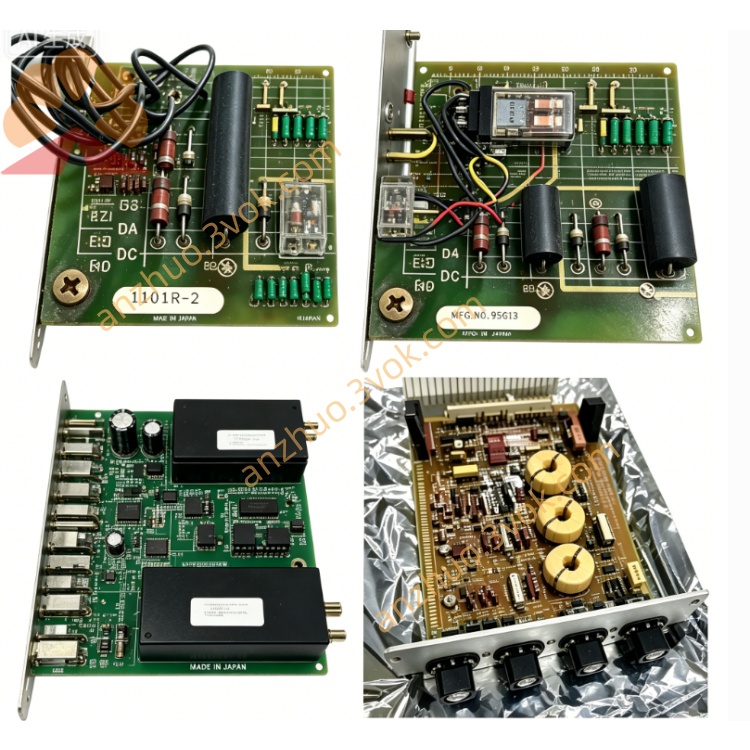
RELIANCE 57C443 Allen‑Bradley RIO remote I/O scanner communication module
57C443 is an AB Remote I/O communication scanner module designed for Reliance AutoMax distributed control system. It serves as protocol conversion unit between AutoMax proprietary backplane bus and Allen-Bradley Remote I/O fieldbus, supporting both master scanner mode and slave adapter mode. The module enables AutoMax main processor to perform real-time data reading and output control over AB Remote I/O field stations such as 1771 series remote racks and distributed Flex I/O devices. It follows standard plug-in specification compatible with AutoMax system rack slots, and multiple modules can be installed inside one rack to expand independent multi-channel Remote I/O bus access capability. Original manufacturing has been stopped, and the component is mainly circulated as replacement spare part for legacy industrial equipment upgrade and maintenance work.
Description
Product Introduction
57C443 is an AB Remote I/O communication scanner module designed for Reliance AutoMax distributed control system. It serves as protocol conversion unit between AutoMax proprietary backplane bus and Allen-Bradley Remote I/O fieldbus, supporting both master scanner mode and slave adapter mode. The module enables AutoMax main processor to perform real-time data reading and output control over AB Remote I/O field stations such as 1771 series remote racks and distributed Flex I/O devices. It follows standard plug-in specification compatible with AutoMax system rack slots, and multiple modules can be installed inside one rack to expand independent multi-channel Remote I/O bus access capability. Original manufacturing has been stopped, and the component is mainly circulated as replacement spare part for legacy industrial equipment upgrade and maintenance work.
Model Definition
57C is the unified series identifier for all plug-in functional modules of Reliance AutoMax control platform. 443 is the exclusive fixed part number defined for Remote I/O bus interface card. Letter suffix like A or B marked on actual product represents updated hardware revision with optimized circuit layout and improved surge protection against field voltage surge and electromagnetic interference.
Technical Specifications
The module receives 5VDC power supply directly from rack backplane with permissible input voltage ranging from 4.75VDC to 5.25VDC and typical operating current near 680mA. Onboard dedicated processing chip and dual-port memory are configured for cyclic I/O data caching and cross-protocol data conversion. Three optional standard communication baud rates are available for Remote I/O bus including 57.6Kbps, 115.2Kbps and 230.4Kbps. A single bus trunk supports up to 32 sets of AB remote I/O racks with total controllable I/O capacity reaching 2048 discrete and analog points. Normal working ambient temperature ranges from 0 degree Celsius to 55 degree Celsius, storage temperature covers minus 25 degree Celsius to 70 degree Celsius, applicable relative humidity keeps between 5 percent and 95 percent under non-condensing environment. Integrated EMC filter circuit and hardware watchdog circuit help restrain interference generated by on-site high-power motors and frequency converters while monitoring internal operating status continuously.
Interface and Communication Configuration
Rear gold finger connector links AutoMax dedicated internal backplane bus to complete high-speed cyclic data exchange with rack main CPU and local installed I/O modules. Front panel is equipped with shielded terminal block for Remote I/O shielded twisted-pair cable connection, together with running status LED indicator, dial switch for station parameter setting and digital display window used for real-time fault code output. The module fully complies with standard Allen-Bradley Remote I/O communication protocol and automatically completes address mapping between AutoMax internal register space and AB remote I/O channel addresses to achieve transparent cross-platform data interaction.
Core Functions
When configured under scanner master mode, the module periodically polls all connected remote AB I/O stations, uploads field collected digital and analog input signals to AutoMax controller and transfers control output commands from main processor down to remote I/O modules to drive field actuators. When set to slave adapter mode, it converts AutoMax local I/O data into standard Remote I/O bus frame so that the whole AutoMax rack can be identified as a single remote slave station and scanned by external AB master PLC. It automatically diagnoses bus open circuit, short circuit and offline remote rack faults during runtime, locks existing cached data and displays corresponding fault codes to prevent abnormal equipment action caused by communication failure. It supports parameter modification of bus baud rate and station address without full system shutdown.
Application Scenarios
The module is widely used for network reconstruction of legacy AutoMax control cabinets on metallurgical rolling production lines, cement processing equipment, papermaking production lines and chemical auxiliary workshop control systems to connect Reliance control units with existing AB Remote I/O distributed network. It is commonly adopted for automation upgrading of pump and fan interlock control cabinets inside water treatment plants, as well as reform projects of traditional textile machinery and industrial furnace control cabinets to access factory centralized Remote I/O monitoring system.
Operation and Maintenance Instructions
Cut off full rack power supply before installation, check circuit board for bent pins, detached components or surface corrosion, insert module into specified empty slot and lock front fixing buckle firmly against loose contact from long-term mechanical vibration. Complete bus baud rate and station address configuration after installation and run short-period no-load communication test with external AB remote I/O racks to verify stable data transmission before formal system commissioning. Perform regular maintenance under fully powered-off state, remove accumulated dust on module surface and wiring terminals by blowing with dry compressed air. Hot plugging operation under powered rack condition is strictly forbidden to avoid backplane short-circuit damage. When persistent abnormal indicator flickering or frequent bus disconnection occurs, isolate equipment power and deliver the module to professional maintenance personnel for circuit inspection, unauthorized disassembly of original sealed circuit is prohibited.
Get a Quote