
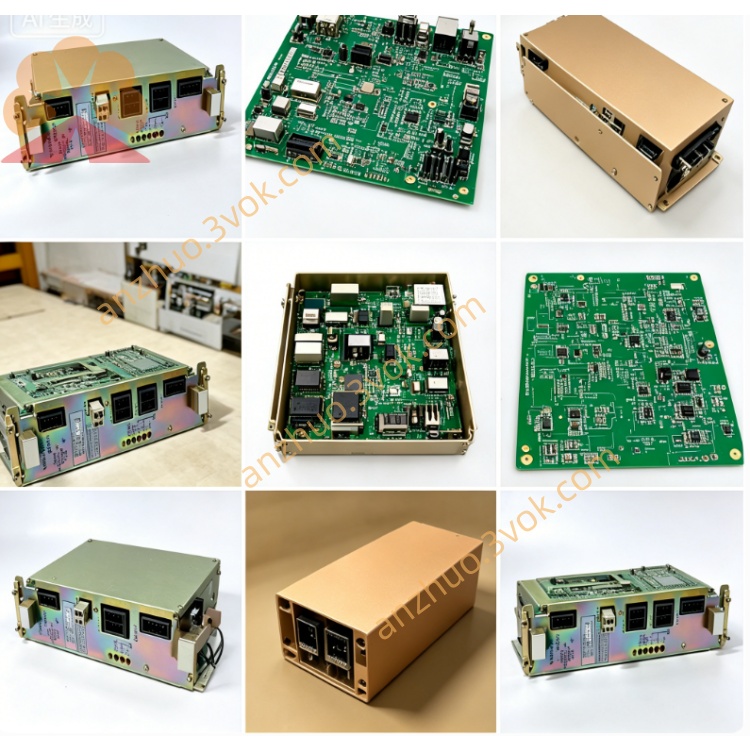
JANCD-SR20B
JANCD-SR20B, also marked JANCD-SR20B-1 and DTN-5330, is an enhanced revision of JANCD-SR20. It is a dedicated 4-axis servo control board manufactured by Yaskawa Electric and Motoman Robotics. This product has been discontinued, and only used or refurbished units are currently available. Designed as a standard backplane plug-in card, it features optimized hardware and firmware to improve anti-interference capability and thermal stability. It can serve as a direct replacement for the original JANCD-SR20.
Description
1. General Information
JANCD-SR20B, also marked JANCD-SR20B-1 and DTN-5330, is an enhanced revision of JANCD-SR20. It is a dedicated 4-axis servo control board manufactured by Yaskawa Electric and Motoman Robotics. This product has been discontinued, and only used or refurbished units are currently available. Designed as a standard backplane plug-in card, it features optimized hardware and firmware to improve anti-interference capability and thermal stability. It can serve as a direct replacement for the original JANCD-SR20.
2. Technical Specifications
The board draws power from the system backplane with +5 V DC and ±12 V DC power supply, and the typical operating current is approximately 1.5 A. It is equipped with a 16-bit dedicated motion control DSP chip, matched with 256 KB RAM for data buffering and 128 KB ROM for firmware storage. This board supports up to 4 servo axes for synchronous operation.
The operating temperature ranges from 0 °C to 45 °C, while the storage temperature is between -20 °C and 60 °C. The applicable relative humidity is 5% to 85%, and condensation is not allowed under any working or storage conditions. It is fitted with gold-edge connectors for stable connection with the controller backplane, and integrates servo bus ports, encoder signal interfaces, limit and emergency stop signal terminals.
3. Main Functions
This board performs full closed-loop control of position, speed and torque for four servo axes. It supports linear and circular interpolation as well as electronic gearing functions to ensure coordinated motion of multiple axes. It generates smooth motion profiles with trapezoidal and S-curve acceleration and deceleration modes to meet high-precision motion requirements.
It receives and processes feedback signals from incremental and absolute encoders to realize real-time position correction. It communicates continuously with main CPU boards such as JANCD-SR01, SR02 and SR03 via the internal system bus, receiving operation commands and feeding back real-time operating status. Built-in hardware protection circuits provide overcurrent, overvoltage and overheat protection for servo systems to avoid equipment damage.
4. Compatibility
This servo control board is fully compatible with YASNAC LX and MX series CNC systems and Motoman ERC robot controllers. It works well with JANCD-SR01, SR02, SR03 main CPU boards and SP series operator interface boards. It can directly replace the standard JANCD-SR20 without any modification. It is not applicable to new generation controllers including XRC, NX100, DX series and YRC series, nor compatible with later updated CPU boards.
5. Installation Instructions
Cut off the main power supply of the controller first, and wait at least five minutes to ensure all internal capacitors are fully discharged. Wear an anti-static wrist strap during operation to prevent static electricity from damaging electronic components. Align the board with the designated slot on the backplane and insert it smoothly, then tighten the fixing screws firmly. After completing all cable connections, restore power and test axis movement and signal status.
6. Troubleshooting
If the servo axes fail to move, check the backplane power supply condition, reinsert the board and clean the gold-edge connectors to solve poor contact problems. When position deviation occurs during operation, inspect encoder wiring and check relevant servo parameters such as gain and backlash. If communication failure happens between this board and the main CPU, re-seat all adjacent boards and examine the backplane bus circuit. Abnormal alarms related to servo can be troubleshooted by checking wiring, load status and hardware protection circuits.
7. Maintenance & Safety Notes
Do not plug or unplug the board and connected cables when the system is powered on. Keep the inside of the control cabinet and the board surface clean and dry, and keep away from heavy dust, oil mist and corrosive gas. Regularly inspect connectors and terminals to prevent poor contact caused by aging and oxidation. All disassembly, installation and maintenance work must comply with industrial electrical safety regulations.
8. Disclaimer
This document is a technical summary for reference only. Yaskawa Electric reserves the right to revise product specifications without prior notice. Please refer to the official original manual for complete technical standards and operation guidelines.
Get a Quote