
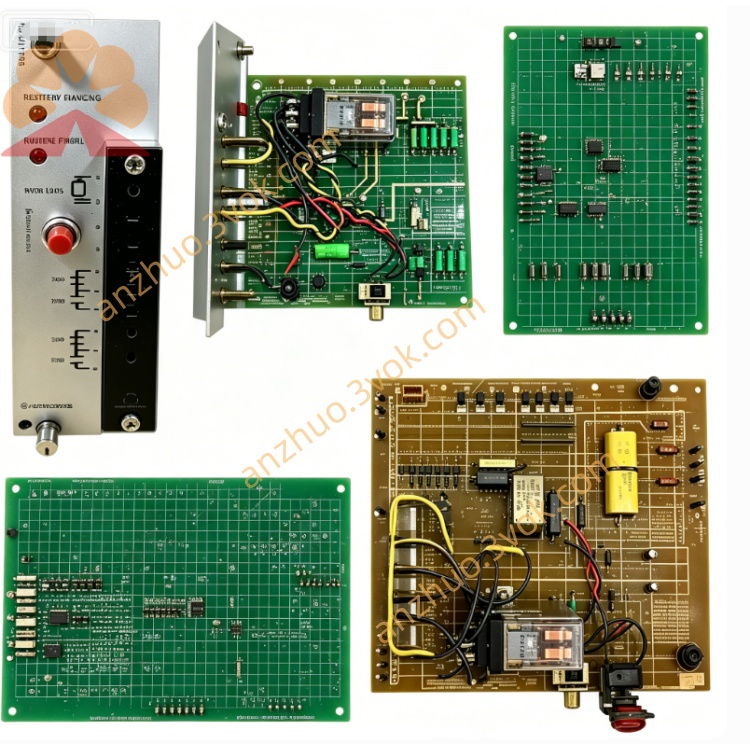
RELIANCE 57412D field regulator module
The RELIANCE 57412D (also marked O-57412-D) is a field regulator module for the AutoMax DCS 5000 platform, serving as a D-version variant of the base 57412 model. It provides precise closed-loop regulation of field current and voltage for large DC motors and excitation systems, built for heavy-duty industrial environments with enhanced stability and compatibility.
Description
Product Overview
The RELIANCE 57412D (also marked O-57412-D) is a field regulator module for the AutoMax DCS 5000 platform, serving as a D-version variant of the base 57412 model. It provides precise closed-loop regulation of field current and voltage for large DC motors and excitation systems, built for heavy-duty industrial environments with enhanced stability and compatibility.
Model Definition
RELIANCE is the brand (now part of ABB/Baldor). 57412 denotes the series for field regulator modules, dedicated to motor field excitation control. The suffix D indicates a specific hardware revision with optimized circuit layout, improved noise immunity, and compatibility with older AutoMax racks.
Technical Parameters
It supports 4 levels of current calibration for fine adjustment of excitation output. The operating voltage is 220/230V AC, 50/60Hz. It delivers regulated DC field current with high accuracy and low ripple. The operating temperature ranges from 0°C to +50°C; storage temperature is -40°C to +85°C. It meets CE certification standards, with built-in overvoltage, overcurrent, and short-circuit protection. The weight is approximately 2.5 lbs (1.13 kg).
Interface and Communication Configuration
The front panel features three RS-232 D-Sub ports: one 25-pin for field gate connector, one 9-pin for isolated armature volts, and one 9-pin for connection to the field power module. A terminal strip labeled “Current” is provided for field signal wiring. It connects to the AutoMax rack backplane for power and data exchange, occupying one standard slot. LED indicators on the front panel display power, run, and fault status. No independent fieldbus is used; all control data is transmitted via the backplane to the host controller.
Core Functions
It provides precision field current/voltage regulation for DC motors, ensuring stable excitation under varying loads. It supports four calibration levels to match different motor excitation requirements. It offers electrical isolation between control circuits and power circuits to suppress EMI and ground loop interference. It includes onboard diagnostics with fault detection for overcurrent, overvoltage, and communication errors, indicated by front-panel LEDs. It enables real-time tuning of excitation parameters via the backplane for dynamic motor control.
Application Scenarios
It is used in heavy-duty DC motor drive systems in metallurgy, mining, paper, and steel industries. It serves as the core excitation control component for large rolling mills, conveyors, and winders requiring precise speed and torque stability. It is suitable for AutoMax DCS 5000 control systems and compatible with Mark V series hardware. It is applied in industrial processes where consistent motor field excitation is critical for production quality.
Operation and Maintenance Instructions
Before installation, inspect for physical damage and verify compatibility with the AutoMax rack and motor excitation system. Perform all wiring and installation with the system power off to avoid electric shock or short circuits. Insert the module firmly into the rack slot and secure it, then connect field wiring and communication cables according to labeling. During operation, keep the installation area dry, ventilated, and free of heavy dust or corrosive gases. Regularly check terminals for looseness or aging and clean LED indicators and connectors. If a fault LED illuminates, power off the system, re-seat the module, and check wiring; do not disassemble the module housing. Replace only with a 57412D or compatible model to ensure regulation accuracy and system reliability.
Get a Quote