
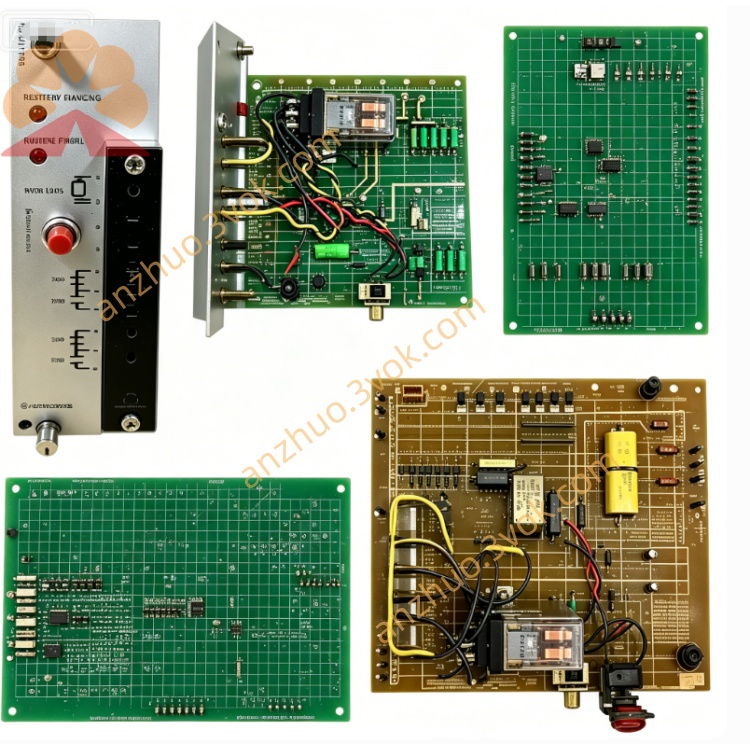
RELIANCE 57411-2E enhanced resolver input module
The RELIANCE 57411-2E is an enhanced resolver input module developed for the AutoMax and DCS 5000 industrial control platforms. It is an upgraded version of the 57411-2 model, built with industrial-grade components to collect position and velocity signals from resolvers. The module features strengthened environmental adaptability and stable operating performance, and it is specially designed to support high-precision closed-loop motion control under severe industrial working conditions.
Description
Product Overview
The RELIANCE 57411-2E is an enhanced resolver input module developed for the AutoMax and DCS 5000 industrial control platforms. It is an upgraded version of the 57411-2 model, built with industrial-grade components to collect position and velocity signals from resolvers. The module features strengthened environmental adaptability and stable operating performance, and it is specially designed to support high-precision closed-loop motion control under severe industrial working conditions.
Model Definition
RELIANCE is the brand name of the product. 57411 is the dedicated series code for resolver input modules, representing the basic hardware type and core functional orientation. The digit 2 stands for the second generation hardware revision with optimized circuit design and performance. The suffix E refers to the enhanced version, which adopts improved design for wider environmental adaptability and reinforced industrial performance.
Technical Parameters
This module provides 12-bit position resolution per revolution and is equipped with a 2-bit revolution counter. Its sampling time can be configured from 500 microseconds to 32.767 seconds via software. The maximum power consumption is 10 watts, and the working frequency is 2381 hertz with a minimum rotor impedance of 400 ohms. It works stably within the temperature range from minus 10 degrees Celsius to plus 60 degrees Celsius, and the storage temperature ranges from minus 40 degrees Celsius to plus 85 degrees Celsius. The product meets UL and CE standards, and it has excellent shock resistance and vibration resistance to adapt to long-term continuous operation.
Interface and Communication Configuration
The module is fitted with D-Sub connector or terminal blocks for resolver signal access. It connects to the system rack through the backplane interface to obtain power supply and realize data transmission. Several LED indicators on the front panel display power status, running state, fault information and signal conditions. Two sets of 6-position DIP switches are reserved for on-site hardware configuration. This module does not support independent field bus communication, and all signal and data exchange is completed through the rack backplane and the main controller.
Core Functions
It converts analog signals from resolvers into digital angular position data to achieve high-precision position detection. It calculates real-time shaft velocity based on continuous position sampling to meet the requirements of closed-loop motion control. The built-in signal conditioning circuit filters interference signals and provides reliable electrical isolation, overvoltage and overcurrent protection. It supports flexible sampling parameter configuration to adapt to different dynamic control demands. The onboard self-diagnosis function can detect operating faults in a timely manner and remind operators through indicator lights.
Application Scenarios
This module is widely used in high-precision motion control equipment such as numerical control machines and industrial robots. It serves as the core feedback component for large AC and DC motor drive systems in metallurgy, mining and papermaking industries. It is also applicable to rotary machinery, winding equipment and conveyor systems that require accurate speed and position control. It can be perfectly matched and installed in AutoMax and DCS 5000 series control systems.
Operation and Maintenance Instructions
Check the appearance for damage and confirm compatibility with the system and supporting resolvers before installation. All wiring and installation operations must be performed after cutting off the system power to prevent short circuit and electric shock hazards. Insert the module firmly into the rack and fix it in place, then complete signal wiring in accordance with specifications. Keep the installation area dry, ventilated and away from heavy dust and corrosive gas during operation. Regularly inspect connecting terminals and lines for looseness or aging. If abnormal status occurs, power off the system first to recheck and troubleshoot. Do not disassemble the module shell without authorization. Replace the module with a matching model in time when permanent faults occur to ensure the whole system runs normally.
Get a Quote