
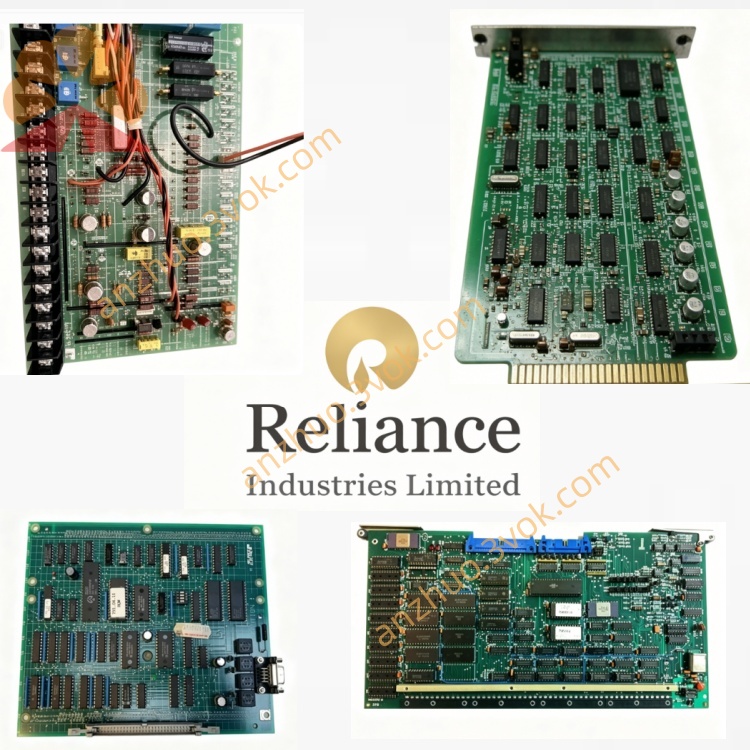
Reliance 45C-410 / 45C410 PLC Control Module
Description
Product Introduction
45C-410 and 45C410 are the same product. They are high-performance control processor modules used by Ryan (now ABB) AutoMate and AutoMax series PLCs. This module serves as the main control core of the system, running control programs, managing input/output points, and handling communication tasks. This model is now out of production. Currently, it is only completed by using refurbished parts, inventory spare parts, and new inventory items to maintain old automation systems.
Model Interpretation
45C is the unified prefix for Ryan AutoMate 45C series control components. 410 represents the high-performance control processor module. 45C-410 and 45C410 are just different numbering formats for industrial products. The products themselves are completely identical. Some products have suffixes such as A, B, C, etc., which are only used to distinguish hardware iteration versions. The core function of the module does not change.
Technical Specifications
The module type is a high-performance central processing unit module. The core is equipped with the Motorola 68000 microprocessor. It is compatible with AutoMate 40, 40E, 40X and AutoMax series PLCs. It has an internal 8K×16-bit non-volatile memory and supports memory expansion. It is configured with one RS-232 communication serial port. The working power supply is provided by the back panel of the frame at 5 volts direct current. The module weighs approximately 0.91 kilograms. The normal operating temperature range is 0 degrees Celsius to 55 degrees Celsius. Installation occupies one standard slot of the 45C series frame.
Interface and Communication Configuration
Before installation, all system power must be cut off. Insert the module into the frame slot and tighten the fixing screws. Do not plug or unplug the module while it is powered on. The external communication uses the RS-232 serial port, which can be connected to programmers, human-machine interfaces and upper-level monitoring devices. Through the back panel bus of the frame, it interacts with various I/O modules, coprocessors and data. The front of the module has power, operation and fault indicator lights, which display the real-time operating status of the equipment. The module does not have a jump switch. All control programs and operating parameters are configured and downloaded through the accompanying programming software.
Core function
The computing speed is excellent, and it can stably execute complex control programs written in ladder diagrams and high-level languages. It uniformly manages the input and output points of the system, and supports up to 1024 digital quantities and 64 analog signals. Through the RS-232 serial port, it enables program upload/download and real-time transmission of on-site data. It has a built-in hardware self-check function. When the equipment malfunctions, the indicator lights will alarm and record the corresponding fault code. It supports multi-task segmented operation, which can meet the control requirements of complex industrial production processes.
Applicable scenarios
It is used to replace the aging or faulty main control modules in the old systems of AutoMate and AutoMax. It is suitable for the core logic control of complex and old production lines in industries such as automobiles, metallurgy, papermaking, and textiles. When conducting equipment renovation, the original I/O modules and wiring lines can be retained, and only this main control module needs to be replaced, thereby reducing the renovation cost. Combined with the upper-level equipment to build a monitoring system, it can achieve production data collection, equipment status monitoring, and remote communication.
Installation and Maintenance Instructions
Before installation, disconnect the system's main power supply, clean the slot debris of the rack, ensure reliable contact between the module and the backplane, and tighten the screws. Connect the programming device through the RS-232 interface, download the matching control program and complete the verification. Confirm there are no errors before reconnecting the power supply. Regularly check the status of the indicator lights, and promptly clean the dust on the module surface. Ensure good ventilation of the rack, do not block the module's heat dissipation area, and avoid equipment failure caused by high temperature. When abnormal operation occurs, first check the power supply and line connection of the backplane, program issues can be re-downloaded or the logic can be checked, and for hardware damage, directly replace the module. Before disassembling and repairing the module, make sure to completely power off, follow safety operation procedures, and prevent electric shock and module damage.
Get a Quote