
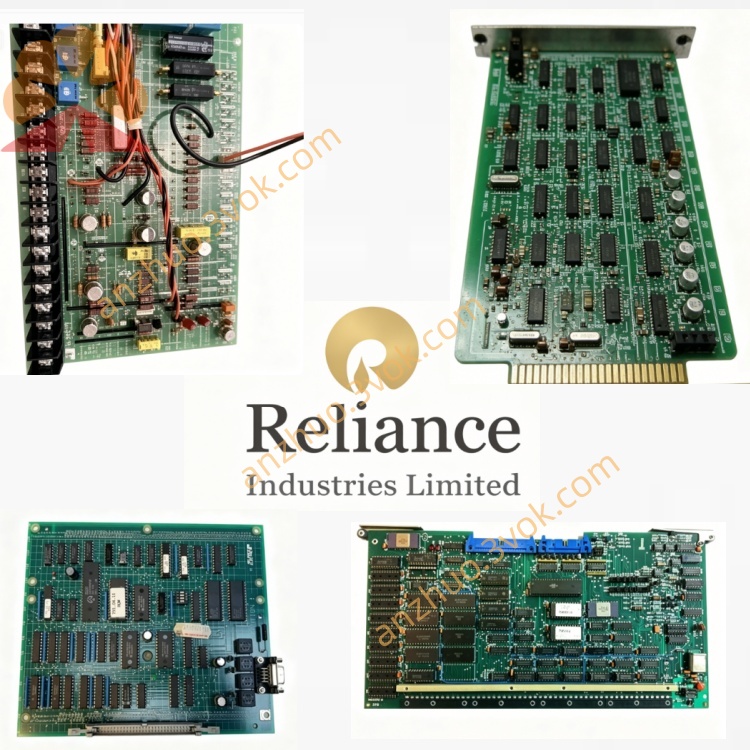
Reliance 45C20A PLC Automation Module
Description
Product Description
Model Number Interpretation
45C: Unified prefix for Reliance AutoMate 45C series control components.
20: Denotes the base CPU/controller model for AutoMate 20 systems.
A: Indicates the first hardware revision with enhanced component reliability, improved noise immunity, and minor circuit optimizations over the original 45C20.
Hyphen: Optional industrial part-number formatting (45C-20A = 45C20A).
Technical Specifications
Power Supply: 120/240 VAC (47–63 Hz), 25 VA typical consumption.
Memory: 4K × 16 non-volatile RAM (battery-free retention).
I/O Capacity: Up to 256 digital I/O + 64 analog I/O; supports remote I/O expansion.
Internal Resources: 736 coils, 512 registers, up to 20 PID loops.
Operating Temperature: 0°C to 55°C; humidity 20%–90% non-condensing.
Mounting: Panel or DIN-rail mount; single-unit footprint (6.5 × 5.8 × 3.2 inches).
Weight: ~2.4 lbs (1.09 kg); rugged metal enclosure.
Safety: EN954-1 Category 3 compliant; user-replaceable 250V AGC 2A fuse.
Interface and Communication Configuration
Power Input: Terminal block for 120/240 VAC connection.
Programming/Serial Port: DB25 RS-232 port; default 9600 baud, switchable to 1200 baud for programming and HMI connection.
Network Port: Optional R-NET (coaxial) port for linking up to 32 AutoMate PLCs in a network.
I/O Expansion: Proprietary backplane/ribbon connector for local and remote I/O modules.
Status LEDs: POWER, RUN, CPU READY, COM DATA, FORCING, RAIL FAULT.
Core Functions
Standalone Machine Control: Executes ladder logic programs for discrete and analog control of conveyors, pumps, machine tools, and process equipment.
PID Process Control: Supports up to 20 independent PID loops for temperature, pressure, flow, and speed regulation.
Network Communication: Acts as an R-NET master/slave to exchange data with other AutoMate PLCs and peripherals.
High-Speed I/O Handling: Manages digital inputs/outputs and analog signals with fast response for real-time applications.
Fault Diagnostics: Provides LED status indication and built-in diagnostics for power, communication, and rail faults.
Application Scenarios
Legacy AutoMate 20 Systems: Direct replacement for aging 45C20 CPUs in manufacturing, packaging, and material handling lines.
Small-to-Medium Process Control: Used in water treatment, pharmaceutical, and food & beverage plants requiring compact, reliable PLCs.
Machine Retrofits: Ideal for upgrading older machinery (extruders, elevators, wire drawers) without full system replacement.
Distributed I/O Networks: Deployed as a node in R-NET networks for coordinated control across multiple production zones.
Usage and Maintenance Instructions
Installation: Mount securely on a DIN rail or panel; connect AC power to the terminal block and ensure proper grounding.
Wiring: Connect I/O devices to expansion modules; link programming cable to the DB25 port; verify R-NET termination if networked.
Power-On Check: Apply AC power; confirm POWER and CPU READY LEDs are on, with no FAULT indicators.
Routine Maintenance: Quarterly inspections; clean dust from enclosure and connectors; check wiring tightness and fuse integrity; backup programs periodically.
Safety: Disconnect all AC power and wait 5 minutes for discharge before servicing; avoid live maintenance; use only compatible AutoMate 20 series I/O modules and accessories.
Get a Quote