
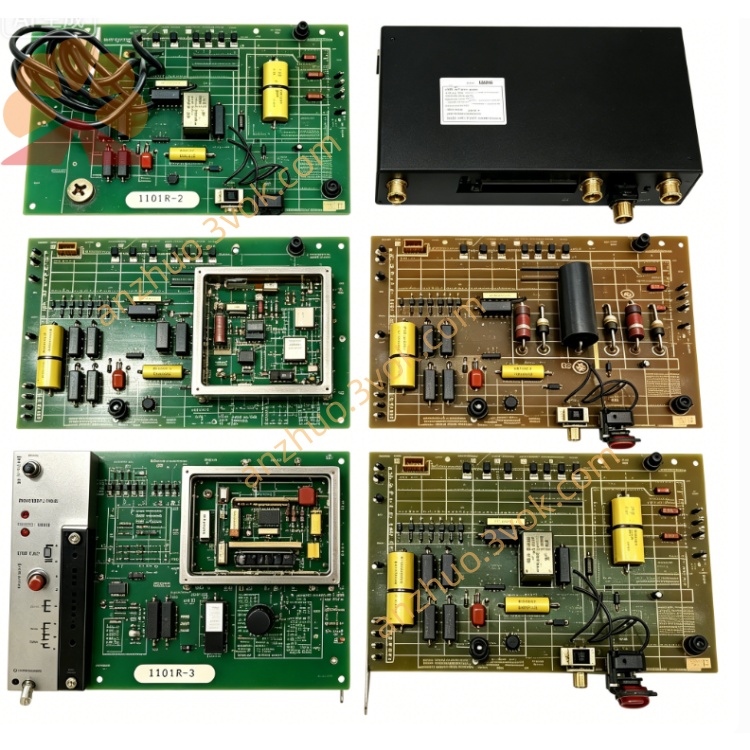
Reliance 2CB4020
Description
Product Description
Model Number Interpretation
2: Series identifier (2 = standard industrial control series)
CB: Control board type (CB = current/feedback control board)
4020: Performance & revision (40 = 40A current rating; 20 = hardware revision 2.0)
Technical Specifications
Current Rating: 40 A continuous
Supply Voltage: 19–30 VDC, 110/220 VAC auxiliary
Control Signals: ±10 V analog input, 24 VDC digital I/O
Operating Temperature: 0 °C to +50 °C
Protection: Overcurrent, overvoltage, overtemperature, short-circuit
Mounting: Panel-mount or DIN-rail
Weight: Approx. 2.3 kg
Interface and Communication Configuration
Control Ports: Analog input (speed reference), encoder feedback port, digital I/O (start/stop, fault reset)
Communication: Supports Reliance proprietary drive protocol; compatible with PLCs via optional fieldbus module (Profibus DP, DeviceNet)
Terminals: Screw-type for power, control, and feedback wiring; shielded cable recommended for encoder signals
Core Functions
Precision Motor Control: Regulates speed, torque, and direction for AC/DC motors
Feedback Processing: Reads encoder signals for closed-loop position/speed control
Fault Diagnostics: Monitors system health with LED indicators and fault code logging
Overload Protection: Built-in thermal and current limiting to prevent motor/module damage
System Integration: Works with Reliance drive units and automation controllers for coordinated motion
Application Scenarios
Factory Automation: Conveyor systems, assembly lines, packaging machinery
Material Handling: Cranes, hoists, and lift equipment requiring precise speed control
Process Industries: Pumps, fans, and mixers with variable-speed operation
Legacy System Upgrades: Replacement for older Reliance control modules in modernized lines
Usage and Maintenance Instructions
Installation: Mount in a clean, dry control cabinet; allow 30 mm clearance for ventilation
Wiring: Use shielded cables for encoder/communication; tighten terminals to 1.2 N·m; verify voltage before power-up
Operation: Power on controller first, then module; check LED status for normal operation
Maintenance: Inspect connections quarterly; clean dust from heat sink semi-annually; update firmware as needed
Safety: Disconnect power before maintenance; wait 1 minute for capacitors to discharge
Get a Quote