
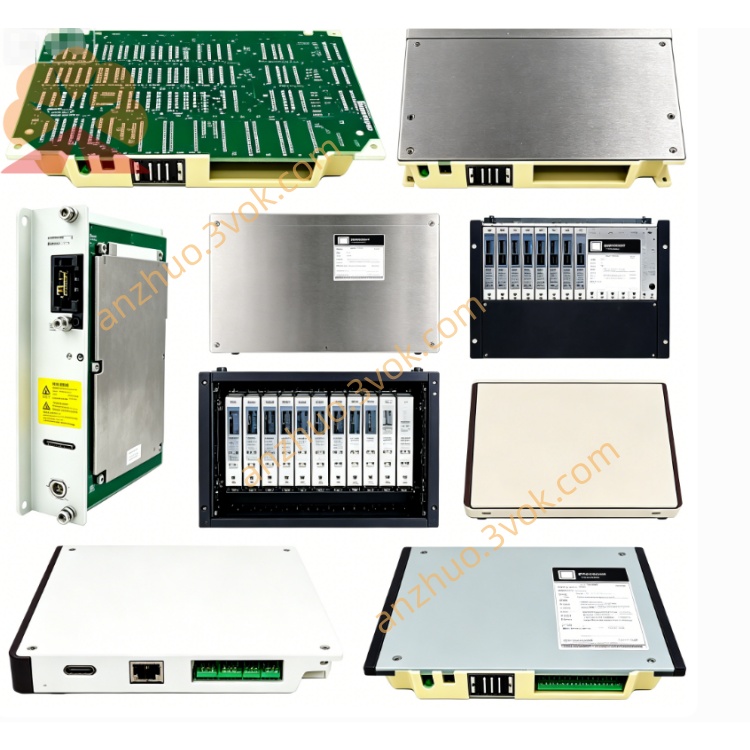
HONEYWELL 51304736-175
Description
Product Description
Model Definition
51304736-175: Official Honeywell part number.
5130 = TDC 3000 DCS series
4736 = Low‑Level Analog Input FTA family
175 = Specific hardware revision, channel configuration, and coating variant
Common Alias: MU‑TAIL03 (Low‑Level Analog Input FTA, Isolated)
Alternative Designations: 51304736175 (no hyphen), LLAI FTA GI, TC/RTD FTA.
Technical Specifications
Channels: 16 differential low‑level analog input channels.
Signal Types:
Thermocouple (TC): J, K, T, E, R, S, B, N types (mV range)
RTD: PT100, PT1000 (2‑wire, 3‑wire, 4‑wire configurable)
Millivolt (mV) transmitters
Galvanic Isolation: 1500 VAC RMS between field side and system side; suppresses EMI/RFI and eliminates ground loops.
Termination: Crimp‑style screw terminals with gold‑plated contacts for vibration resistance and long‑term stability.
Loop/Reference Power: 24 VDC nominal for RTD excitation; open‑circuit voltage 28 VDC; short‑circuit current ≤ 93 mA.
Operating Temperature: -20°C to +60°C.
Storage Temperature: -40°C to +70°C.
Humidity: 5%–95% non‑condensing.
Conformal Coating: Yes (protected PCB for harsh environments).
Certifications: CE, UL, CSA, RoHS compliant.
Form Factor: Size B, 307 mm length.
Weight: Approx. 2.2 kg.
Interface and Communication Configuration
System Interface: Connects via dedicated ribbon cable to Honeywell low‑level analog input modules (e.g., MC‑PLAM02 / 51304362‑150).
Field Interface: 16 differential terminal pairs, supporting TC, RTD, and mV transmitters; polarity‑sensitive with built‑in cold‑junction compensation (CJC) routing.
Isolation Barrier: Complete electrical separation between field wiring and DCS backplane; blocks high‑voltage transients and ground potential differences.
Onboard Communication: Passive FTA—no independent protocol; all data processing, linearization, and diagnostics handled by the connected LLAI module and DCS network.
Core Functions
Low‑Level Signal Termination: Accepts 16 channels of TC, RTD, or mV signals from process sensors.
Galvanic Isolation: 1500 VAC isolation protects DCS hardware and improves measurement integrity.
Signal Conditioning & CJC: Precision circuitry amplifies/filters low‑level signals; routes cold‑junction compensation for thermocouple accuracy.
RTD Excitation: Provides stable 24 VDC excitation for 2/3/4‑wire RTDs.
Vibration‑Resistant Termination: Gold‑plated crimp terminals minimize corrosion and signal loss in industrial environments.
Drop‑In Compatibility: Matches TDC 3000/TPS/UCN low‑level analog input modules for seamless integration.
Application Scenarios
Target Systems: Honeywell TDC 3000, TPS, UCN DCS.
Industries: Oil & gas, chemical, petrochemical, power generation, pharmaceutical, pulp & paper, and other continuous process industries.
Field Devices: Thermocouples, PT100/PT1000 RTDs, millivolt‑level pressure/temperature transmitters.
Installation: Control room cabinets, local panels, and field junction boxes in process plants.
Usage and Maintenance Instructions
Usage
Mounting: Install in standard DCS cabinet with adequate ventilation and wiring clearance.
System Connection: Attach ribbon cable to MC‑PLAM02 or compatible LLAI module; ensure connectors are fully seated and latched.
Field Wiring: Terminate TC/RTD/mV cables per polarity and wiring standards; use recommended torque to avoid loose connections. For RTDs, configure 2/3/4‑wire jumpers as required.
Power‑On & Verification: Energize DCS; check for no fault alarms; verify accurate sensor readings via DCS operator interface.
Maintenance
Environment: Keep area clean, dry, and ventilated; avoid excessive dust, moisture, and corrosive gases.
Periodic Inspection (Quarterly): Check terminal tightness, cable integrity, and isolation status; retighten terminals if loose; replace damaged cables.
Cleaning: Wipe enclosure with dry, lint‑free cloth; do not use liquid or abrasive cleaners on PCB/terminals.
Spare Storage: Store spare FTAs in anti‑static bags in cool, dry location; minimize ESD exposure during handling.
Get a Quote