
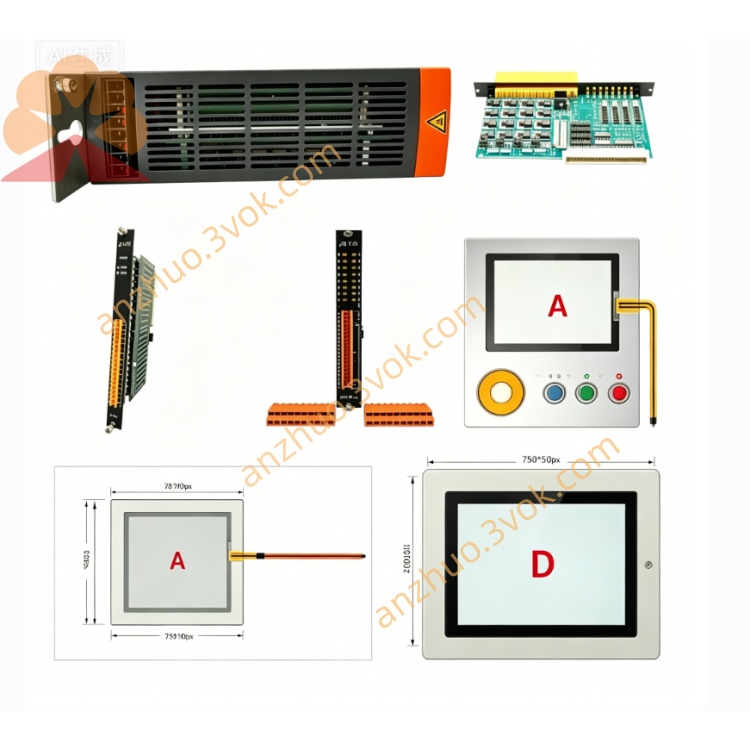
B&R 3IF787.9-1 Interface Module
Description
B&R 3IF787.9-1 Interface Module - Detailed Product Description
I. Basic Information
B&R 3IF787.9-1 is an aPCI dual-bus interface module specifically designed by Austria-based B&R for the 2005 system and the Automation PC platform. It integrates 1 POWERLINK real-time Ethernet interface and 1 CAN bus interface, enabling simultaneous connection of high-speed real-time buses and traditional field buses, achieving interconnection and protocol conversion of heterogeneous networks, and is suitable for installation in a control cabinet's aPCI slot. It is widely used in motion control, distributed I/O, networking of old equipment, and scenarios of mixed multi-bus networking, serving as the core interface component for connecting real-time control and traditional industrial networks. B&R Industrial Automation.
II. Core Technical Parameters
(1) Hardware Interfaces
POWERLINK Interface (IF2): Type 3 interface, compatible with POWERLINK V1/V2, configurable as a master (management node) or slave (controlled node), standard RJ45 connector, supports 100 Mbps rate, single segment maximum transmission distance 100 meters, suitable for real-time motion control networks B&R Industrial Automation.
CAN Bus Interface (IF1): 4-pin male multi-point connector, supports CAN 2.0A/B protocol, maximum transmission rate 500 kbps, maximum communication distance 1000 meters (at 125 kbps rate), built-in bidirectional object buffer, supports multi-node networking B&R Industrial Automation.
System Bus Interface: Standard aPCI bus, compatible with B&R 2005 series CPUs, Automation PC 910 and other devices, powered directly by the slot, no need for additional external power supply.
Electrical Isolation: POWERLINK, CAN interfaces are fully electrically isolated from the system side, isolation voltage 2500V AC, effectively suppressing common-mode interference, surge voltage and electromagnetic interference, ensuring stable communication in harsh environments B&R Industrial Automation.
(2) Electrical Characteristics
Power Supply Voltage: 3.3V DC ±10% (typical power consumption 2.5W), 5V DC ±10% (typical power consumption 0.5W), total typical power consumption 3.0W, powered by the aPCI slot B&R Industrial Automation.
Working Current: 3.3V side typical 750mA, 5V side typical 100mA, low power consumption design suitable for compact power supply environments in cabinets, reducing heat dissipation pressure B&R Industrial Automation.
Anti-interference Capability: Compliant with IEC 61000-6-2/4 industrial electromagnetic compatibility standards, capable of withstanding strong electromagnetic interference from frequency converters, large power motors, etc.
(3) Environmental Adaptability
Operating Temperature: 0℃ to + 60℃ (horizontal standard installation), suitable for conventional industrial sites; for vertical installation or high-load scenarios, the environmental temperature should be reduced.
Storage Temperature: -25℃ to + 70℃, meets long-term storage, transportation and idle standby requirements.
Relative Humidity: 5% to 95%, no condensation, avoiding short circuits or corrosion in humid environments. Protection level: IP20, dust-proof and solid foreign object-proof, suitable for clean and dry installation environments within control cabinets. It should not be exposed directly to outdoor areas or areas with severe dust and moisture. B& R Industrial Automation.
Resistance to vibration and shock: Compliant with IEC 60068-2-6 (vibration) and IEC 60068-2-27 (shock), capable of withstanding regular mechanical vibrations and shocks in industrial environments. Long-term operation is not prone to loosening or failure.
(4) Performance indicators
POWERLINK performance: In master station mode, it can support up to 32 slave stations. The shortest bus cycle is 100μs. It supports hard real-time data transmission, meeting the requirements for multi-axis servo synchronization and high-precision motion control; In slave station mode, it supports high-speed real-time response, suitable for connecting servo drivers, remote I/O and other devices.
CAN bus performance: Supports CANopen protocol. It can connect CANopen slave station devices (such as sensors, actuators, frequency converters), supports NMT network management, PDO process data, and SDO service data transmission. Node ID can be configured. Networking is flexible.
Protocol support: Fully supports POWERLINK (V1/V2), CAN 2.0A/B, CANopen, and is compatible with TCP/IP basic network protocols. It realizes data interaction and protocol conversion between POWERLINK and CAN bus. B& R Industrial Automation.
System compatibility: Fully compatible with B&R Automation Studio development environment. Supports module parameter configuration, communication protocol settings, remote diagnosis, and online firmware upgrade. It is seamlessly compatible with the 2005 system and the Automation PC ecosystem.
III. Core functions
(1) POWERLINK real-time bus communication
As a high-speed real-time interface, it can be configured as a POWERLINK master or slave station. In master station mode, it manages the real-time motion network, connects servo drivers, encoders, and machine vision equipment, achieving multi-axis synchronous control and high-speed data transmission; In slave station mode, it connects to the superior POWERLINK network, expanding the system's real-time control nodes. The bus cycle is the shortest 100μs, ensuring hard real-time communication. B& R Industrial Automation.
(2) CAN bus and CANopen device interconnection
Integrated CAN bus interface. Supports CAN 2.0A/B and CANopen protocols. Can directly connect CANopen slave station devices, such as field sensors, temperature meters, pressure transmitters, frequency converters, remote I/O modules, etc., achieving seamless connection between traditional fieldbus devices and B&R real-time control system, compatible with upgrading scenarios of old CAN devices.
(3) Dual bus data bridging and protocol conversion
Core implementation of data intercommunication between POWERLINK real-time network and CAN bus. Supports bidirectional data mapping and forwarding. It can convert POWERLINK high-speed control data into CAN bus data or vice versa, solving the interconnection problems of new and old devices and different bus networks, simplifying heterogeneous system integration architecture, and reducing renovation costs.
(4) Bus diagnosis and status monitoring The module is equipped with multiple LED status indicators, which can display the module's power supply status, POWERLINK port connection / data transmission status, CAN bus communication status, and fault alarm status in real time. When combined with the Automation Studio software, it can achieve remote diagnosis, online status monitoring of nodes, analysis of communication load rate, fault location and log recording, and provide early warnings of risks such as bus overload and link failure, thereby reducing maintenance difficulty. B& R Industrial Automation.
(5) Hot-swappable and flexible system expansion
It is compatible with the hot-swappable function of the B&R 2005 system. Modules can be inserted and replaced without stopping the controller or shutting down the system, significantly reducing maintenance downtime. Through the aPCI slot, multiple modules can be installed in parallel, flexibly expanding the number of POWERLINK and CAN bus interfaces, and adapting to the expansion requirements of different-sized automation systems.
(6) Network management and data buffer
It has a bidirectional object buffer built-in, supporting data caching and forwarding for POWERLINK and CAN bus, avoiding data loss. It supports CANopen NMT network management, allowing configuration of node ID, baud rate, and PDO mapping parameters, adapting to the networking requirements of different CAN devices. POWERLINK supports network topology management to ensure the stable operation of the real-time network. B& R Industrial Automation.
Four. Product features
Dual-bus integrated design: It integrates POWERLINK real-time Ethernet and CAN bus interfaces simultaneously, allowing one module to handle both high-speed real-time control and traditional fieldbus communication, simplifying hardware configuration and reducing networking costs. B& R Industrial Automation.
Industrial-grade high reliability: It uses industrial-grade components, has a fanless cooling design, operates within a wide temperature range, and has strong electromagnetic interference resistance, adapting to harsh industrial environments with dust, vibration, and severe electromagnetic interference, ensuring stable and reliable operation over the long term. B& R Industrial Automation.
Hard real-time and compatibility: The POWERLINK bus supports microsecond-level communication cycles, with hard real-time transmission characteristics that meet the requirements of multi-axis synchronization and high-precision motion control; at the same time, it is compatible with CANopen legacy devices, adapting to scenarios of upgrading and transforming new and old systems. B& R Industrial Automation.
Compact modular design: Standard aPCI size, small in volume, can be directly fixedly installed by inserting into the aPCI slot of the control cabinet, occupying less space, suitable for the limited space layout of the control cabinet, and installation is convenient and efficient.
Protocol conversion and easy maintenance: Native support for POWERLINK and CAN bus protocol conversion to achieve interconnection of heterogeneous networks; LED status indicators + remote diagnosis via software provide dual guarantees for quick fault location; supports hot swapping, maintenance does not require stopping the system, reducing operation and maintenance costs. B& R Industrial Automation.
Seamless compatibility with B&R ecosystem: Fully compatible with the B&R 2005 system, Automation PC, and Automation Studio development environment, unified configuration, programming, and maintenance, supports firmware online upgrade, with strong compatibility and good scalability. B& R Industrial Automation. Global Certification Compliance: Achieve international industrial certifications such as CE, UKCA, KC, cULus HazLoc, etc., meet industrial safety and electromagnetic compatibility standards, and be applicable for use in industrial sites worldwide. The compliance is highly reliable. B& R Industrial Automation.
V. Application Scenarios
Expansion of Motion Control System: As a POWERLINK slave or master, connect servo drives and encoders to build a multi-axis motion control network. At the same time, connect auxiliary sensors and actuators through the CAN bus to achieve high-precision synchronous control and linkage with auxiliary equipment, suitable for robots, CNC machines, packaging machinery, etc. B& R Industrial Automation.
Renovation of Old CAN Devices: Connect traditional CANopen sensors, frequency converters, and remote I/O modules to the Bechtel POWERLINK real-time control system to enable data exchange between new and old devices without the need to replace existing CAN devices, reducing the cost of upgrading and renovation.
Distributed I/O Hybrid Networking: Connect high-speed remote I/O through POWERLINK and low-speed on-site I/O through the CAN bus to build a hierarchical distributed control system, balancing high-speed control and low-cost on-site signal acquisition, suitable for intelligent manufacturing lines, intelligent warehousing logistics, etc. B& R Industrial Automation.
Multi-Bus Protocol Conversion Gateway: As a protocol conversion gateway between POWERLINK and CAN bus, realize data interaction between two heterogeneous networks, adapt to automation systems with mixed use of multiple brands and multiple protocols, and solve the problem of equipment interconnection.
Special Industrial Control Scenarios: Adapt to industries such as metallurgy, power, chemical engineering, and rail transportation, operate stably in strong electromagnetic interference and wide temperature environments, achieve reliable transmission of real-time control signals and on-site bus data, ensuring production safety and stability. B& R Industrial Automation.
VI. Installation and Usage Precautions
Installation Environment Requirements: The module should be installed in a sealed control cabinet, maintaining internal ventilation, dryness, cleanliness, and dust-free; the environmental temperature should be controlled within 0°C to + 60°C, away from damp, corrosive gases, strong heat sources, and frequency converters, large-power motors, etc., which are strong electromagnetic interference sources, to avoid affecting communication stability and module lifespan.
Installation Operation Specifications: Before installation, the power supply of the controller and control cabinet must be cut off to prevent damage to the module due to live operation; align the module with the aPCI slot and push it in smoothly to ensure that the gold fingers are fully in contact with the slot without any deviation or looseness; tighten the module fixing screws; after installation, check if the module is firmly fixed without shaking; the TB704 wiring terminal for CAN bus wiring must be ordered separately.
Wiring and Wiring Requirements: The POWERLINK port uses standard shielded twisted-pair cables, the RJ45 interface is firmly inserted, the cable shielding layer is grounded at one end; the CAN bus uses dedicated shielded bus cables, the 4-pin connector is connected according to the specification, keep away from power cables, high-voltage cables, avoid parallel long-distance wiring, reduce electromagnetic interference; all wiring must be neat and orderly, with clear markings, facilitating later maintenance. B& R Industrial Automation.
Parameter Configuration and Debugging: After power-on, identify the module through the Automation Studio software, configure the POWERLINK master/slave mode, IP address, bus cycle, configure the CAN bus baud rate, node ID, CANopen parameters (PDO mapping, NMT mode); After configuration is completed, download the parameters to the module and restart the module to take effect; during the debugging stage, check the LED status indicator light, monitor the communication status and bus load rate through the software, and troubleshoot communication faults. B& R Industrial Automation.
Maintenance and servicing: Regularly (monthly) check if the module is securely fixed, if the wiring is loose, and if the LED status is normal. Use a dry soft cloth to clean the dust on the module surface to avoid dust accumulation affecting heat dissipation; avoid frequently plugging and unplugging the module to prevent wear on the gold fingers and poor contact; firmware upgrades must be operated through the official Automation Studio software of Beckhoff. During the upgrade process, it is strictly prohibited to power off or plug and unplug the module to prevent damage to the module firmware. B& R Industrial Automation.
Fault handling prohibitions: When the LED fault indicator alarms or the software diagnoses communication abnormalities, first check for loose wiring, baud rate / node ID conflicts, excessive bus load, and network loops, and gradually troubleshoot;严禁 plugging and unplugging the faulty module while powered on to prevent short circuits or electric shock hazards; when the fault cannot be resolved, contact the official Beckhoff technical support or authorized dealers, and do not attempt to disassemble or repair the module yourself.
Get a Quote