
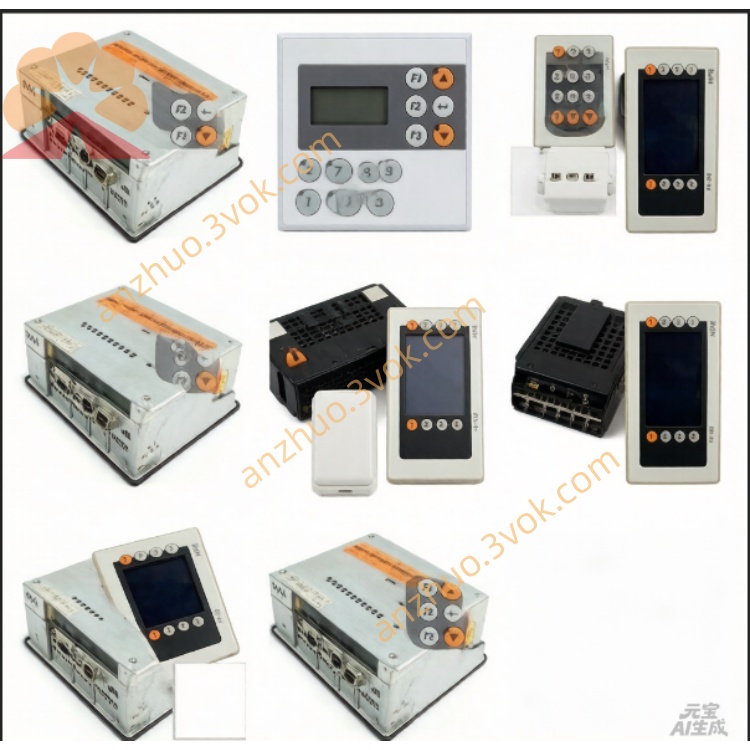
B&R 3IF772.9 Network and Fieldbus Module
Description
3IF772.9 Network and Fieldbus Modules Detailed Product Description
Product Introduction
3IF772.9 is an aPCI bus dual CAN+RS232 network and fieldbus module from B&R SYSTEM 2005 platform, specially designed for multi-bus integration communication and distributed control in industrial environments. The module integrates two independent isolated CAN-Bus fieldbus interfaces and one configurable RS232 serial port. It is installed in a plug-in manner, compatible with 2005 series CPUs and IF060, IF260 standard IF slots. The module has a width of approximately 35mm, a height of 126.1mm, a depth of 54mm, a weight of about 0.15kg, a protection level of IP20, and is limited to indoor control cabinets. The power supply is provided by the system backplane at 3.3VDC and 5VDC. The power consumption is 0.2W at 3.3VDC and 1.8W at 5VDC, totaling approximately 2.0W. No additional external power supply is required. It has passed international industrial certifications such as CE, UKCA, EAC, and KC, and complies with industrial EMC and safety standards, suitable for long-term stable operation in industrial scenarios.
Key Features and Positioning
This module serves as the core expansion component of the multi-protocol network and fieldbus of SYSTEM 2005 PLC, integrating dual CAN fieldbus and RS232 interfaces to achieve redundant communication of fieldbuses, multi-device networking, and serial data interaction. Both CAN-Bus interfaces have electrical isolation functions, effectively suppressing ground loop currents and field interference, supporting CAN 2.0A/B protocols and CANopen master/slave station mode, with a maximum of 500kbps for each path. It can build redundant CAN fieldbus networks or connect multiple CANopen servo, frequency converters, remote I/O, field sensors, and actuators. The RS232 interface can be configured online as a debugging interface or data transmission interface, connecting to the upper computer, serial terminal, and enabling program download, on-site monitoring, and data interaction with third-party serial devices. The interfaces and interfaces with the system bus are electrically isolated, with strong anti-interference capability; it supports hot plugging, allowing for on-site replacement without downtime, reducing on-site operation risks; it can complete CAN baud rate, node address, RS232 parameters, and CANopen configuration through Automation Studio software, suitable for redundant CAN fieldbus construction, multi-CAN device networking, online serial debugging, and multi-protocol on-site communication renovation of old equipment scenarios.
Core Performance Parameters
The communication interfaces include 2 CAN-Bus (4-pin male connector) multi-point connectors, 1 RS232 (9-pin male connector DSUB connector), all with electrical isolation. Supported protocols: CAN 2.0A/B, CANopen master/slave station, RS232 asynchronous communication. CAN transmission rate up to 500kbps, supporting adjustable baud rates from 10kbps to 500kbps; RS232 up to 115.2kbps. The CAN bus topology is linear. A single network segment can have up to 110 nodes, with a transmission distance ranging from 1000 meters (10 kbps) to 40 meters (500 kbps); the maximum transmission distance for RS232 is 900 meters. Data processing: CAN transmits data bidirectionally through two-way object buffering, supports PDO and SDO communication, and offers flexible process data throughput. The total power consumption is approximately 2.0W. The operating environment temperature ranges from 0°C to + 60°C, the storage temperature ranges from -25°C to + 70°C, the relative humidity is 5%–95%, and there is no condensation. The panel is equipped with multiple groups of LED indicators: 2 for displaying data from the RS232 interface transmission, 1 for each CAN interface sending data indication, which can display real-time bus activity, fault alarms, and power status, and support rapid on-site diagnosis. The configuration method is through Automation Studio software configuration, setting the baud rate, node address, communication cycle, and CANopen parameters.
General adapter components
Communication cable adapters are compatible with CAN-Bus standard shielded twisted pair and RS232 shielded cables; connection accessories include 4-pin CAN connector terminals, 9-pin RS232 shielded connectors, CAN bus termination resistors; optional accessories include SYSTEM 2005 series standard backplane (6/9/12 slots), DIN rail installation kit; accompanying software tools include B&R Automation Studio programming configuration software, CANopen configuration tool, network diagnostic tool, and bus monitoring software.
Applicable equipment fields
Widely used in industrial automation systems such as SYSTEM 2005 PLC control systems, CANopen distributed I/O systems, and factory CAN fieldbus networks; suitable for CANopen servo/variable frequency network connection, data interaction between PLC and CAN sensors/indicators, distributed motion control and process monitoring systems; can be paired with general industrial machinery equipment such as CNC machines, industrial robots, packaging machinery, textile equipment, injection molding machinery, electronic processing equipment; in construction machinery, rail transit, and new energy equipment, used for CAN bus control and data acquisition; also compatible with redundant CAN fieldbus construction, multi-protocol communication expansion, upgrading of old equipment fieldbus, and upgrading of distributed control system architecture.
Get a Quote