
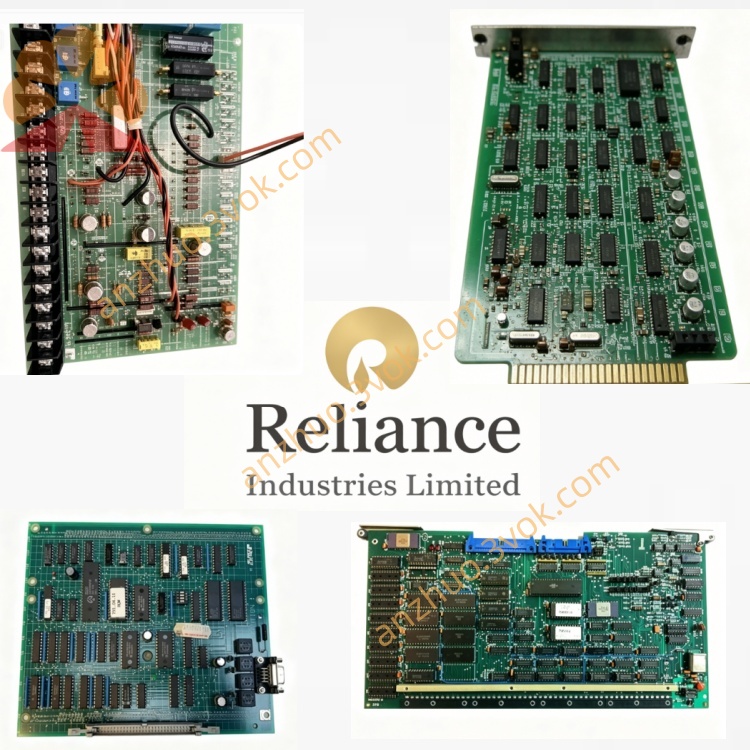
0-57C407
Description
Model Definition
0-57C407: Full part number
Leading 0: Factory-original, unmodified unit
57C407: Base model (DCS 5000 processor module)
Series: AutoMax 57C Series (Reliance PLC/DCS) / DCS 5000 Series
Common variants: 0-57C407-4H (high-temperature + conformal coating)
Technical Specifications
General
Brand: RELIANCE (Reliance Electric / Baldor Reliance)
Type: DCS 5000 System Processor / Network Controller Module
Form Factor: 1-slot AutoMax rack-mount (slots 0–4 only)
Dimensions: 11.75 in (H) × 3.5 in (W) × 1.2 in (D) approx
Weight: ~1.2 kg (2.6 lbs)
Operating Temperature: 0°C to +60°C (standard); ‑20°C to +70°C (‑4H variant)
Storage Temperature: ‑40°C to +85°C
Humidity: 5%–95% non-condensing
Isolation: 1500 Vrms processor-to-backplane
Certifications: CE, RoHS, UL listed
Processor & Memory
CPU: 16-bit DCS 5000 processor, 8 MHz clock
RAM: 128 KB (user program + data)
ROM: 64 KB (firmware/OS)
Backup: Lithium battery (≥5 years retention)
Scan Time: 1 ms typical (1K logic instructions)
Communication
Network Protocol: DCS-Net (proprietary, 1 Mbps)
Serial Ports: 2 × RS-232 (Programmer + Local Comm, 19.2 kbps)
Backplane: AutoMax Multibus (2 Mbps)
Node Capacity: Up to 32 nodes per DCS-Net network
Compatibility: DCS 5000 racks (57C331/332/334); AutoMax I/O modules
Electrical
Backplane Power: +5 VDC ±5% (from rack power supply)
Current Draw: 1.0 A (typical), 1.5 A (max)
Protection: Overvoltage, overcurrent, ESD, transient suppression
Interface & Communication Configuration
Physical Interfaces
Front Panel:
2 × 7-segment LED fault indicators (1st/2nd)
Green OK LED (steady = run, flash = fault)
2 × RS-232 DB9 ports (Programmer / Local Comm)
Backplane: AutoMax proprietary edge connector (power + Multibus + DCS-Net)
LED Indicators
OK: Green (steady = normal operation; flashing = fault/init)
1st/2nd: 7-segment red LEDs (fault code display)
Core Functions
DCS 5000 System Control: Executes user logic for motion/process control; coordinates I/O modules.
DCS-Net Network Management: Manages 1 Mbps proprietary network; connects up to 32 nodes.
Serial Communication: 2 × RS-232 ports for programming, HMI, or local device connection.
Fault Diagnosis: 7-segment LEDs display fault codes for quick troubleshooting.
Battery-Backed Memory: Preserves program/data during power outages (≥5 years).
Backward Compatibility: Direct replacement for all 57C407 variants in legacy DCS 5000 systems.
Application Scenarios
Legacy DCS 5000 Retrofits: Direct CPU replacement for 57C407 in industrial control systems.
Motion Control: Coordinates drives (SD3000/SF3000/SA3000) for conveyors, cranes, machine tools.
Process Control: Central control for water treatment, packaging, material handling, oil/gas.
Distributed I/O Systems: Manages remote I/O via DCS-Net in large-scale factories.
Harsh Environments: ‑4H variant for high humidity, dust, or temperature extremes.
Usage & Maintenance Instructions
Installation
Power Off: De-energize the DCS 5000 rack before insertion.
Insert Module: Align with slots 0–4 only; push firmly until backplane connector seats.
Secure: Tighten captive screws (torque 0.8–1.0 N·m).
Wiring: Connect RS-232 devices to front-panel DB9 ports; use shielded cable for noise immunity.
Operation
Power-On: OK LED flashes (~5 s) during self-test; 7-segment LEDs show init codes.
Normal: OK steady green; no fault codes displayed.
Fault: OK flashes red; 7-segment LEDs show fault code → check wiring, network, or battery.
Get a Quote