
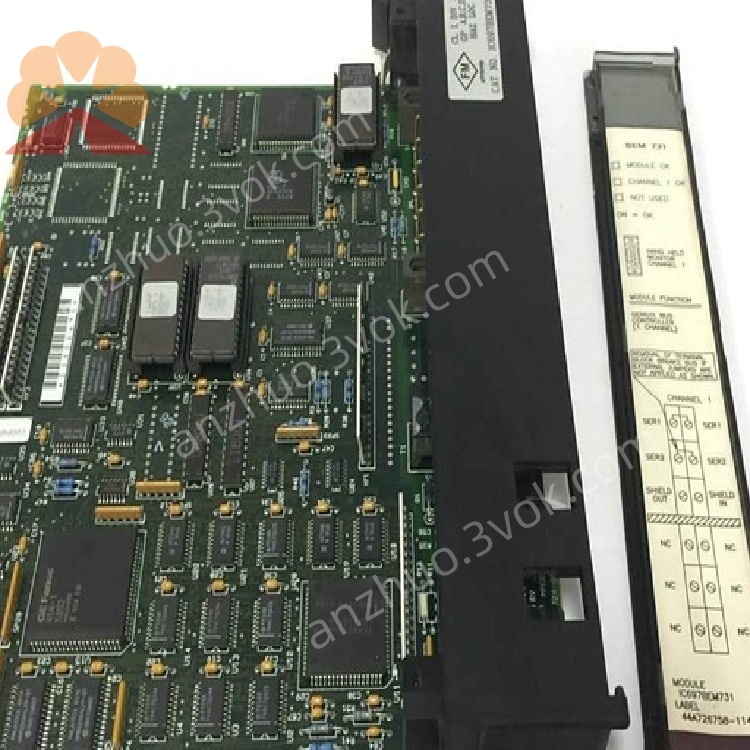
GE Fanuc IC697CPX928-FE Series 90-70 High Performance CPU Module
Description
1. General Description1.1 Product Overview
High‑Speed Processor: 96 MHz 80486DX4 32‑bit CPU with on‑chip floating‑point unit (FPU).
Large Memory: 6 MB battery‑backed CMOS RAM (user/program/data); 256 KB non‑volatile flash memory (optional).
Firmware Upgradeable: OS stored in flash; update via serial port without hardware changes.
Multi‑Communication Ports: 1×RS‑232, 2×RS‑485; supports SNP, SRTP, Modbus RTU.
High I/O Capacity: Up to 12,288 total I/O points (digital + analog).
Redundancy Support: Hot‑standby redundancy with <50 ms automatic failover.
Run/Stop Control: Three‑position switch (RUN/STOP/LOCK) for local operation.
Memory Protection: Software password + physical keyswitch to lock program/config data.
LED Status Indicators: Seven on‑board LEDs for power, run, fault, and communication status.
Industrial Ruggedness: IP20 rated; conformal‑coated PCB; extended temperature range.
2. Technical Specifications
2.1 Processor & Performance
| Parameter | Specification |
|---|---|
| Processor | 80486DX4 (32‑bit, FPU) |
| Clock Speed | 96 MHz |
| Execution Speed | 0.15 ms/K instructions (Boolean) |
| Floating‑Point | Native FPU (real‑time complex math) |
| Redundancy | Hot‑standby, failover <50 ms |
2.2 Memory
| Type | Capacity | Retention |
|---|---|---|
| User RAM | 6 MB CMOS (program/data/config) | Lithium battery‑backed |
| User Flash | 256 KB (optional, non‑volatile) | Permanent (no battery) |
| Firmware Flash | 1 MB (OS) | Upgradeable via serial |
2.3 Communication Interfaces
| Port | Type | Protocols |
|---|---|---|
| Channel 1 | RS‑232 (D‑sub 9) | SNP, SRTP, Modbus RTU |
| Channel 2/3 | RS‑485 (terminal block) | SNP, Modbus RTU, slave networking |
| Backplane | VMEbus | I/O, module, and CPU redundancy link |
2.4 I/O & System
| Parameter | Specification |
|---|---|
| Max I/O Points | 12,288 (digital + analog) |
| Rack Compatibility | IC697 series racks (e.g., IC697CHS770D) |
| Power Supply | 5 VDC (backplane‑powered) |
| Power Consumption | ≤10 W (typical) |
2.5 Environmental & Mechanical
| Parameter | Specification |
|---|---|
| Operating Temperature | 0°C to +60°C (32°F to +140°F) |
| Storage Temperature | −40°C to +85°C (−40°F to +185°F) |
| Relative Humidity | 5%–95% (non‑condensing) |
| Altitude | Up to 2,000 m (derate >1,000 m) |
| Protection Class | IP20 (front; install in cabinet) |
| Dimensions (H×W×D) | 150 mm × 80 mm × 35 mm (5.9” × 3.1” × 1.4”) |
| Weight | Approx. 0.5 kg (1.1 lb) |
3. Front Panel Layout
3.1 Controls & Indicators
- RUN/STOP/LOCK Switch
RUN: Execute program; enable I/O.
STOP: Halt program; disable I/O.
LOCK: Prevent local mode changes (software override possible).
- Memory Protect Keyswitch
ON: Write‑protect program/config data.
OFF: Allow read/write access.
- LED Indicators (7)
PWR: ON = Backplane power OK.
RUN: ON = Program executing; blinking = fault.
FAULT: ON = System error (CPU, memory, I/O).
COM1/2/3: Blinking = Activity on respective ports.
REDUND: ON = Redundancy active; blinking = failover.
- Ports
RS‑232: D‑sub 9 (programming/HMI).
RS‑485: Terminal blocks (Ch2/Ch3).
4. Installation Instructions
4.1 Pre‑Installation
Power Off: Disconnect all rack power before installation.
Unpack & Inspect: Check for physical damage; verify connectors and battery.
Battery Installation: Insert lithium CMOS battery into the onboard slot (maintains RAM data during power loss).
4.2 Rack Mounting
Slot Selection: Install the CPU in Slot 1 of the IC697 rack (primary segment; redundant CPU in Slot 7 for dual‑redundant racks like IC697CHS770D).
Insertion: Align module with rack guides; push firmly until backplane connectors fully seat.
Secure: Tighten front panel screws (torque: 0.8–1.0 N·m).
Grounding: Ensure rack chassis is connected to protective earth (PE).
4.3 Wiring
RS‑232: Connect D‑sub 9 cable to programming PC/HMI.
RS‑485: Wire to terminal blocks (Ch2/Ch3) for fieldbus networks; observe polarity.
Redundancy: Connect CPU redundancy link cable between primary and secondary CPUs (for hot‑standby).
5. Redundant System Configuration
5.1 Redundancy Setup
Dual CPUs: Install two identical IC697CPX928‑FE modules (primary in Slot 1, secondary in Slot 7 of a dual‑redundant rack).
Redundancy Link: Connect dedicated synchronization cable between primary and secondary CPUs.
Configuration Software: Use GE Fanuc programming software to enable hot‑standby mode and set failover parameters.
5.2 Redundancy Operation
Primary Active: Primary CPU controls I/O and executes program; secondary CPU mirrors all data (hot standby).
Failover: On primary failure (CPU, power, or critical I/O), system switches to secondary in <50 ms (no PLC downtime/reset).
Resynchronization: After repair, primary automatically resynchronizes with secondary; redundancy restored.
6. Maintenance & Troubleshooting
6.1 Preventive Maintenance
Battery Replacement: Every 3–5 years (or when low‑battery LED alerts); use GE‑specified lithium battery.
Cleaning: Every 3–6 months, use low‑pressure dry air to remove dust from module, ports, and rack.
Inspection: Check module seating, connector integrity, LED status, and redundancy cable connections.
6.2 Common Troubleshootin
| Symptom | Possible Cause | Solution |
|---|---|---|
| PWR LED OFF | No backplane power; faulty rack/power supply | Check rack power supply; verify module seating |
| RUN LED OFF / FAULT LED ON | Program error; memory fault; I/O overload | Check program logic; verify battery; inspect I/O modules |
| COM LED Not Blinking | No communication; wrong wiring; protocol mismatch | Check cable connections; verify protocol settings |
| REDUND LED OFF | Secondary CPU offline; missing/broken link cable | Verify secondary CPU power; check/replace redundancy cable |
| REDUND LED Blinking | Failover in progress; configuration mismatch | Check primary CPU faults; ensure identical firmware/config on both CPUs |
7. Safety & Compliance
7.1 Safety Warnings
Disconnect all power before servicing.
Do not open the module casing; no user‑serviceable parts inside.
Avoid moisture, dust, and corrosive gases.
Proper chassis grounding is required for safety and EMC.
7.2 Compliance Certifications
CE: EN 61000‑6‑2 (EMC), EN 61010‑1 (LVD).
UL: UL 508 (industrial control equipment).
CSA: CSA C22.2 No. 142.
RoHS: EU RoHS compliant.
8. Ordering Information
Model: IC697CPX928‑FE
Manufacturer: GE Fanuc (Emerson Automation)
Series: Series 90‑70 PLC
Standard Warranty: 12 months
Get a Quote