
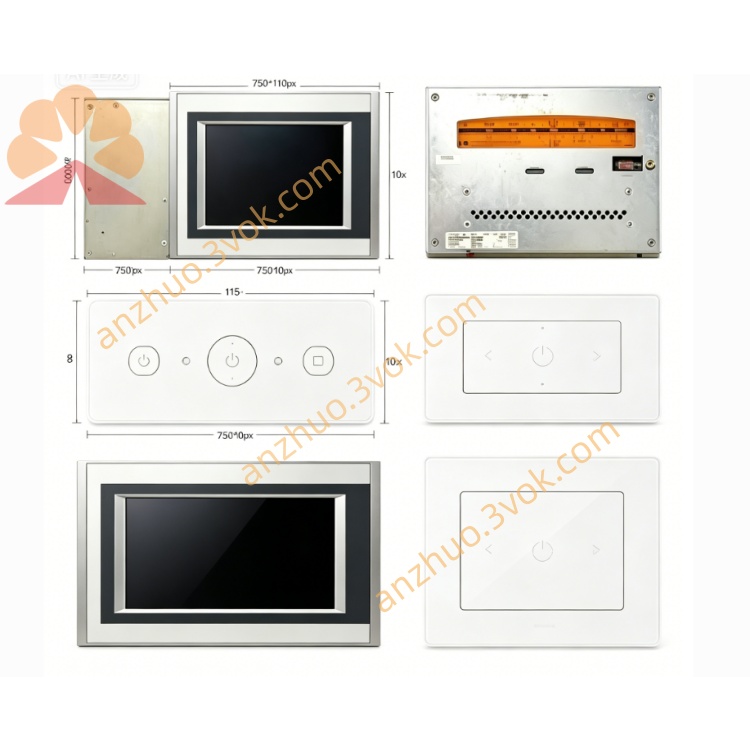
B&R 7CP470.60-1 Module
7CP470.60-1 is not a passive bus slave module. It is a high-performance master CPU controller for the B&R System 2003 PCC industrial control platform, manufactured in Austria in compliance with European industrial quality standards. It integrates the internal backplane bus master controller as a core built-in function, while external fieldbus physical interfaces rely on separate 7CM series bus expansion modules such as 7CM411.70-1. This CPU takes full charge of bus network scheduling, data processing and overall system coordination, rather than only acting as a bus signal transceiver. The System 2003 product line has been officially discontinued by B&R. Available stock consists of brand-new original surplus units and fully tested refurbished spare parts for maintenance, equipment retrofits and urgent replacement of legacy production machinery. The module holds CE and UL/cULus industrial safety certifications, with enhanced EMC anti-interference circuits to withstand electromagnetic noise from inverters, servo drives and contactors inside factory control cabinets.
Description
Product Description of B&R 7CP470.60-1 Module
1. Core Product Definition Correction
7CP470.60-1 is not a passive bus slave module. It is a high-performance master CPU controller for the B&R System 2003 PCC industrial control platform, manufactured in Austria in compliance with European industrial quality standards. It integrates the internal backplane bus master controller as a core built-in function, while external fieldbus physical interfaces rely on separate 7CM series bus expansion modules such as 7CM411.70-1. This CPU takes full charge of bus network scheduling, data processing and overall system coordination, rather than only acting as a bus signal transceiver. The System 2003 product line has been officially discontinued by B&R. Available stock consists of brand-new original surplus units and fully tested refurbished spare parts for maintenance, equipment retrofits and urgent replacement of legacy production machinery. The module holds CE and UL/cULus industrial safety certifications, with enhanced EMC anti-interference circuits to withstand electromagnetic noise from inverters, servo drives and contactors inside factory control cabinets.
2. Mechanical Installation and Bus Slot Matching
This CPU uses the unified System 2003 plug-in form factor, compatible with all 7BP DIN rail backplanes including 7BP701.1, 7BP702.0, 7BP703.0, 7BP704.0, 7BP707.0, 7BP708.0 and 7BP709.0. It must be inserted into the first primary master slot of the backplane, which is the only position authorized to activate the internal backplane bus master function. All subsequent slots serve as slave positions for bus expansion modules, analog I/O, digital I/O and counter units. If installed into any slave slot, the backplane bus will fail initialization and trigger persistent fault alarms.
An integrated elastic snap lock at the bottom secures the module onto a standard 35 mm DIN rail after full horizontal insertion into the master slot, with no extra fixing brackets required. The enclosure is flame-retardant reinforced industrial plastic with an IP20 protection rating, limited to installation inside sealed indoor electrical cabinets only. Multiple front-panel LED indicators display power status, RUN/STOP mode, backplane bus communication status, system fault alerts and RTC backup power for real-time clock operation, enabling quick on-site bus health diagnosis without external testing equipment. Permanent laser marking on the housing shows the B&R logo, full part number 7CP470.60-1, hardware revision, unique serial number and Austrian production batch for complete supply chain traceability and genuine validation. The mechanical design meets EN 60068-2-6 vibration standards to endure continuous oscillation from servo axes, conveyors and processing equipment during long-term bus network operation.
3. Electrical Bus Performance and Power Supply
The CPU runs on 24 V DC power delivered through the backplane’s internal power bus, with an allowable operating voltage range of 18 V DC to 30 V DC. No independent high-voltage power supply is needed for the bus control circuitry. Power consumption is stable and moderate, without overloading System 2003 dedicated rack power supplies. An onboard replaceable backup battery maintains the real-time clock to timestamp bus fault logs, communication records and production recipes through brief power outages.
As the proprietary System 2003 backplane bus master, the CPU employs differential signal transmission with built-in hardware filtering. It performs cyclic polling, task priority allocation and synchronized bidirectional data exchange with every slave module on the rack, including 7CM bus modules like 7CM411.70-1, analog I/O, digital I/O and counter modules. Full galvanic isolation separates the CPU core logic from the backplane bus signals to eliminate ground loop interference, a major cause of bus jitter and frame loss in noisy industrial environments. Multi-layer electrical protection covers overvoltage, overcurrent, reverse polarity and ESD surges to prevent permanent damage to bus transceiver circuits from wiring errors or power transients. All backplane contact pins are gold-plated to sustain stable bus conduction and anti-oxidation performance under long-term vibration.
4. Bus Related Interface Layout
No native external fieldbus physical ports are mounted directly on the 7CP470.60-1 CPU housing. All external fieldbus connections to servo drives, HMIs, remote I/O and third-party controllers require installation of 7CM bus expansion modules into vacant slave backplane slots. The CPU’s embedded backplane bus controller manages all internal rack bus traffic without external auxiliary transceiver chips. A separate isolated programming interface on the front panel connects to B&R Automation Studio via official download cables for project configuration, bus parameter setup and online bus monitoring; this port is electrically isolated from both the internal backplane bus and external fieldbus networks to avoid disrupting real-time bus control during debugging sessions.
5. Core Bus Management Functions
5.1 Internal Backplane Bus Master Control
The CPU acts as the sole master for the System 2003 rack backplane bus. It sets communication cycle times, polls each slave module sequentially, synchronizes I/O sampling and actuator output timing, and distributes bandwidth across all expansion units including bus interface modules. It collects status data from each 7CM bus module and compiles unified network information for system fault evaluation.
5.2 External Fieldbus Network Coordination
Each 7CM bus expansion module acts as a fieldbus physical interface slave under the CPU’s master logic. The CPU generates motion commands, analog setpoints and digital control signals, packages data for transmission through the 7CM modules to fieldbus slave devices such as ACOPOS servo drives and frequency converters. It also receives feedback data including axis position, torque, temperature and fault codes from field nodes via the same bus modules, processing values to execute closed-loop motion and process control. Multiple independent fieldbus segments can be managed simultaneously when several 7CM modules are fitted in one rack.
5.3 Bus Fault Detection and Safe Response
Continuous real-time monitoring tracks backplane module presence, bus signal integrity, communication timeouts, power fluctuations and runtime program errors. If critical bus failures occur, the CPU executes preprogrammed safe state routines: stopping all servo axes, de-energizing hazardous actuators, activating alarm outputs and locking unsafe machine movements to protect personnel, tooling and workpieces. It records detailed bus fault timestamps and error codes in internal memory for post-failure analysis.
5.4 Bus Parameter Configuration via Software
All bus settings including station addresses, baud rates, protocol selection, data mapping tables and communication cycle times are fully configured, compiled and downloaded using B&R Automation Studio. There are no physical hardware jumpers or dials on the CPU for bus adjustment; all network layout modifications are completed through software project editing, simplifying multi-bus system commissioning and later adjustments.
6. Environmental Operating Conditions
Continuous operational ambient temperature ranges from 0 °C to +60 °C, suitable for control cabinets on injection molding machines, packaging lines, CNC machining centers, textile equipment and water treatment regulation systems. Storage and transportation temperatures span -25 °C to +70 °C. Ambient humidity must stay between 5% and 95% non-condensing. The module cannot be deployed in environments with corrosive vapors, persistent high humidity, heavy dust, liquid splashes or flammable explosive atmospheres; fully sealed ventilated protective cabinets are required for harsh workshop conditions. Shielded twisted-pair wiring is mandatory for programming cables and external fieldbus lines to preserve long-distance bus communication stability and noise immunity. The embedded real-time operating system delivers precise fixed cycle times to guarantee synchronized multi-bus, multi-axis and multi-loop control performance.
7. Compatible System 2003 Hardware Ecosystem
7CP470.60-1 only works with other System 2003 series hardware and is mechanically and electrically incompatible with later B&R platforms (X20, X67, APC, standalone ACOPOS drives) and third-party PLC rack systems. Fully matching supporting hardware includes all 7BP DIN rail backplanes, 7AF104.7 analog adapter bases paired with 7AI analog input and 7AO analog output submodules, System 2003 digital input and digital output submodules, counter and positioning expansion modules, 7CM fieldbus communication modules (primary example 7CM411.70-1), 7AC020.9 blank slot baffles for unused positions and dedicated 24 V DC rack power supplies built for System 2003 racks. All empty slave slots must be covered with 7AC020.9 baffles to stabilize backplane bus impedance, block dust and pin oxidation, and prevent signal reflection that degrades bus communication reliability between the CPU and 7CM bus modules.
8. Typical Industrial Applications with Bus Network Architecture
This CPU serves as the bus coordination core for legacy System 2003 automated machinery across discrete and process manufacturing. Key equipment includes medium and large plastic injection molding machines with multi-axis servo fieldbus networks, high-speed packaging and filling lines with positioning servo and valve drive bus segments, textile winding and drying machinery with spindle and tension drive bus links, CNC lathes, milling machines and machining centers with X/Y/Z feed and spindle servo bus systems, printing presses, multi-station automated assembly lines with clamping and ejection servo bus networks, food and beverage thermal processing equipment, municipal water treatment multi-pump regulation cabinets with frequency converter bus connections, and heavy-duty long-distance material conveyor systems with speed adjustment drive bus channels. It is the essential replacement master unit for System 2003 machine maintenance, maintaining full compatibility with existing installed bus modules, I/O units and fieldbus slave devices without full rack replacement.
9. Quality Assurance, Commissioning and Maintenance Rules
Every authentic 7CP470.60-1 CPU has a unique serial number archived in B&R’s Austrian production database for full traceability and authenticity verification. Refurbished units undergo strict pre-delivery bus testing: backplane plug vibration cycling, power fluctuation aging, bus cycle stability checks, compatibility validation with 7CM modules and ACOPOS servos, LED function verification and 72-hour continuous burn-in under simulated factory bus interference conditions. Qualified refurbished products carry a standard supplier warranty of 12 to 24 months.
Standard commissioning steps begin with securely mounting the 7BP backplane onto a 35 mm DIN rail inside the cabinet. Insert the 7CP470.60-1 into the first master slot and lock the snap buckle firmly. Install analog I/O, digital I/O and 7CM bus expansion modules into subsequent slave slots one by one and lock each buckle. Energize the rack 24 V power supply and confirm the CPU power LED illuminates normally. Connect a PC running B&R Automation Studio to the CPU programming port using official download cable. Create or open the user project, configure backplane module layout, internal backplane bus parameters, external fieldbus protocol settings, slave node addresses and motion control logic within the software. Compile the full project and download it to the CPU’s non-volatile program memory. Switch the CPU from STOP to RUN mode, inspect front LEDs to confirm healthy backplane bus communication and no active fault codes. Perform manual jog tests, I/O signal verification and fieldbus slave connection checks before enabling fully automatic production operation.
Unauthorized disassembly of the CPU PCB, memory chips, bus interface transceivers or onboard circuit modification is strictly forbidden, as tampering voids all warranty and creates critical risks of bus network collapse, uncontrolled axis movement, machine collision and unplanned production downtime. Spare backup CPUs must be stored long-term in dry, stable-temperature, low-humidity warehouses to avoid pin oxidation, plastic housing degradation and internal circuit moisture damage. When replacing a faulty CPU on active bus-controlled production equipment, fully back up all recipes, machine parameters and project files first. Install a mechanically and bus-compatible replacement unit, restore saved data post-installation and revalidate project matching with the existing layout of 7CM bus modules and I/O hardware before restarting production.
Get a Quote