
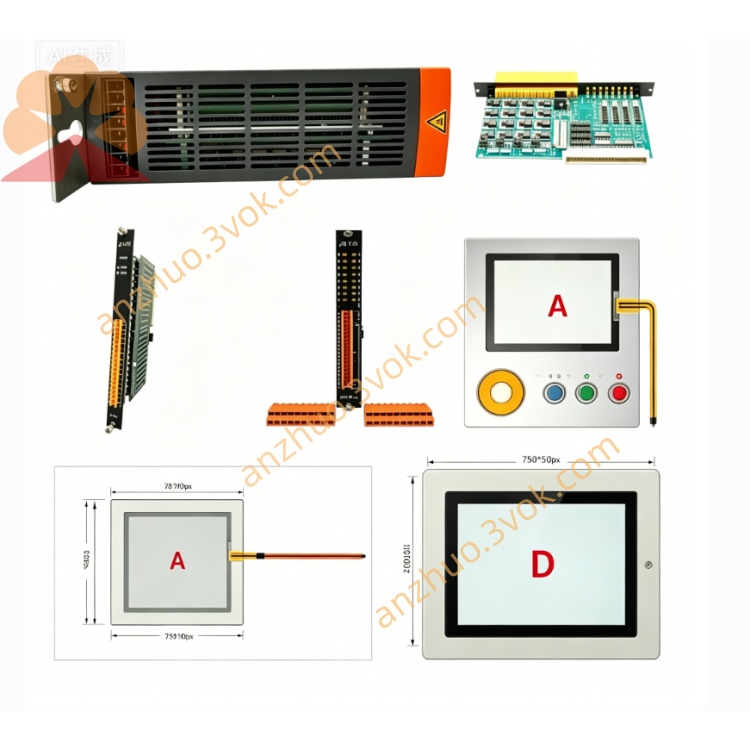
B&R 7CM411.70-1 Module
7CM411.70-1 is not a servo drive amplifier or power drive unit. It is a pluggable fieldbus communication expansion module built exclusively for the B&R System 2003 PCC industrial control platform, fully manufactured in Austria to certified European industrial quality standards. This unit contains no high-power output circuits, motor winding drive stages, current/velocity position loop control hardware or power switching components required to operate servo motors. All servo motion closed-loop control, power amplification and motor driving tasks are handled by independent B&R ACOPOS servo drive units. The sole purpose of the 7CM411.70-1 is to transmit motion command data, position feedback values, servo fault codes and parameter sets between the local System 2003 control rack and external servo drives via industrial fieldbus networks. The entire System 2003 hardware series has been officially discontinued by B&R headquarters. Available stock includes brand-new original imported modules and fully validated refurbished spare parts for legacy machine maintenance, production line retrofits and emergency component replacement. The module holds CE and UL/cULus global industrial safety certifications, equipped with galvanic isolation and surge suppression circuits to run steadily inside electrical cabinets with heavy electromagnetic noise generated by high-power servo and spindle drive systems.
Description
Product Description for B&R 7CM411.70-1 Module
1. Critical Product Clarification
7CM411.70-1 is not a servo drive amplifier or power drive unit. It is a pluggable fieldbus communication expansion module built exclusively for the B&R System 2003 PCC industrial control platform, fully manufactured in Austria to certified European industrial quality standards. This unit contains no high-power output circuits, motor winding drive stages, current/velocity position loop control hardware or power switching components required to operate servo motors. All servo motion closed-loop control, power amplification and motor driving tasks are handled by independent B&R ACOPOS servo drive units. The sole purpose of the 7CM411.70-1 is to transmit motion command data, position feedback values, servo fault codes and parameter sets between the local System 2003 control rack and external servo drives via industrial fieldbus networks. The entire System 2003 hardware series has been officially discontinued by B&R headquarters. Available stock includes brand-new original imported modules and fully validated refurbished spare parts for legacy machine maintenance, production line retrofits and emergency component replacement. The module holds CE and UL/cULus global industrial safety certifications, equipped with galvanic isolation and surge suppression circuits to run steadily inside electrical cabinets with heavy electromagnetic noise generated by high-power servo and spindle drive systems.
2. Mechanical and Power Supply Specifications
The module features a unified compact plug-in footprint fully compatible with the complete lineup of 7BP System 2003 DIN rail rack backplanes, including 7BP701.1, 7BP702.0, 7BP703.0, 7BP704.0, 7BP707.0, 7BP708.0, 7BP709.0 and 7BP710.0. An integrated snap locking buckle secures the module tightly into backplane slots to withstand continuous mechanical vibration from multi-axis servo-driven production machinery such as injection molding machines, CNC machining centers and textile winders. 24 V DC operating power is pulled directly from the backplane internal power bus, eliminating any requirement for separate high-voltage power inputs or external power supply adapters. The outer enclosure is constructed from flame-retardant industrial plastic material with an IP20 protection rating, restricting installation solely to sealed indoor electrical control cabinets. Multiple multi-color LED indicators on the front panel deliver real-time status feedback for module power, internal backplane bus connection, external fieldbus communication activity and system fault alarm codes, enabling fast on-site troubleshooting without extra test instruments. Permanent laser marking on the housing prints the B&R brand logo, full part number 7CM411.70-1, hardware revision code, unique serial number and Austrian production batch code, supporting full end-to-end supply chain traceability and genuine product authentication. Low power consumption ensures minimal load impact on the rack’s 24 V DC power supply unit.
3. Data Transmission Functions for Servo Motion Control Systems
First, the module enables high-speed synchronous bidirectional data exchange with the 7CP series System 2003 host CPU over B&R’s proprietary internal backplane bus. It receives CPU-computed motion commands including target position coordinates, speed profiles, acceleration/deceleration ramps, torque limits and homing parameters, then forwards these motion instruction frames to external servo drives through the fieldbus network. In the reverse transmission direction, it uploads real-time servo feedback data such as actual motor position, rotational speed, output torque, motor temperature, drive fault codes and overload warning flags back to the 7CP CPU for closed-loop motion correction and fault logic processing. This communication module never generates PWM power signals, supplies high motor operating voltage, or executes position/speed loop calculations independently.Second, it acts as a protocol translation bridge linking the control rack to external servo drive hardware. It converts internal control bus motion data into standard fieldbus frames compatible with B&R ACOPOS servo drives and third-party servo amplifiers, and translates feedback response signals from the servo units into data formats interpretable by the System 2003 CPU. This supports stable multi-axis coordinated motion for injection molding clamping/injection axes, CNC feed and spindle axes, packaging positioning axes and textile traverse winding axes.Third, multiple 7CM411.70-1 modules can be installed on separate vacant slots of a single backplane to create several electrically isolated external fieldbus channels. For equipment with distinct axis groups such as spindle servos, feed axis servos and auxiliary conveyor servos, segregated bus segments prevent cross-talk interference that would otherwise cause position jitter, unstable speed regulation or motion command lag in high-noise factory environments.Fourth, full galvanic isolation separates internal control bus circuits and external fieldbus wiring circuits. This design completely eliminates ground loop potential difference interference, a common root cause of distorted position feedback signals and erratic servo axis movement on multi-drive production systems. Supplementary overvoltage, overcurrent and reverse polarity protection circuits on the terminal block side shield internal core electronics from permanent damage caused by miswiring, cable short circuits and voltage transients generated by fast-switching servo power stages.Fifth, all communication parameters relevant to servo motion data mapping, including station address, baud rate, bus protocol type and data register mapping for position, speed and torque values, are fully configured, compiled and downloaded through B&R Automation Studio programming software. No hardware jumpers, potentiometer trimmers or manual dial switches exist on the module housing, streamlining commissioning for multi-axis servo motion automation workflows.
4. Environmental Continuous Operating Performance Parameters
The stable continuous operating ambient temperature range for standard industrial servo motion production environments is 0°C to +60°C, suitable for cabinet installations on CNC machining centers, plastic injection molding equipment, textile winding machinery and packaging servo positioning lines. The allowable temperature range for storage and transportation is -25°C to +70°C. The module’s mechanical frame is reinforced to withstand typical vibration magnitudes produced by running servo motor assemblies, rotating spindles and automated processing equipment. Direct deployment is prohibited in environments with corrosive chemical vapors, persistent high humidity, heavy dust accumulation, splashing liquids or flammable explosive atmospheres unless the unit is housed within fully sealed upgraded protective cabinet enclosures. Standard screw terminals are provided for field bus wiring, and shielded twisted-pair communication cables are required for all external bus connections to suppress radiated and conducted electromagnetic interference from high-power servo drive power components. There is no standalone local firmware execution environment; all communication protocol stacks, data scheduling logic and fault detection rules for servo motion command transfer are centrally managed and updated by the application program running on the System 2003 7CP host CPU.
5. Compatible System Hardware Ecosystem
7CM411.70-1 is exclusive to the B&R System 2003 hardware ecosystem. It cannot achieve mechanical plug-in fit or reliable electrical communication with newer B&R platforms such as X20, X67, APC and ACOPOS, nor third-party PLC rack systems from other manufacturers. The full list of fully compatible supporting hardware includes 7CP series System 2003 PCC CPU main control modules that execute all multi-axis motion planning, interpolation and closed-loop logic calculations, the complete lineup of 7BP DIN rail rack backplanes, 7AF104.7 four-channel analog adapter bases paired with matching 7AI analog input submodules and 7AO analog output submodules for auxiliary process control, standalone System 2003 digital input/output submodules for limit switch and safety interlock signals, 7AC020.9 blank slot protective baffles and dedicated 24 V DC rack power supply units designed for System 2003 control stations. Unoccupied backplane slots must be covered with 7AC020.9 blank covers to stabilize internal bus impedance and block dust contamination of contact pins, which would degrade long-term data transmission reliability for servo motion command signals. Installation relies entirely on the DIN rail-mounted backplane framework; no separate independent mounting brackets or fixing hardware are needed for the communication module itself.
6. Typical Industrial Application Fields with Servo Drive Systems
This communication module is widely deployed within System 2003 PCC automation stations across discrete manufacturing industries that rely heavily on servo motor motion control. Key application machinery includes medium and large plastic injection molding machines with clamping servos, injection screw servos and ejector axis servos, high-throughput packaging and filling production lines with cutting positioning servos, bottle transfer servos and sealing axis servos, textile winding and drying equipment with spindle servos, yarn tension traverse servos and meter feed servos, CNC metal cutting lathes, milling machines and machining centers with X/Y/Z feed axis servos and high-speed spindle servos, large-format printing presses, multi-station automated assembly production lines with press positioning servos, component clamping servos and part eject servos, food and beverage thermal processing equipment, municipal water treatment multi-pump control cabinets with flow regulation variable speed drives and heavy-load long-distance material conveyor control systems with speed adjustment servos. It serves as a vital network upgrade component for aging System 2003 machine retrofits, enabling connection of modern upgraded ACOPOS servo drives without full replacement of the original main control rack and CPU hardware responsible for core motion planning computations.
7. Quality Assurance, Commissioning and Maintenance Instructions
Each genuine original 7CM411.70-1 module features a unique factory serial number archived in B&R’s Austrian production database to enable complete end-to-end supply chain traceability and authenticity validation. Refurbished spare modules undergo extensive multi-stage pre-delivery functional testing before shipment, covering backplane plug contact continuity checks, galvanic isolation performance verification, full communication protocol compatibility testing with standard 7CP CPUs and ACOPOS servo drive units, front panel LED indicator functional validation, surge and reverse wiring durability testing and extended bus stability operation trials under simulated high-interference multi-servo system conditions. All qualified refurbished units are supplied with a standard supplier warranty of 12 to 24 months.The standardized on-site commissioning sequence follows fixed steps: mount the 7BP backplane securely onto a standard 35 mm DIN rail inside the control cabinet; insert the 7CP CPU module first as the core unit for all motion planning calculations, followed by auxiliary analog and digital signal submodules, then install the 7CM411.70-1 communication module into an empty slot and engage the snap lock; power on the rack’s 24 V DC power supply unit after verifying secure seating of all modules; route shielded twisted-pair fieldbus cables from the module’s screw terminal block to each ACOPOS servo drive following official bus wiring specifications; connect a programming computer running B&R Automation Studio to the control station; configure communication protocol parameters, station addresses and data register mappings for position, speed and torque motion values within the project, compile the program and download the full project to the System 2003 7CP CPU; monitor front panel LED status lights to confirm stable internal backplane bus linkage and normal bidirectional servo motion data exchange before activating automatic multi-axis production motion mode.Unauthorized disassembly of the module’s internal printed circuit board or manual modification of onboard circuit components is strictly prohibited during installation, inspection and maintenance activities. Such improper actions will immediately void all warranty coverage and introduce critical risks of motion command loss, uncontrolled servo axis movement, machine collision, workpiece damage and unplanned production downtime. Backup spare modules require long-term storage in dry, constant-temperature, low-humidity warehouse environments to prevent metal terminal oxidation, plastic housing degradation and internal circuit moisture damage during idle storage periods. When replacing faulty modules on active servo-driven automation equipment, maintenance technicians must strictly verify full mechanical slot dimensional matching and System 2003 proprietary bus protocol compatibility with existing on-site hardware, and must not substitute with communication modules engineered for incompatible newer B&R control platforms.
Get a Quote