
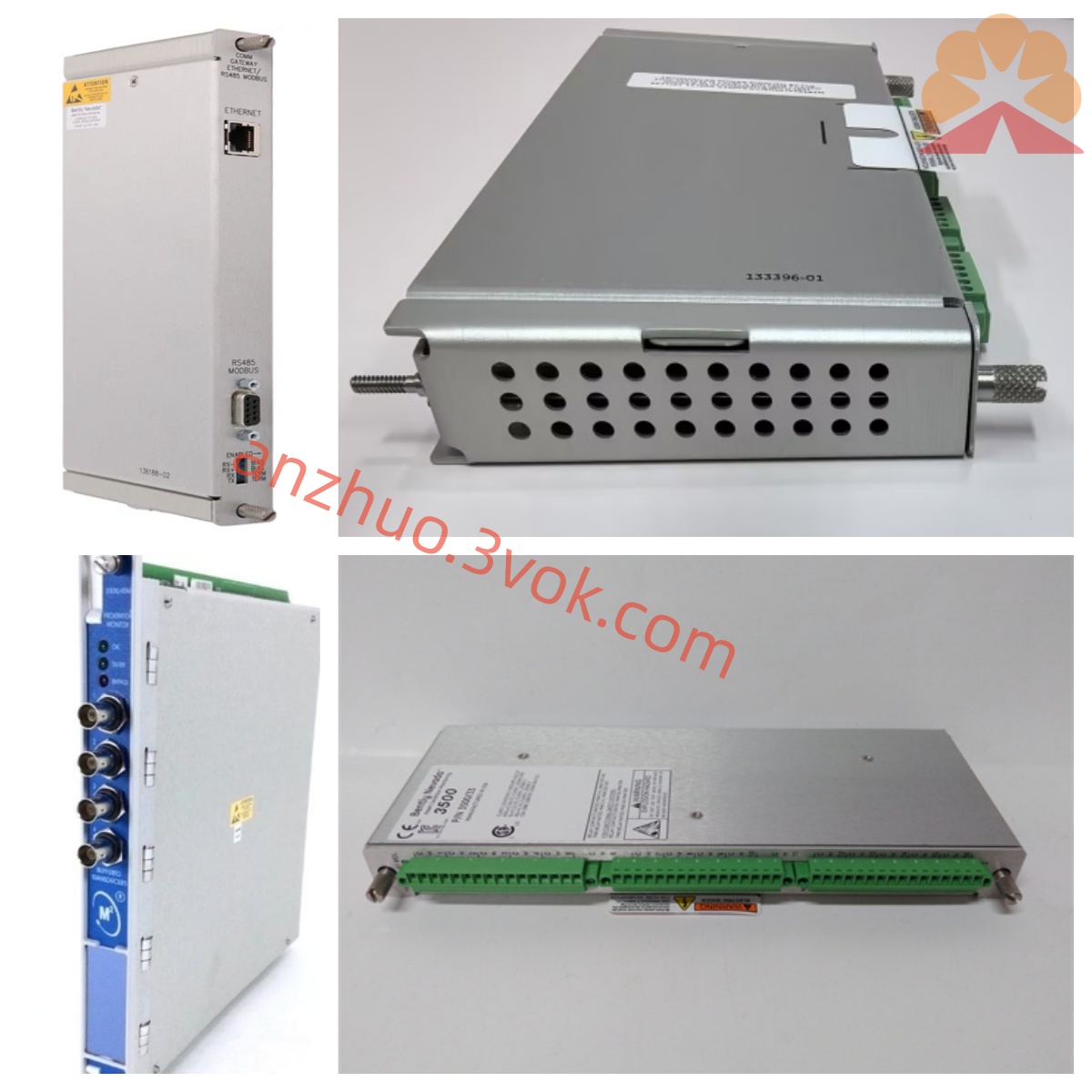
Bently Nevada 1701/25 FieldMonitor Seismic Input Monitor Product Specification
1701/25 is a dual-channel seismic vibration monitoring module belonging to Bently Nevada FieldMonitor decentralized machinery condition monitoring product series, manufactured in the United States and specially developed for casing absolute vibration monitoring of rotating equipment. It is designed to be plug-mounted on matched dedicated 1701 series terminal base, working cooperatively with piezoelectric accelerometers and velocity-type seismic transducers to collect casing vibration signals of industrial rotating machinery, finishing full set of raw signal conditioning, integral conversion, amplitude calculation and programmable alarm judgment locally near field equipment. Different from proximity monitor modules targeting shaft displacement measurement, this unit focuses on casing absolute vibration parameter acquisition, widely deployed on large centrifugal compressors, steam turbine auxiliary pumps, induced draft fans and boiler feed pumps in thermal power, petrochemical, coal chemical and metallurgical industries to implement continuous online vibration monitoring and machinery over-vibration protection. The product has passed ATEX, CSA and Class I Division 2 hazardous area certification, meeting installation standards for explosive and flammable industrial working environments, and complies with international API670 machinery protection specifications for critical equipment safety management.
Description
Bently Nevada 1701/25 FieldMonitor Seismic Input Monitor Product Specification
1. Product Overview
1701/25 is a dual-channel seismic vibration monitoring module belonging to Bently Nevada FieldMonitor decentralized machinery condition monitoring product series, manufactured in the United States and specially developed for casing absolute vibration monitoring of rotating equipment. It is designed to be plug-mounted on matched dedicated 1701 series terminal base, working cooperatively with piezoelectric accelerometers and velocity-type seismic transducers to collect casing vibration signals of industrial rotating machinery, finishing full set of raw signal conditioning, integral conversion, amplitude calculation and programmable alarm judgment locally near field equipment. Different from proximity monitor modules targeting shaft displacement measurement, this unit focuses on casing absolute vibration parameter acquisition, widely deployed on large centrifugal compressors, steam turbine auxiliary pumps, induced draft fans and boiler feed pumps in thermal power, petrochemical, coal chemical and metallurgical industries to implement continuous online vibration monitoring and machinery over-vibration protection. The product has passed ATEX, CSA and Class I Division 2 hazardous area certification, meeting installation standards for explosive and flammable industrial working environments, and complies with international API670 machinery protection specifications for critical equipment safety management.
2. Core Functional Description
2.1 Dual-channel Flexible Transducer Matching Configuration
The module integrates two fully electrically isolated independent measurement channels without internal signal cross-talk interference, each channel can be freely configured via official FieldMonitor configuration software to adapt to two mainstream seismic sensors: constant current driven piezoelectric accelerometer and passive output velocity transducer, requiring no hardware modification during mode switching. When set under accelerometer mode, the module supplies fixed constant current excitation power to connected piezoelectric sensors, then completes integral computation to convert acceleration raw signal into velocity or displacement vibration value as final measured output; under velocity transducer working mode, it directly receives alternating voltage vibration signal output from passive velocity pickups and implements amplitude screening and unit conversion after internal filtering processing. The two channels can be set to different sensor types and measurement ranges separately, enabling simultaneous collection of two independent casing vibration parameters with one single module to optimize cabinet wiring layout on site.
2.2 Multi-stage Filtering and Dual-level Programmable Alarm Logic
Built-in multi-order configurable active filter circuit inside each channel, users can customize upper cutoff frequency of vibration filter through configuration software to eliminate power frequency clutter, high-frequency mechanical noise and low-frequency environmental interference according to actual equipment rotating speed and mechanical structural characteristics. Every channel supports independent setup of Alert pre-warning threshold and Danger shutdown protection threshold, with adjustable alarm delay ranging from 0 second to 60 seconds to filter instantaneous abnormal spike signal and avoid false protection action triggered by transient vibration fluctuation. Alert alarm is applied for early fault reminder to arrange predictive maintenance plan, while Danger alarm can drive passive dry contact switching output to access equipment emergency interlock circuit for equipment trip protection when vibration seriously exceeds safe limit; all threshold parameters, delay settings and channel bypass status support online remote modification without module power interruption, and bypass function is commonly enabled during on-site sensor replacement and equipment maintenance to shield temporary open-circuit false alarm.
2.3 Multimode Standardized Data Output System
Three types of signal output are equipped for seamless docking with mainstream industrial control and monitoring systems. First, front panel reserves buffered raw waveform signal output interface for portable vibration analyzer access to conduct on-site waveform check, orbit analysis and equipment fault diagnosis, with built-in short-circuit protection circuit to prevent internal component damage caused by external wiring short failure. Second, each channel provides galvanically isolated 4–20mA linear analog output corresponding proportionally to full-scale configured vibration range, which can be directly connected to DCS or PLC analog input cards to realize real-time vibration data acquisition and long-term historical trending storage for process control room centralized monitoring. Third, measured data, alarm status and module self-check fault information are transmitted via backplane bus to system communication adapter and converted into Modbus RTU protocol over RS485 bus for remote upper computer centralized data management, allowing multiple 1701 series modules cascaded on one same communication bus to build distributed field monitoring network.
2.4 Full-range Automatic Built-in Self-diagnosis Function
After power-on initialization, the module starts uninterrupted cyclic self-inspection covering internal power supply circuit, each channel input wiring loop, transducer open-circuit/short-circuit abnormal state and backplane communication link connection status. Front panel is configured with multiple LED status indicator lamps: green RUN indicator keeps steady on under normal operating condition; yellow channel fault lamp lights up when corresponding channel detects sensor disconnection, wiring short or excitation power anomaly; red alarm lamp illuminates once measured vibration value exceeds preset Danger protection threshold. All detected fault codes and abnormal working status will be uploaded to upper monitoring platform through communication bus synchronously, helping maintenance staff rapidly complete fault location and troubleshooting to shorten equipment downtime effectively.
3. Electrical Performance Specifications
The module acquires working power supply from matched 1701 series terminal base backplane with rated nominal input voltage of 24VDC, allowing wide input fluctuation range from 18VDC to 36VDC to adapt unstable power supply condition of complex industrial field, typical total power consumption under full-load dual-channel operating status is controlled below 3.5W. For accelerometer input channel, fixed constant current excitation output is configured matching mainstream industrial piezoelectric seismic sensors, with internal over-current and short-circuit protection to avoid module burnout caused by field wiring misconnection and short fault; velocity transducer input terminal matches standard passive alternating voltage signal output specification of industrial velocity pickups with rated input impedance set to adapt mainstream transducer output impedance parameter.
In terms of measurement precision, vibration amplitude measuring error is controlled within ±0.5% full scale under normal ambient temperature environment; equipped with internal temperature compensation circuit, full-temperature drift error across full working temperature scope is limited below ±0.35% full scale to guarantee stable measuring accuracy under variable site temperature condition. All 4–20mA analog output circuits implement independent electrical isolation above 500VAC between measuring channel and module core circuit, effectively isolating reverse voltage and surge interference transmitted from DCS side loop to protect internal measuring circuit from breakdown damage.
4. Environmental and Mechanical Parameters
Certified continuous working ambient temperature range of the module is -20℃ ~ +70℃, spare part storage temperature covers -40℃ ~ +85℃ for long-term warehouse storage; applicable ambient relative humidity is 5%~95% non-condensing environment, resisting internal circuit condensation and corrosion damage under high-humidity, oil mist and dusty cabinet installation environment on industrial site. The structural design is verified to sustain continuous mechanical vibration of 10Hz~1500Hz generated by adjacent running rotating equipment, suitable for installation inside compact bearing pedestal cabinets and on-site control boxes near high-temperature mechanical equipment.
Overall outer dimension of 1701/25 is 126.8mm × 21.6mm × 104.2mm with net weight around 0.314kg, adopting standardized plug-in card structural design exclusively matching original 1701 series shared terminal base rack; outer shell adopts shielding aluminum alloy material to enhance anti-electromagnetic interference capacity against surrounding high-power frequency converter and large-current power cable electromagnetic disturbance on industrial site.
5. System Matching and On-site Application Guidance
1701/25 must be installed on original matching Bently Nevada 1701 terminal base to realize power supply access and field sensor wiring connection, mismatched non-original base accessories will lead to abnormal signal collection and measuring precision deviation. Only factory-calibrated original seismic accelerometers, velocity transducers and matched extension cables are recommended for supporting configuration; arbitrarily cut, spliced or uncalibrated third-party sensors and cables will change system inherent calibration parameter, resulting in measuring drift, data distortion and unexpected protection misoperation. During field commissioning, complete channel function definition, measuring range setup and alarm threshold programming via dedicated FieldMonitor configuration software after finishing all field wiring between module and transducers; before equipment overhaul and sensor disassembly, related measuring channel can be switched to bypass mode to shield false open-circuit alarm output temporarily. When multiple modules are installed on one same terminal base, reasonable power load calculation is required to prevent terminal base power unit overload damage; field communication bus wiring must adopt shielded twisted-pair cable with single-point grounding construction to ensure stable long-distance data transmission quality.
6. Quality Assurance and Warranty Provisions
Every finished 1701/25 module undergoes strict factory full-function aging test, high-low temperature cycle impact test and full-range signal precision calibration before factory delivery to verify performance consistency and measuring stability. Standard warranty period for brand-new genuine original product is 12 months counted from formal delivery date; within valid warranty term, the manufacturer provides free maintenance and component replacement service for non-artificial damage faults occurring under specified standard installation environment and normal operating condition, while damage caused by incorrect wiring, improper operation and man-made destruction is not covered by free warranty service scope.
Get a Quote