
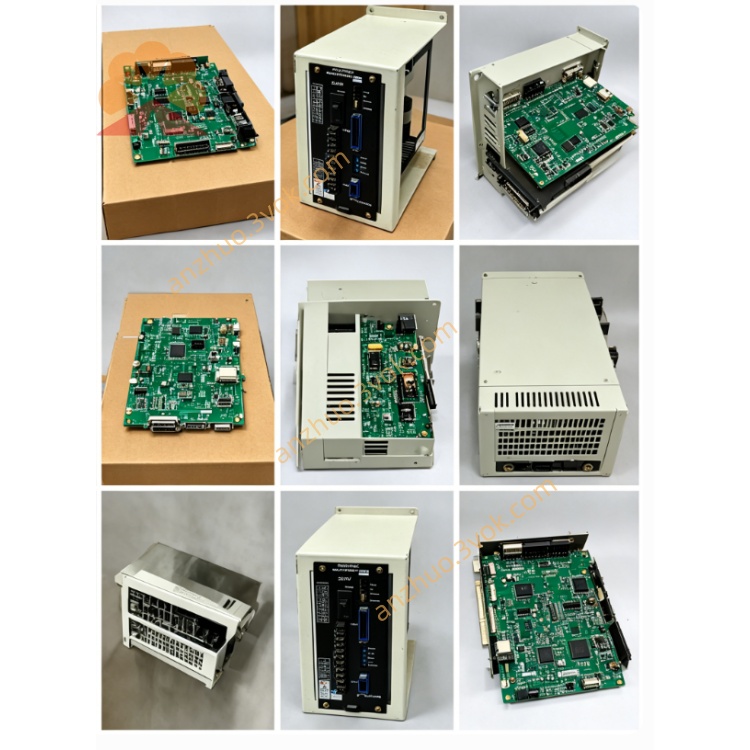
CACR-SR10SB1BF
CACR represents Yasnac VS800 full digital AC servo amplifier for CNC feed axis closed-loop motion control.
SR supports three parameter-selectable control modes: ±10VDC analog speed control, torque control and differential pulse position control.
10 stands for rated matched 1.0kW servo motor with continuous rated output current 7.6Arms under AC200V input grade.
SB refers to compact PCB and housing structure equipped with built-in standard dynamic braking circuit, different internal layout from BB/BY/BZ series.
1 defines power supply standard: three-phase AC200~230V main power plus independent single-phase AC200~230V separated control power supply.
B means dual command input hardware supporting both ±10VDC analog signal and differential pulse position command.
F is factory-locked firmware; core loop gain, encoder and partial I/O parameters are pre-set and write-protected at factory, full factory parameter reset function is restricted by software lock.
Description
1. MODEL CODE DEFINITION
CACR represents Yasnac VS800 full digital AC servo amplifier for CNC feed axis closed-loop motion control.SR supports three parameter-selectable control modes: ±10VDC analog speed control, torque control and differential pulse position control.10 stands for rated matched 1.0kW servo motor with continuous rated output current 7.6Arms under AC200V input grade.SB refers to compact PCB and housing structure equipped with built-in standard dynamic braking circuit, different internal layout from BB/BY/BZ series.1 defines power supply standard: three-phase AC200~230V main power plus independent single-phase AC200~230V separated control power supply.B means dual command input hardware supporting both ±10VDC analog signal and differential pulse position command.F is factory-locked firmware; core loop gain, encoder and partial I/O parameters are pre-set and write-protected at factory, full factory parameter reset function is restricted by software lock.
2. ELECTRICAL SPECIFICATIONS
Main input power: three-phase AC200V~230V, allowable voltage fluctuation -15%~+10%, compatible with 50Hz/60Hz industrial power grid. Control power requires separate single-phase AC200~230V independent wiring to isolate surge interference from main circuit.Continuous rated output current:7.6Arms; 150% overload can run continuously for 60 seconds, 300% instantaneous peak overload limited within 3 seconds for motor startup acceleration. Normal DC bus operating voltage DC280V~DC320V; terminals P and BN reserved for external regenerative braking resistor connection for frequent rapid deceleration and heavy-duty machining.IGBT sine-wave PWM modulation is adopted with maximum output frequency up to 300Hz; encoder matching parameters are locked under F firmware setting.
3. INSTALLATION & ENVIRONMENT REQUIREMENT
Operating ambient temperature:0℃~+55℃; storage temperature: -20℃~+70℃. Working relative humidity 5%~80%RH without dew condensation; protection grade IP20, vertical upright installation inside electrical cabinet is required.Max allowable installation altitude below 1000 meters above sea level; load derating required when installed over 1000m elevation. Anti-vibration specification:10Hz~55Hz with 0.5mm single amplitude during stable operation; net weight approx 3.0kg.
4. CONTROL PERFORMANCE AND FEATURES
Speed adjustment ratio reaches 1:5000, full-load steady speed deviation controlled within ±0.01%. Built-in digital notch filter suppresses mechanical resonance and low-speed crawling during frequent start-stop cycles.B-type dual input hardware accepts both ±10VDC analog speed/torque signal and differential pulse position command; users can switch control mode via internal parameters.Auto-tuning function partially restricted: complete full automatic motor parameter identification is locked, only minor auxiliary gain fine-tuning available for slight on-site mechanical matching; CN1 I/O definition follows factory fixed setting of F version and cannot be freely redefined via parameter modification.Onboard RS422 serial communication supports real-time runtime data reading and historical fault record inquiry; locked core F parameters cannot be modified or overwritten via communication cable.
5. TERMINAL & CONNECTOR DESCRIPTION
R/S/T: three-phase main AC power input terminals; U/V/W: three-phase output terminals connecting servo motor stator cable; P/BN: external regenerative brake resistor wiring terminals for regenerative energy dissipation during repeated fast deceleration and emergency stop.CN1: opto-isolated digital I/O terminal block with fixed factory preset signal definition under F firmware lock, arbitrary reallocation of I/O functions is prohibited.CN2: dedicated connector exclusively for incremental encoder feedback cable.
6. PROTECTION FUNCTIONS
Complete built-in protection includes overcurrent protection, DC bus overvoltage/undervoltage protection, drive overheat protection, encoder disconnection protection and motor overload protection. The servo automatically stores latest 10 groups of historical fault codes for maintenance inspection; F locked preset parameters remain intact after power-off or fault reset operation.Built-in standard dynamic braking circuit handles regular deceleration energy consumption; external regenerative resistor must be installed between P and BN terminals under long-time heavy-load repeated emergency stop working conditions.
7. REPLACEMENT INSTRUCTION
CACR-SR10SB1BF cannot be directly substituted with SB1AF series due to different command input hardware (BF with dual analog+pulse input vs AF analog-only input). Only identical full part number CACR-SR10SB1BF supports plug-and-play replacement.
8. ROUTINE MAINTENANCE GUIDE
Check wiring tightness of power cables, motor cable and CN1/CN2 connectors before every startup to eliminate poor-contact-induced faults. Clean radiator fin dust every 3~6 months to guarantee heat dissipation efficiency and avoid overheat shutdown.Cut all AC power supply and wait over 15 minutes for internal DC bus capacitor full discharge before opening drive casing for maintenance to prevent electric shock hazard. Random full factory parameter reset is forbidden to avoid loss of F factory preset matching parameters and machine abnormal operation.
9. COMMON FAULT TROUBLESHOOTING
Overheat alarm mainly caused by radiator dust clogging, poor cabinet ventilation or long-term overloaded running; encoder fault originates from loose CN2 connector or damaged feedback cable.Overvoltage alarm during frequent heavy-load rapid deceleration can be fixed by installing external regenerative resistor between P and BN terminals; parameter write failure when modifying F-version locked core parameters belongs to firmware anti-write protection instead of hardware breakdown; overload alarm triggers when actual mechanical load exceeds motor rated output, inspect stuck transmission structure or reduce machining cutting load accordingly.
Get a Quote