
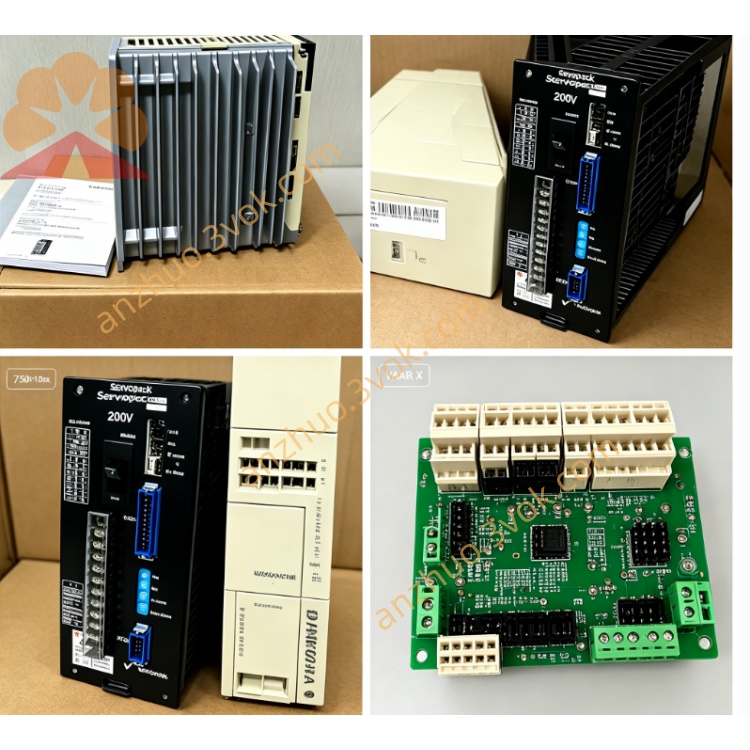
CACR-SR10BE12G-E
CACR stands for Yasnac VS800 full digital AC servo amplifier developed for CNC feed axis closed-loop motion control.
SR denotes universal multi-control platform supporting analog speed, torque and differential pulse position control via internal parameter configuration.
10 means rated matched servo motor power 1.0kW, standard continuous rated output 7.6Arms under 200V input grade.
BE refers to exclusive PCB layout and housing structure with upgraded built-in regenerative brake circuit, different from BC/BB internal power circuit design.
1 specifies power supply standard: three-phase AC200~230V main power plus independent single-phase AC200~230V separated control power input.
Description
1. MODEL CODE EXPLANATION
CACR stands for Yasnac VS800 full digital AC servo amplifier developed for CNC feed axis closed-loop motion control.SR denotes universal multi-control platform supporting analog speed, torque and differential pulse position control via internal parameter configuration.10 means rated matched servo motor power 1.0kW, standard continuous rated output 7.6Arms under 200V input grade.BE refers to exclusive PCB layout and housing structure with upgraded built-in regenerative brake circuit, different from BC/BB internal power circuit design.1 specifies power supply standard: three-phase AC200~230V main power plus independent single-phase AC200~230V separated control power input.2 indicates dual-encoder hardware circuit, compatible with incremental encoder and serial absolute encoder two feedback types via parameter switching at CN2 port.G is universal general firmware version, only few core protection parameters locked by factory, most gain and I/O parameters support full user modification, wider parameter adjustable range versus F version.-E stands for global export standard specification without OEM fixed machine program, free user-defined CN1 I/O function without factory locked signal allocation.
2. ELECTRICAL SPECIFICATIONS
Main input: three-phase AC200V~230V, allowable voltage fluctuation -15%~+10%, compatible with 50Hz/60Hz industrial power grid; control power requires independent single-phase AC200~230V separate wiring to isolate main circuit surge interference.Continuous rated output current:7.6Arms; 150% overload sustainable for 60 seconds, 300% instantaneous peak overload limited within 3 seconds for motor acceleration startup; DC bus normal operating voltage DC280V~DC320V, terminals P and BN reserved for external regenerative braking resistor wiring for frequent high-speed deceleration and heavy-load cutting application.Adopts IGBT sine-wave PWM driving scheme, maximum output frequency 300Hz; built-in bus spike suppression circuit to reduce overvoltage during dynamic braking. Input rated RMS total current approx 8A for main power circuit.
3. INSTALLATION & ENVIRONMENT CONDITIONS
Operating ambient temperature range:0℃~+55℃; storage temperature -20℃~+70℃; working humidity 5%~80%RH without dew condensation, protection grade IP20, must be vertically installed inside electrical cabinet.Normal applicable installation altitude below 1000m above sea level; continuous output power derating required when installed over 1000m elevation. Anti-vibration standard:10~55Hz with 0.5mm single amplitude during stable operation; unit net weight about 3.1kg.
4. CONTROL PERFORMANCE & FUNCTION FEATURES
Speed regulation ratio up to 1:5000, full-load steady speed fluctuation controlled within ±0.01%; built-in digital notch filter to eliminate mechanical resonance and low-speed crawl during frequent start-stop cycles.Dual command input compatible: ±10VDC analog speed/torque signal and line-driver differential pulse position signal; 2-suffix dual encoder function allows switching encoder type freely via internal parameters at CN2 feedback port.G general firmware supports full automatic motor parameter identification for standard 1kW Yasnac servo motor; speed loop, position loop gain parameters are fully adjustable by user without factory write lock; -E export version cancels fixed OEM I/O definition, all CN1 input/output signal functions editable via parameter setup. Onboard RS422 serial communication supports parameter upload/download, real-time operation data reading and fault history query.
5. TERMINAL & CONNECTOR DEFINITION
R/S/T: three-phase main AC power input terminals; U/V/W: three-phase power output connecting servo motor stator cable; P/BN: external regenerative brake resistor connection terminals for extra energy dissipation under repeated emergency stop and heavy-duty working condition.CN1: opto-isolated digital I/O connector with multi-point input/output terminals; -E standard version allows full user redefinition of every I/O function via parameters.CN2: dual-purpose encoder feedback connector matching 2-suffix dual encoder hardware, wiring adaptable for incremental or serial encoder accordingly.
6. FULL PROTECTION FUNCTIONS
Standard built-in protection list: overcurrent, DC bus overvoltage/undervoltage, drive overheat, encoder disconnection, motor overload/stall, main circuit phase-loss protection.Embedded internal small-capacity dynamic braking resistor for regular deceleration energy consumption; external regenerative resistor must be mounted between P-BN terminals for long-time heavy-load frequent braking scenario. Drive automatically stores latest 10 groups of historical fault codes for maintenance inspection; G-version user-modified parameters will not be cleared after power cut or fault reset.
7. REPLACEMENT GUIDANCE
CACR-SR10BE12G-E is general export universal model; non-E suffix CACR-SR10BE12G can substitute after full parameter reset and manual gain tuning; customized Y-suffix locked OEM servo cannot direct replacement due to fixed factory firmware and mismatched I/O logic; plug-and-play requires identical full part number CACR-SR10BE12G-E.
8. MAINTENANCE INSTRUCTION
Check wiring tightness of R/S/T, U/V/W and CN1/CN2 plugs before equipment startup to avoid poor-contact triggered alarms; clean radiator dust every 3~6 months to ensure heat dissipation and prevent overheat shutdown.Cut off all AC power supply and wait minimum 15 minutes for internal DC bus capacitor full discharge before opening casing for maintenance to avoid electric shock hazard; random full factory parameter reset is allowed for G version but recommended to backup parameters in advance before reset operation.
9. COMMON FAULT DIAGNOSIS
Overheat alarm mainly caused by radiator dust clogging, cabinet poor ventilation or long-term overloaded running; encoder fault originates from loose CN2 connector, damaged feedback cable or wrong encoder type selected against dual-encoder setting standard.Overvoltage alarm during rapid frequent deceleration can be fixed by installing external regenerative resistor on P-BN terminals; parameter write failure only happens when modifying few factory-locked core protection parameters, belongs to firmware protection not hardware breakdown; overload alarm occurs when actual mechanical load exceeds motor rated output, check transmission jamming or reduce machining cutting load accordingly.
Get a Quote