
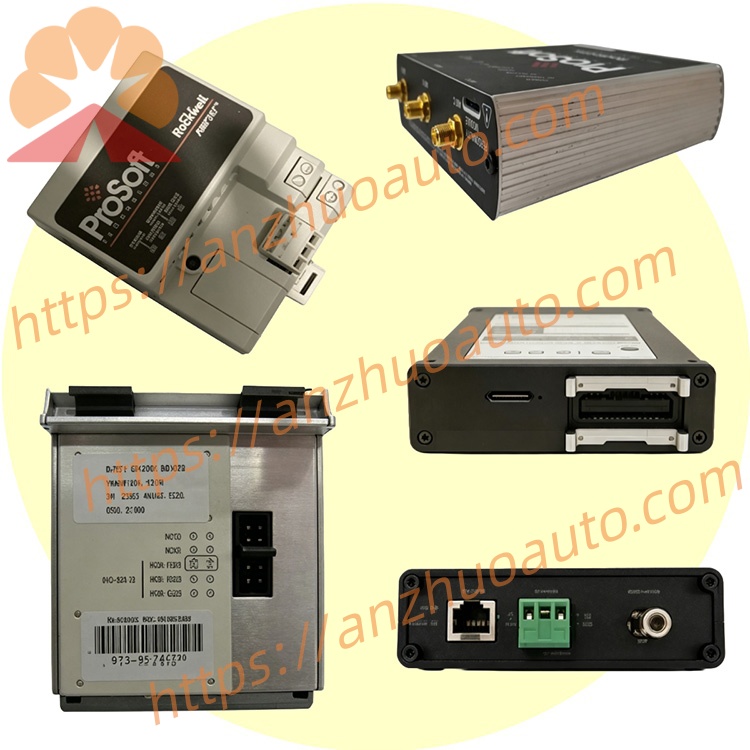
B&R 3IF787.9-1 Bus Control Module
The 3IF787.9-1 is a professional aPCI-based bus control module developed by B&R, which is an essential communication and control expansion unit for the System 2005 control platform. This module integrates dual industrial bus interfaces and is designed to implement bus communication management, data forwarding and device interconnection in industrial automation systems. Manufactured in Austria, it features a compact mechanical structure, high integration level and outstanding anti-interference performance, and is capable of operating continuously and stably in various complex and harsh industrial environments. As a core component for bus control, it effectively expands the bus scheduling and data processing capabilities of the main controller.
Description
3IF787.9-1 Bus Control Module
Product Overview
The 3IF787.9-1 is a professional aPCI-based bus control module developed by B&R, which is an essential communication and control expansion unit for the System 2005 control platform. This module integrates dual industrial bus interfaces and is designed to implement bus communication management, data forwarding and device interconnection in industrial automation systems. Manufactured in Austria, it features a compact mechanical structure, high integration level and outstanding anti-interference performance, and is capable of operating continuously and stably in various complex and harsh industrial environments. As a core component for bus control, it effectively expands the bus scheduling and data processing capabilities of the main controller.
Basic Information
The official model of the product is 3IF787.9-1, belonging to the aPCI series bus control modules of B&R, and it is fully compatible with all rack devices of the System 2005 series. Adopting a plug-in design, the module can be directly inserted into the standard aPCI slot of the supporting controller for quick installation and replacement. It has a compact overall size and a net weight of about 0.5 kg, which saves the installation space of the control cabinet and facilitates on-site layout and wiring. The product complies with international industrial electronic standards, with stable quality and strong universal compatibility, and is widely used in medium and large industrial control projects as a standard bus control accessory.
Functions and Positioning
As a dedicated bus control expansion module for B&R industrial controllers, the 3IF787.9-1 undertakes the core tasks of bus network management, data transmission control and cross-protocol data interaction. It is equipped with one independent POWERLINK fieldbus interface, which can be flexibly configured as a managing node or a controlled node in the network to realize the construction and operation management of high-speed real-time bus networks for distributed control systems. Meanwhile, it is fitted with one CAN bus interface, which is responsible for data communication and control instruction transmission with CAN protocol-based field sensors, actuators and auxiliary equipment. The module is built with send and receive object buffers, which optimizes data caching and processing efficiency, solves the limitation of the controller’s native bus interfaces, and realizes unified control and seamless networking of different types of fieldbuses.
Core Performance Parameters
In terms of bus communication performance, the POWERLINK interface conforms to international industry standards, with a communication rate up to 100 Mbit/s, excellent real-time performance and stable transmission, and it supports linear, star and other mainstream network topologies. The CAN bus interface supports a maximum transmission rate of 500 kbps, fully complies with standard CAN bus specifications, and maintains good compatibility with various CAN bus industrial devices. All internal bus circuits of the module adopt complete electrical isolation design, which can effectively isolate external electromagnetic interference and surge voltage, and protect the safety of the module and the whole control system. The module is powered by the aPCI bus of the controller without an additional external power supply, and the total power consumption is about 3.0 W, which is energy-saving and efficient. It is equipped with dedicated LED status indicators, which can clearly display the running status, bus communication status and fault information, facilitating rapid status checking and on-site fault diagnosis. The rated working temperature range is 0°C to 60°C, adapting to conventional industrial ambient temperature conditions.
General Matching Accessories
The 3IF787.9-1 adopts standard aPCI slot plug-in installation, and no additional fixing parts are required for the main body. For on-site bus wiring, professional industrial Ethernet cables for POWERLINK and standard CAN bus cables are applicable. It is recommended to use original B&R cables to ensure long-term stability of bus communication. The CAN bus interface of the module needs to be matched with a terminal block for wiring, and the TB704 terminal block is a special supporting accessory that needs to be purchased separately. This bus control module can be freely combined with various CPU modules and I/O modules of the System 2005 series to build a complete industrial control and bus communication system.
Application Fields
This bus control module is widely used in industrial automation scenarios that require multi-bus coordinated control and high-reliability communication. It is commonly applied to automated production lines, packaging machinery, textile equipment, 3C manufacturing equipment and industrial robot control systems. It also fits food processing, pharmaceutical production and general machinery industries that have strict requirements on bus real-time performance and operation stability. Relying on the dual-bus control capability of POWERLINK and CAN bus, the module realizes data exchange and instruction transmission between controllers, field devices, remote I/O units and upper monitoring systems, and is a key part for building intelligent and integrated industrial control networks.
Installation and Maintenance Notes
Before installation, be sure to completely cut off the power of the matched controller to avoid electrostatic damage and short-circuit faults to the module. Insert the module into the designated aPCI slot and lock it tightly to prevent poor contact caused by equipment vibration. After installation, carefully check all bus cables and terminal connections to ensure correct and reliable wiring. The module should be installed away from strong electromagnetic interference sources, humid areas and heavy dust environments to prolong the service life. For daily maintenance, regularly check whether the interfaces are loose, the cables are aged and the terminals are oxidized. The product enjoys a standard warranty period. It is recommended to use original accessories for replacement and maintenance to maintain the overall control performance and long-term operation stability of the system.
Get a Quote